Ḥunayn, Ḥubaysh, and the Arabic vocabulary of Galen
Arabic series, installment: Ḥunayn's Risāla on the Galen translations, رسالة حنين بن إسحق إلى علي بن يحيى في ذكر ما ترجم من كتب جالينوس بعلمه وبعض ما لم يترجم, written 855–856.
The film
download the MP4 · the credits as text
The Videos session made this film in motion/films/hunayn from the research package below. The final render of the cut, motion/out/hunayn.mp4, plays here from its web copy.
Credits
Ḥunayn, Ḥubaysh, and the Arabic vocabulary of Galen (motion/films/hunayn), 99.82 s, 1920 x 1080. A General Translation film, translation series. Ship this text with the film wherever it is published (the description field of the post or the video page). Each picture's credit is also on screen while the picture is shown.
Images
- Constantine the African, Liber de oculis, in the Codex Gigas (Bohemia, between 1204 and 1230), f. 249r, column a: the prologue with its rubric, and the coats of the eye. National Library of Sweden (Kungliga biblioteket), HS A 148, manuscripta.se/ms/100500 (IIIF image ms-100500_0495). Photograph: Per B. Adolphson, CC BY 4.0 (creativecommons.org/licenses/by/4.0/). Changes: cropped, graded for legibility (the channel divided by the parchment's own level, which flattens the water stain), and printed through the film's dither screen. No reading or expansion of the leaf's Latin is set on screen: the leaf's words are lit where the narration names them, without captions. The Latin names in the film's table of the coats of the eye, retina, uvea and cornea, are Constantine's names as the narration says them, in modern spelling (the leaf writes uuea), not a transcription of the leaf.
- Ḥunayn ibn Isḥāq's diagram of the coats of the eye, from the copy of the Ten Treatises on the Eye dated 1196, as reproduced by Max Meyerhof, The Book of the Ten Treatises on the Eye Ascribed to Hunain ibn Is-hâq (Cairo: Government Press, 1928), Plate 1, and the same book's Arabic p. 80. Wellcome Collection, wellcomecollection.org/works/xxrzwgrq (IIIF b31362370_0001_0444 and _0437). Public Domain Mark. Changes: Plate 1 cropped to the drawing and turned 90 degrees counterclockwise, so the optic nerve points up as on the manuscript page; both cropped and printed through the film's dither screen.
- Ḥunayn ibn Isḥāq, Risāla to ʿAlī ibn Yaḥyā, Arabic text ed. Gotthelf Bergsträsser, Ḥunain ibn Isḥāq über die syrischen und arabischen Galen-Übersetzungen (Leipzig, 1925), Arabic pp. 1 to 5, 10, 17 and 18. Wellcome Collection, wellcomecollection.org/works/j357bdwz (IIIF b31350598_0080 to _0084, _0073, _0066, _0065). Public Domain Mark. Changes: cropped (the margins with a later reader's pencil notes, the running heads and the apparatus are outside the crops) and printed through the film's dither screen.
- Galen, To Glaucon, in the Alexandrian summary, the heading naming Ḥunayn ibn Isḥāq as translator. Wellcome Collection, MS Arabic 62, image 0005, wellcomecollection.org/works/ynu85x86. Public Domain Mark. Changes: cropped to the right-hand page's text block and printed through the film's dither screen.
- The globe is drawn from Natural Earth's 1:50m land (public domain), through world-atlas 2.0.2 (Mike Bostock, ISC licence).
Texts set in type
- The table of the coats of the eye: the Arabic names as Max Meyerhof prints them on Arabic p. 80 of The Book of the Ten Treatises on the Eye (1928), where the Greek names stand beside them in Arabic letters; the Greek names in Greek letters as Meyerhof's English translation gives them (p. 4), with their meanings; the Latin names from Constantine the African's Liber de oculis, in modern spelling.
- The people's names and dates: after Bergsträsser 1925, Meyerhof 1928, Ibn Abī Uṣaybiʿa (ʿUyūn al-anbāʾ, ch. 8.29 to 8.31) and Ibn al-Qifṭī (Taʾrīkh al-ḥukamāʾ).
- "This is my habit in everything I translate.": Ḥunayn's sentence on Bergsträsser's Arabic p. 5, l. 7, translated for this film and checked against Bergsträsser's German translation (p. 4).
- D. W. Tschanz, "Hunayn bin Ishaq: The Great Translator", Journal of the International Society for the History of Islamic Medicine 1, no. 3 (2003), cited as an example of the popular account. Dimitri Gutas, Greek Thought, Arabic Culture (London: Routledge, 1998), pp. 53 to 60; M.-G. Balty-Guesdon (1992); M. Di Branco (2012): titles set in type only.
Type: Inter (Rasmus Andersson), Noto Sans Arabic (the Noto Project Authors) and Geist Mono (Vercel), SIL Open Font License 1.1. Voices: ElevenLabs (Frederick Surrey, narrator; Ghizlane, Arabic reader). Music: ElevenLabs Music API. Effects: made from seeded noise.
The anchor is the record of the translation work. It holds the place that the 1908 dictionary holds in the Hebrew series: a book whose own text records how the words were made. Ḥunayn's letter lists Galen's books, who translated each one, for whom, and how. The vocabulary comes from a second book of his, the Ten Treatises on the Eye. It names each coat of the eye in Greek and in Arabic, and its Latin version renders the Arabic names as retina, uvea and cornea.
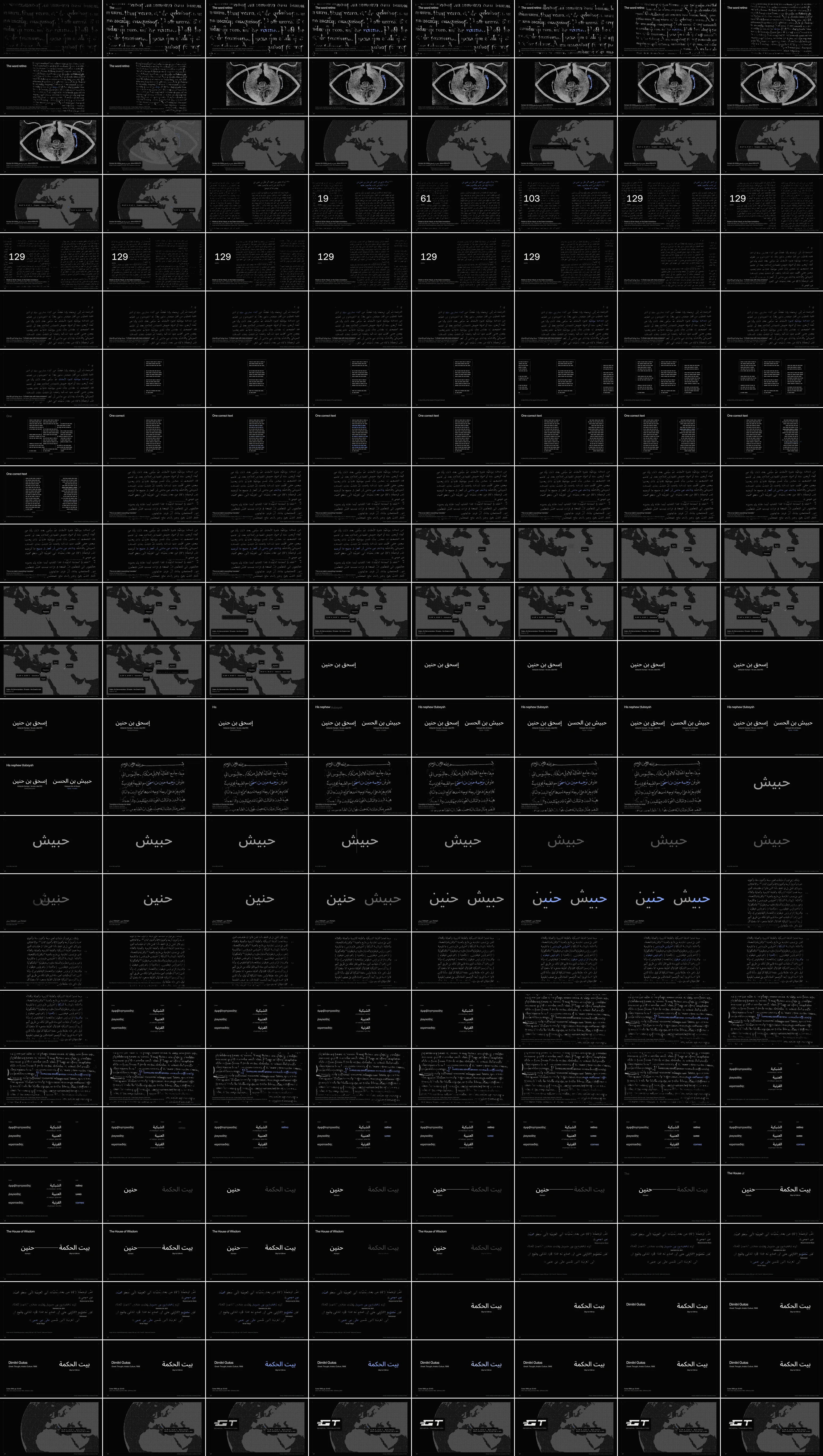
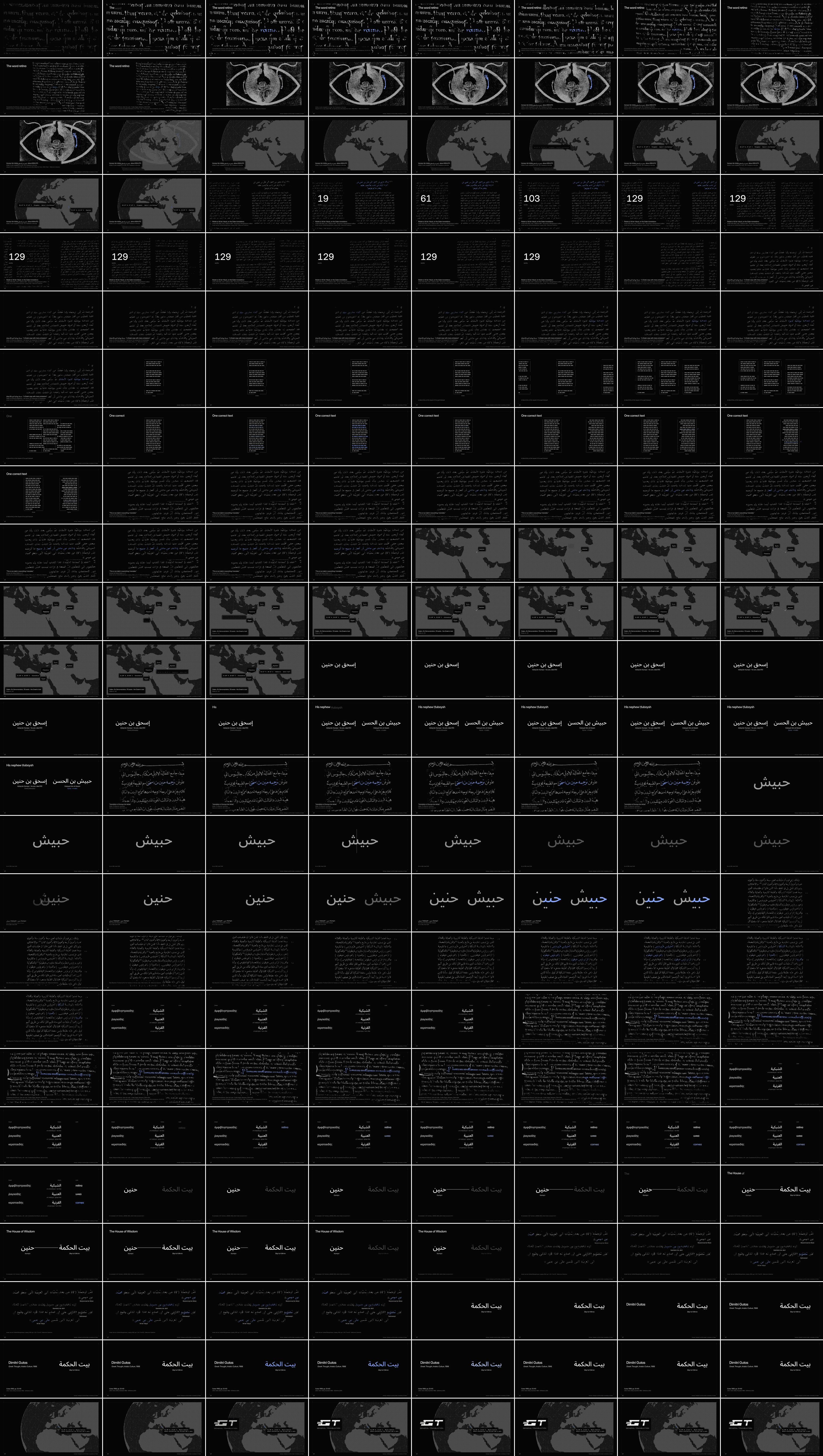
Contact sheet
Two frames a second across the cut, each from the middle of its half second, eight to a row: 200 frames. It is the cut that plays above.
Script
The word retina is already in a Latin version of Ḥunayn ibn Isḥāq’s Arabic book on the eye; his letter on the Galen translations lists 129 works and records how he collated several Greek copies into one correct text before he corrected his translation; his nephew Ḥubaysh put many of his Syriac versions into Arabic, and a later historian says some readers scraped Ḥubaysh’s name off them and wrote Ḥunayn’s; his book gives each coat of the eye a Greek name and an Arabic name that translates it, and Constantine the African’s Latin called three of them retina, uvea and cornea; and the House of Wisdom that popular histories put him in charge of is not in his letter.
| Time | Voice | Line | On screen |
|---|---|---|---|
| 0:00.62 | Narrator | The word retina is already in a Latin version of an Arabic book on the eye. | The Codex Gigas, f. 249r, close on the written word retina, which lights; the camera eases back to the column. Heading: The word retina. |
| 0:05.12 | Narrator | The Arabic book is by Ḥunayn ibn Isḥāq, who translated the works of the Greek physician Galen in ninth-century Baghdad. | Ḥunayn’s diagram of the coats of the eye (Meyerhof’s Plate 1, from the copy dated 1196), its label الملتحمه lit; it mixes into the globe: pins on Pergamon and Baghdad. |
| 0:13.08 | Narrator | His letter lists 129 works and says which ones had been translated, and by whom. | Bergsträsser’s Arabic text of the letter, pp. 1 to 5, in Arabic reading order; the title lights and a counter runs to 129. |
| 0:19.36 | Narrator | He translated one of them at about twenty, from a single Greek copy with many gaps. | p. 5: أبناء عشرين سنة lights, then نسخة يونانية كثيرة الأسقاط in reading order: نسخة يونانية together, then كثيرة, then الأسقاط. |
| 0:24.92 | Narrator | At about forty he compared several copies until one correct text emerged, and corrected his translation against it. | Drawn pages: three Greek copies, each with its gaps, slide together into one complete page; a Syriac page beside it takes two correction marks. Heading: One correct text. |
| 0:32.73 | Reader | وكذلك من عادتي أن أفعل في جميع ما أترجمهSubtitle: “This is my habit in everything I translate.” | p. 5, l. 7: each word of the sentence lights as she reads it. |
| 0:38.32 | Narrator | He searched Syria, Palestine and Egypt for Galen's On Demonstration and found about half of it in Damascus. | The globe: an arc from Baghdad through Syria and Palestine to Egypt and Alexandria; the Damascus pin lights. |
| 0:45.78 | Narrator | His son Isḥāq translated Greek philosophy, and his nephew Ḥubaysh put many of Ḥunayn's Syriac versions into Arabic. | إسحق بن حنين and حبيش بن الحسن with their readings and glosses; then Wellcome MS Arabic 62, its heading ترجمه حنين بن اسحق lit. Heading: His nephew Ḥubaysh. |
| 0:55.64 | Narrator | A later historian says some readers scraped Ḥubaysh's name off his translations and wrote Ḥunayn's. | The name حبيش printed large; a blade passes and, as it leaves, the ink lifts away to a trace; حنين is written over it; the two names side by side, their dots lifted, the same first three letter shapes lit. |
| 1:03.90 | Narrator | His book on the eye gives each coat its Greek name and an Arabic name that translates it. | Meyerhof’s Arabic p. 80: the Greek names in Arabic letters light, then their Arabic names; three rows of type: Greek, Arabic, meaning. |
| 1:10.84 | Narrator | Constantine the African translated it into Latin under his own name and called these coats retina, uvea and cornea. | The Codex Gigas again: the red rubric lights, then the prologue line where Constantine names himself; the rows take their Latin names. |
| 1:20.48 | Narrator | Popular histories put Ḥunayn in charge of an academy called the House of Wisdom. | حنين, and بيت الحكمة in grey; a line drawn from حنين toward it as it comes up to white, Bayt al-Ḥikma. Heading: The House of Wisdom. |
| 1:24.56 | Narrator | His letter never mentions it and names the people he translated for. | The line draws back and بيت الحكمة greys; four lines of the letter, the patrons’ names lit in turn, each with its English under it: Muḥammad ibn Mūsā, Bukhtīshūʿ ibn Jibrīl, Salmawayh, ʿAlī ibn Yaḥyā. |
| 1:30.24 | Narrator | The historian Dimitri Gutas argues that it was a library in the caliphs' administration. | Dimitri Gutas, Greek Thought, Arabic Culture, 1998, set in type beside بيت الحكمة, which lights on “library”. |
| 1:35.82 | No voice | The globe, the pin on Monte Cassino, where Constantine the African was a monk; the General Translation lockup. |
Times are where each line starts in the final, read from the film's own audio.
Animation script
| Time | Voiceover | Visual | Caption (on screen, not spoken) | Link |
|---|---|---|---|---|
| 0:00–0:07 | "The word retina is already in a Latin version of an Arabic book on the eye." | Codex Gigas, f. 249r, whole page under one lamp. Push in to column a. The line quasi rete, unde dicitur retina lights, then the word retina alone | unde dicitur retina · "and so it is called retina" · Constantine the African, Liber de oculis · Codex Gigas, Bohemia, 1204–1230 · National Library of Sweden, A 148 | iiif.manuscripta.se/iiif/ms-100500/ms-100500_0495.tif/full/full/0/default.jpg |
| 0:07–0:15 | "The Arabic book is by Ḥunayn ibn Isḥāq, who translated the works of the Greek physician Galen in ninth-century Baghdad." | Hard cut to Ḥunayn's diagram of the coats of the eye, from the copy dated 1196, as Meyerhof printed it (Plate 1, turned 90° counterclockwise so that the optic nerve points up, as on the manuscript page). Slow push in. The label الملتحمه, which then runs down the right side of the drawing, lights | Ḥunayn ibn Isḥāq حنين بن إسحق, about 808–873 · Kitāb al-ʿashr maqālāt fī al-ʿayn, Ten Treatises on the Eye · diagram from a copy dated 1196 · Max Meyerhof, Cairo, 1928 | wellcomecollection.org/works/xxrzwgrq (Plate 1: IIIF b31362370_0001_0444) |
| 0:15–0:23 | "His letter on the Galen translations lists 129 works and says which ones had been translated, and by whom." | Bergsträsser's printed Arabic text. Pages slide past in Arabic reading order while a counter of entries runs to 129 in tabular figures | Risāla to ʿAlī ibn Yaḥyā · written 855–856, at 48 · additions 864 · Arabic text ed. Gotthelf Bergsträsser, Leipzig, 1925 | wellcomecollection.org/works/j357bdwz |
| 0:23–0:29 | "He translated one of them at about twenty, from a single Greek copy with many gaps." | Bergsträsser, Arabic p. 5, l. 3: نسخة يونانية كثيرة الأسقاط lights. Then type on paper: one page shape with blank bands where text is missing | Galen, On Sects for Beginners · into Syriac, for a physician of Jundishapur · نسخة يونانية كثيرة الأسقاط · "a Greek copy with many omissions" | archive.org/details/b31350598 (leaf n79) |
| 0:29–0:37 | "At about forty he compared several copies until one correct text emerged, and corrected his translation against it." | Three page shapes slide in, each with gaps in different places. Each passes behind the next, and the text of one shows through the gaps of another, until one complete page stands. The Syriac version slides beside it and two of its lines take correction marks. Back to p. 5: فقابلت تلك بعضها ببعض حتى صحت منها نسخة واحدة lights | وكذلك من عادتي أن أفعل في جميع ما أترجمه · "This is my habit in everything I translate." | same |
| 0:37–0:44 | "He searched Syria, Palestine and Egypt for Galen's On Demonstration and found about half of it in Damascus." | Globe. An arc runs from Baghdad up the Euphrates, through Syria and Palestine to Egypt and Alexandria. Each region flashes its label as the arc passes. The Damascus pin stays lit | 33.51° N, 36.31° E · Damascus · about half · 31.20° N, 29.89° E · Alexandria · Galen, On Demonstration, 15 books · the Greek is lost · Risāla no. 115 | Make: own render |
| 0:44–0:51 | "His son Isḥāq translated Greek philosophy, and his nephew Ḥubaysh put many of Ḥunayn's Syriac versions into Arabic." | Type: إسحاق بن حنين and حبيش بن الحسن, each with its gloss. Cut to a manuscript heading that names Ḥunayn alone as translator: ترجمه حنين بن اسحق lights (ترجمه can be read as the verb, "Ḥunayn ibn Isḥāq translated it", or as the noun ترجمة written with ه; both say the same) | Isḥāq ibn Ḥunayn إسحاق بن حنين, died 910 · Ḥubaysh ibn al-Ḥasan al-Aʿsam حبيش بن الحسن الأعسم, son of Ḥunayn's sister · ترجمه حنين بن اسحق "translation of Ḥunayn ibn Isḥāq" · Galen, To Glaucon, summary · Wellcome MS Arabic 62 | iiif.wellcomecollection.org/image/b20295054_WMS_Arabic_62_0005.jp2/full/full/0/default.jpg |
| 0:51–0:57 | "A later historian says some readers scraped Ḥubaysh's name off his translations and wrote Ḥunayn's." | Type on paper: حبيش in brown ink. A blade passes across it and the ink lifts away. A pen writes حنين in the same place. The two names then stand side by side with their dots lifted, and their first three letter shapes match | Ibn al-Qifṭī, died 1248 · حبيش Ḥubaysh · حنين Ḥunayn | Make: typographic |
| 0:57–1:04 | "His book on the eye gives each coat its Greek name and an Arabic name that translates it." | Meyerhof, Arabic p. 80: the list of seven coats with their Greek names in Arabic letters. الشبكية (امفيبليسطرويذيس), العنبية (راغويذيس خيطون) and القرنية (قراتويذيس خيطون) light in turn. Then three rows of type: ἀμφιβληστροειδής · الشبكية, ῥαγοειδής · العنبية, κερατοειδής · القرنية | ἀμφιβληστροειδής · الشبكية al-shabakiyya · "net-like" · ῥαγοειδής · العنبية al-ʿinabiyya · "grape-like" · κερατοειδής · القرنية al-qarniyya · "horn-like" | archive.org/details/b31362370_0001 (leaf n436) |
| 1:04–1:12 | "Constantine the African translated it into Latin under his own name and called these coats retina, uvea and cornea." | Back to Codex Gigas, f. 249ra. The red rubric Prohemium Constantini monachi Cassinensis lights. The camera moves down the column, and ragaidos, id est uvea and keraidos, id est cornea light in turn. The Latin words join the end of each row of type: retina, uvea, cornea | Prohemium Constantini monachi Cassinensis · "preface of Constantine, monk of Monte Cassino" · ragaidos, id est uvea · keraidos, id est cornea | Codex Gigas IIIF, as row 1 |
| 1:12–1:17 | "Popular histories put Ḥunayn in charge of an academy called the House of Wisdom." | Type card on the ground: بيت الحكمة · Bayt al-Ḥikma · "House of Wisdom" | for example: D. W. Tschanz, JISHIM, 2003, which cites no source for it | Make: card |
| 1:17–1:22 | "His letter never mentions it and names the people he translated for." | Bergsträsser's text again. Patron names light one at a time: محمد بن موسى, بختيشوع بن جبريل, سلمويه, علي بن يحيى | Muḥammad ibn Mūsā · Bukhtīshūʿ ibn Jibrīl · Salmawayh · ʿAlī ibn Yaḥyā | Wellcome, as row 3 |
| 1:22–1:28 | "The historian Dimitri Gutas argues that it was a library in the caliphs' administration." | Type card: Dimitri Gutas, Greek Thought, Arabic Culture, 1998, set in the film's type | Gutas 1998, pp. 53–60 · other views: Balty-Guesdon 1992 · Di Branco 2012 | Make: card |
| 1:28–1:30 | (silent) | Globe, pin on Monte Cassino. Series tag | 41.49° N, 13.81° E · Monte Cassino · where Constantine the African was a monk | Make: own render |
The narration is 13 lines and 217 written words, or 220 spoken once 129 is read as "a hundred and twenty-nine". At about 2.65 words a second that is about 83 s of speech. Gaps of 0.3 s, one 1 s hold for the row 5 caption and the 2 s closing globe bring it to about 90 s (checking pass 1 lengthened lines 3 and 13 and re-timed the rows after line 2). If the takes run long, line 3 can drop "on the Galen translations" and line 6 can drop "Syria, Palestine and Egypt" ("He searched as far as Alexandria for...").
Headings, if the film uses them, are made of the words spoken at that moment. Five fit:
- "the word retina" (row 1)
- "one correct text" (row 5)
- "his nephew Ḥubaysh" (row 7)
- "retina, uvea and cornea" (row 10)
- "the House of Wisdom" (row 11)
Coordinates for the globe build
- Baghdad, the Round City of al-Manṣūr (founded 762): 33.348° N, 44.335° E.
- This is Wikipedia's point for the reconstructed site. The city lies under modern Baghdad, and reconstructions of its plan differ, so caption "Baghdad" only.
- Ḥunayn's house and the court's buildings are not located.
- al-Ḥīra, Ḥunayn's birthplace: 31.98° N, 44.39° E. This is Wikipedia's point for the ruins near Kufa; the town's extent is not established.
- al-Raqqa, where Ḥunayn and Salmawayh worked on Galen's Therapeutic Method "at the time of al-Maʾmūn's campaigns": 35.95° N, 39.01° E.
- The translation was sent from here to Baghdad and burned in the vessel on the way (Risāla no. 20).
- Town center; the place of work is not known.
- Damascus, where he found about half of On Demonstration: 33.513° N, 36.309° E. City center; the place is not named.
- Alexandria, the farthest point of that search, and one of the two places the biographers give for his Greek studies: 31.198° N, 29.893° E. City center.
- Jundishapur (Gondēshāpūr), home of the physician for whom he made his first translation of On Sects: 32.283° N, 48.517° E (Wikipedia). Optional. Caption the place only, and do not call it an academy (fact-check item 30).
- Samarra, the caliph's residence under al-Mutawakkil, whom Ḥunayn served as physician: 34.198° N, 43.874° E. Optional. Where Ḥunayn wrote the Risāla is not recorded.
- Monte Cassino, the abbey where Constantine the African was a monk (closing pin): 41.490° N, 13.814° E. The standing abbey is a reconstruction after its destruction in 1944.
- Pergamon, Galen's birthplace: 39.133° N, 27.184° E (Wikipedia). Optional.
Image notes
- No authentic portrait of Ḥunayn exists. The image used as his portrait on Wikidata (Q503130, property P18) and on many Wikipedias ("Hunayn ibn-Ishaq al-'Ibadi Isagoge.jpg", used on 90 pages) is the initial D of Theophilus' treatise on urines in a Latin Articella, NLM MS E 78 ("Census 78"), f. 42v (NLM records 101445101 and 101594881). It shows an unnamed physician. Never caption it as Ḥunayn, and use no modern portrait, statue or stamp.
- The eye diagram:
- The famous colour image, Commons "Cheshm_manuscript.jpg", is 450 × 600 px and has no traceable source or photographer. Its description says only "dated circa 1200CE ... kept at the Cairo National Library. Image of copy is by [[user:Zereshk]]"; it was copied to Commons from the English Wikipedia in 2005. It cannot be cleared for the film.
- It is Treatise I of the Ten Treatises, and its page carries the text's own words "وهي على هذا المثال" ("and it is like this figure").
- It is probably Meyerhof's manuscript C (copied 1 Dhū al-Ḥijja 592 AH, 25 October 1196; Taimur Pasha's library, Cairo), but that is not confirmed. Its text matches Meyerhof's Arabic p. 75: "وهي على هذا المثال", then the red heading "عن منفعة الرطوبة التي خلف الجليدية".
- For a full frame use Meyerhof's Plate 1: a black and white halftone of the same drawing, Public Domain Mark (Wellcome). Meyerhof's plates must come from MS C, because he says only C has the five diagrams and L has none (pp. xlviii–xlix). Caption it "diagram from a copy dated 1196, as reproduced by Max Meyerhof, Cairo, 1928".
- Plate 1 is printed turned 90° clockwise: the optic nerve points right, where the manuscript page has it pointing up. Turned upright, the label الملتحمه runs down the right side of the drawing. Plate 2 is printed upright.
- Plates 2 (the eyes and optic nerves) and 3 (the muscles) are on the same terms.
- Codex Gigas (National Library of Sweden, A 148; Bohemia, 1204 to 1230). Constantine's Liber de oculis runs from f. 249ra to f. 252ra. Licence CC BY 4.0. Credit: "National Library of Sweden (Kungliga biblioteket), HS A 148. Photograph: Per B. Adolphson, CC BY 4.0".
- The rubric "Prohemium Constantini monachi Cassinensis" is in the upper part of column a (IIIF region
350,3900,1900,1300). - The coats are further down the same column (region
350,6450,1900,1350). - The parchment is stained, so grade for legibility at 640 × 360.
- The scribe abbreviates: the page writes "uñ dr̄ retina", "ragaidos .i. uuea" and "keraidos .i. cornea". The captions expand them to unde dicitur retina and id est; that is a normal editorial expansion, but say "Latin, abbreviations expanded" in the credits.
- Column b of the same page has the list of seven coats ("computabant retinam. secundinam. scliros. aranee telam. uveam. corneam. & coniunctivam") and "panniculus autem exterior .i. coniunctiva" (IIIF regions near
2380,4420,1900,320and2380,2900,1900,240). - The Isagoge in the same manuscript lists the coats too: f. 240ra, end of column a, "Oculorum tunice sunt vii ... Prima tunica dicitur retina" (image
ms-100500_0477, region near380,8580,1800,200). - The readings in
research/readings.mdwere checked on the image in checking pass 1, with abbreviations expanded; a Latinist should still confirm them before any word is set as a caption. - Lyon 1515 print. The crisper alternative is Omnia opera Ysaac (Lyon: [Jean de La Place for Barthélemy Trot], 1515), fol. 172r for chapter 1 and fol. 172v for the list of seven coats. It is the BIU Santé (Paris) copy on the Internet Archive, leaves n794 and n795, under "Licence ouverte / Open licence Etalab".
- The running head of fol. 172r (n794) reads "Liber de oculis. Fo. clxxij."; fol. 172v (n795) has only "Liber".
- Caption it "printed at Lyon, 1515". Never caption it as Constantine's own copy.
- Bergsträsser 1925. The Wellcome scan (works/j357bdwz) carries the Public Domain Mark. The Internet Archive copy of the same scan carries a generic "In Copyright" label; rely on Wellcome's mark.
- Bergsträsser died in 1933, and the book was published in 1925, so it is public domain in Germany and in the US.
- The Arabic is his printed type of 1925. Caption it as an edition, never as a manuscript of the letter.
- No image of the letter's manuscript (Aya Sofya 3631, Istanbul) was found under an open licence.
- Manuscript credit lines. Wellcome MS Arabic 62 (works/ynu85x86), image 0005 (Public Domain Mark 1.0, verified; a two-page opening, with the heading on the right-hand page), opens the summary of Galen's To Glaucon with "ترجمه حنين بن اسحق". Its next lines name nature, temperament and faculty: "احدها مزاج البدن ... والثالث القوة المدبرة للبدن". Use it for the credit-line beat in row 7, and again for the vocabulary if the film wants an Arabic page with mizāj on it.
- The strongest pages are in the British Library and are served by the Qatar Digital Library. QDL marks them "Public Domain", but its terms require consent for commercial use, so ask QDL and the British Library in writing before using any of them.
- BL Arundel Or 10, f. 28r, the Arabic Isagoge, dated 711 to 712 AH. It reads انتحله حنين ومات من غير تتمة وانتحل حبيش تتمته. The verb انتحل means "to claim another's work as one's own", so the note says that Ḥunayn claimed the book as his own and died before finishing it, and that Ḥubaysh claimed its completion. A similar note in another British Library copy, quoted by the 1978 editors (p. 25), names the book "كتاب ايساغوجي لجالينوس" and adds "وادعاه": it accuses both men of taking over a work it ascribes to Galen. The page shows that a later copyist doubted the attribution; it does not show the two-step method, so do not use it for row 7 without saying what it says.
- BL Or 9202, f. 1r, the Alexandrian Summaries, dated 1050 to 1152 CE. It names الاسطقسات والمزاج والقوى الطبيعية والتشريح with ترجمة حنين بن اسحق. This is the best page for the vocabulary.
- The Articella.
- For the Isagoge, the Bayerische Staatsbibliothek copy of the Venice 1483 Articella (2 Inc.c.a. 1337, f. 2r, digitale-sammlungen.de/en/view/bsb00045725?page=11) is coloured and carries the Public Domain Mark. Its printed incipit "INCIPIUNT ISAGOGE IOHANNITII AD TEGNI GALIENI" sits over the opening lines on natural and non-natural things.
- NLM Census 78 (MS E 78), f. 1r, has the manuscript rubric "Incipiunt ysagoge iohannicij in tegni galieni" and a historiated M. NLM "believes this item to be in the public domain". Its date is uncertain: the manuscript record (NLM Catalog 101249705) says "[Paris? : between 1210 and 1230?]" and the image record says "[Oxford?, 125-]", so caption it "thirteenth century".
- The patron names in row 12. All four were read on Bergsträsser's Arabic pages in checking pass 1: "لأبي جعفر محمد بن موسى" (p. 5, ll. 8–9; also p. 18, l. 16), "لبختيشوع بن جبريل" (p. 18, l. 7), "كان سلمويه" (p. 17, l. 19) and "لأبي الحسن علي بن يحيى" (p. 10, l. 7). Crop them from those lines.
- Do not show:
- the covers or pages of Gutas 1998, Lamoreaux 2016, İhsanoğlu 2023 or other modern scholarship (set titles as type);
- the Commons muscle diagram sourced to a tweet;
- the Christie's photograph of a nineteenth-century Qajar copy;
- BnF Gallica pages without a BnF licence.
- Make:
- the globe (flat matte, one pin, monospace coordinates);
- the page shapes for the collation beat;
- the Ḥubaysh and Ḥunayn names;
- the Greek, Arabic and Latin rows;
- the House of Wisdom card and the Gutas title card.
The post
33.35° N, 44.34° E · Baghdad
Ḥunayn ibn Isḥāq (حنين بن إسحق) translated the medical works of the Greek physician Galen into Syriac and Arabic in ninth-century Baghdad. Most sources date his life from about 808 to 873. He came from the ʿIbād, the Arab Christian community of al-Ḥīra in southern Iraq. He belonged to the Church of the East. He probably grew up with Arabic and Syriac, and he learned Greek as a young man. The medieval biographers disagree about where he learned it: Alexandria or Byzantine territory.
The best record of his work is a letter he wrote in 855 or 856, when he was 48. He wrote it for ʿAlī ibn Yaḥyā, a secretary at the court of the caliph al-Mutawakkil. Its title promises an account of "the books of Galen that have been translated, to his knowledge, and some that have not." He wrote it from memory, because he had lost every book he had collected in his life. The letter lists 129 works of Galen. For most of them it gives:
- the number of books and their contents;
- the earlier translations and their quality;
- Ḥunayn's own Syriac or Arabic version;
- the person the version was made for.
Ḥunayn added his newer translations to the letter in 864. By Max Meyerhof's count, the list credits Ḥunayn with 95 Syriac and 39 Arabic versions. It credits his pupils with about 70 Arabic versions, most of which he revised. Gotthelf Bergsträsser edited the letter in 1925 from a manuscript in the Aya Sofya library in Istanbul and translated it into German; the count of 129 is the number of entries in his edition. A second version of the letter survives in another Aya Sofya manuscript. John C. Lamoreaux edited that version with an English translation in 2016, with his own section numbers and Bergsträsser's in the margin.
The letter describes his method. Ḥunayn translated Galen's On Sects for Beginners into Syriac at "twenty or a little more", for a physician of Jundishapur. He worked from a single Greek manuscript with many omissions. When he was about forty, his pupil Ḥubaysh asked him to correct the translation. By then Ḥunayn had several Greek manuscripts of the book. He collated them against one another until one correct copy came out of them. Then he collated his Syriac against that copy and corrected it. "This is my habit in everything I translate," he writes. A few years later he translated the book into Arabic for Muḥammad ibn Mūsā, one of three brothers who paid for many translations.
Other entries show how much work the method took. The sixth-century translator Sergius of Rēsh ʿAynā had put Galen's Therapeutic Method into Syriac, and the physician Salmawayh asked Ḥunayn to correct the second half. Salmawayh held the Syriac and read it aloud, and Ḥunayn held the Greek. Each time the two differed, Ḥunayn told him. Partway through one book, Salmawayh decided that a new translation would be easier and better, and Ḥunayn made one. That was in al-Raqqa, during al-Maʾmūn's campaigns.
The new translation was sent down to Baghdad to be copied. A fire broke out in the vessel carrying it, and no copy survived. Years later Ḥunayn translated the whole work again for the physician Bukhtīshūʿ ibn Jibrīl. For the last eight books he now had a number of Greek manuscripts, and he collated them into one correct copy. For the first six books he had found only one very faulty manuscript, and later a second. He wrote that he would collate a third if one came his way.
He looked for Galen's On Demonstration in Mesopotamia, Syria, Palestine and Egypt, as far as Alexandria. He found about half of it, in incomplete parts, in Damascus. The Greek text of that book is now lost.
Ḥunayn worked with his family and his pupils. His son Isḥāq translated mainly Greek philosophy, above all Aristotle. Isḥāq died in 910. His nephew Ḥubaysh ibn al-Ḥasan al-Aʿsam was the son of Ḥunayn's sister. Ḥubaysh and Ḥunayn's pupil ʿĪsā ibn Yaḥyā made many of the Arabic versions. A translation usually went through two steps:
- Ḥunayn put the Greek into Syriac, often for a Christian physician.
- Ḥubaysh or ʿĪsā put the Syriac into Arabic, often for a Muslim patron.
Ḥunayn then revised some of the Arabic. Ḥubaysh suggested that Ḥunayn collect his separate treatises on the eye into one book. After Ḥunayn's death, Ḥubaysh completed his introduction to medicine, the Questions on Medicine for Students.
The names on the manuscripts do not always match the translators. In 987 the bibliographer Ibn al-Nadīm wrote that "among Ḥunayn's good fortunes" was this: the Arabic translations of Ḥubaysh, ʿĪsā ibn Yaḥyā and others were ascribed to Ḥunayn. In the thirteenth century the historian Ibn al-Qifṭī added a story. He wrote that readers who found Ḥubaysh's name on an old translation often thought that a copyist had miswritten Ḥunayn's. Those readers scraped the name off and wrote Ḥunayn's. In Arabic script the two names, حبيش and حنين, begin with the same three letter shapes. They differ in their dots and in their last letter.
The Ten Treatises on the Eye shows how the Arabic medical vocabulary was made. Ḥunayn wrote its parts over more than thirty years, and Meyerhof called the collection the earliest surviving systematic textbook of ophthalmology. Ḥunayn calls the lens the ice-like humour (al-ruṭūba al-jalīdiyya). The first treatise places it between two other humours: a glass-like humour behind it and an egg-white-like humour in front. Three coats lie behind these and three in front. For each part Ḥunayn gives the Greek name in Arabic letters, followed by an Arabic name that translates it:
- The net-like coat is amphiblēstroeidēs in Greek and al-shabakiyya in Arabic.
- The coat like the membrane around a fetus is chorioeidēs in Greek. Ḥunayn calls it al-mashīmiyya, from mashīma, the afterbirth.
- The grape-like coat is rhagoeidēs in Greek and al-ʿinabiyya in Arabic.
- The horn-like coat is keratoeidēs in Greek and al-qarniyya in Arabic.
- The outer membrane is epipephykōs, "grown upon," in Greek, and al-multaḥim, "the one that adheres," in Arabic.
Ḥunayn notes that some authorities count seven coats and others six, five, four, three or two. He adds that they disagree only about which parts to call coats.
Meyerhof's two manuscripts were copied in 1156 and 1196, and both go back to a copy dated 1003. Only the copy of 1196 has the diagrams that the text introduces with the words "and it is like this figure." Meyerhof printed the book as "ascribed to" Ḥunayn. Bergsträsser had judged that its surviving Arabic was not Ḥunayn's own in its present form and might have been changed by Ḥubaysh and other pupils. Meyerhof took the original edition to be Ḥunayn's and the final redaction to be his pupils'.
Constantine the African was a monk of Monte Cassino. In the late eleventh century he translated nine of the ten treatises into Latin and issued them as his own Liber de oculis. An otherwise unknown Demetrius made a second Latin version, and it was printed among the works of Galen. Julius Hirschberg showed in 1903 that both Latin books are Ḥunayn's.
Constantine's Latin keeps Ḥunayn's pattern of a Greek name followed by a translated one. The Lyon print of 1515 also keeps both of Ḥunayn's comparisons for the thin membrane over the lens. The Arabic says it is "like the skin of an onion and the web of a spider", and the print says "sicut tenuissimum cepe vel aranee tela", like the finest onion or a spider's web. The Codex Gigas has rete, "net", where the print has cepe. That manuscript was written in Bohemia between 1204 and 1230, and its copy of the Liber de oculis reads:
- The first coat behind the vitreous "surrounds it like a net, and so it is called retina."
- The second "resembles the afterbirth, and it is called secundina."
- The grape-like coat is "ragaidos, that is, uvea," from the Latin uva, a grape.
- The horn-like coat is "keraidos, that is, cornea."
The Codex Gigas and the Lyon print of 1515 both list the seven coats as retina, secundina, scliros, aranee tela ("spider's web"), uvea, cornea and coniunctiva.
English took retina, uvea and cornea from medieval Latin, and the Latin coniunctiva is already in these medieval translations from Arabic. The English names choroid, sclera and arachnoid came later, through the New Latin of the sixteenth to nineteenth centuries, from Greek. Before sclera, English used sclerotic, from the medieval Latin sclerotica. The historian of ophthalmology Julius Hirschberg wrote in 1908 that the modern names of the coats and humours of the eye come less from the Greeks than from the Arabs, through the medieval Latin translations. One of the Latin names follows the Arabic where the Arabic departs from the Greek: coniunctiva means "joined", as al-multaḥim does, and the Greek epipephykōs means "grown upon".
Ḥunayn's introduction to medicine also reached Latin. His Questions on Medicine for Students (al-Masāʾil fī al-ṭibb lil-mutaʿallimīn) became the Isagoge of Johannitius, the Latin name for Ḥunayn. It stands first in the Articella, a collection of short medical texts that the US National Library of Medicine calls "the most popular textbook of the late Middle Ages". Its chapter on the eye names the same seven coats as the Liber de oculis, beginning "prima tunica dicitur retina" ("the first coat is called retina"). The chapter reads this way in the Codex Gigas (f. 240ra) and in the Venice Articella of 1483 (fol. 2v).
The Isagoge's first lines divide the theory of medicine into three studies: things natural, things not natural and things contrary to nature. The Arabic book divides it differently, into the study of the natural things, of the causes and of the signs, and it sets out the triad later in the book. Both list the seven natural things in the same order. Each Latin term renders an Arabic one:
- elementa: arkān (elements)
- commixtiones: amzija (temperaments)
- compositiones: akhlāṭ (humours)
- membra: aʿḍāʾ (organs)
- virtutes: quwā (faculties)
- operationes: afʿāl (actions)
- spiritus: arwāḥ (spirits)
The Latin sentence "commixtiones sunt novem: octo inequales et una equalis" translates the Arabic sentence that gives nine temperaments, eight unbalanced and one balanced. The things not natural became the "six non-naturals" of later European medicine. Galen had grouped the same six as "necessary causes" in his Art of Medicine. In his order they are:
- contact with the surrounding air
- motion and rest
- sleep and waking
- what is taken in
- what is expelled or retained
- what happens to the soul
Some of the Arabic terms translate Greek words directly:
- Mizāj, "mixture", renders Galen's krasis. Galen's On Temperaments is Kitāb al-mizāj in Arabic.
- Akhlāṭ, "mixtures", renders chymoi, the humours. The Latin translator of the Isagoge rendered it as compositiones.
- Buḥrān, the crisis of a disease, renders krisis in Ḥunayn's translation of Hippocrates. It is also in the Arabic title of Galen's On Critical Days. The word passed into Persian and Turkish, where bohrān and buhran now mean a crisis of any kind.
For the elements, Arabic texts of the period use three words: usṭuqus, a transcription of the Greek stoicheion; rukn, a pillar; and ʿunṣur, an origin. In the Encyclopaedia of Islam, Gotthard Strohmaier credits Ḥunayn and his school with transcribing Greek terms as rarely as they could. He writes that they helped to form the Arabic scientific vocabulary in this way.
Popular histories describe the organization of this work differently. A common version says that the caliph al-Maʾmūn put Ḥunayn in charge of the House of Wisdom (Bayt al-Ḥikma), an academy for translation. In that version the caliph paid him the weight of his books in gold. The medieval sources say less:
- Ibn Abī Uṣaybiʿa, writing in the thirteenth century, reports that al-Maʾmūn "is said to have paid Ḥunayn in gold, weight for weight." He also reports that the caliph summoned Ḥunayn when he was "no more than a youth."
- Ibn Juljul was a tenth-century physician, and Ibn Abī Uṣaybiʿa quotes him. He says that the later caliph al-Mutawakkil put Ḥunayn over a staff of translators and that Ḥunayn corrected their drafts.
Neither names the House of Wisdom as Ḥunayn's post. Ḥunayn's own letter names the people he translated for: physicians such as Jibrīl ibn Bukhtīshūʿ and Salmawayh, the brothers Muḥammad and Aḥmad ibn Mūsā, and officials such as ʿAlī ibn Yaḥyā. It never mentions the House of Wisdom. It names al-Maʾmūn once, to date the translation made in al-Raqqa. Strohmaier called this silence remarkable. He concluded that the whole activity "seems to have been based on a kind of private enterprise."
In Greek Thought, Arabic Culture (1998), Dimitri Gutas reads the evidence the same way and goes further:
- He describes the Bayt al-Ḥikma as a library, most likely set up under al-Manṣūr as a bureau of an ʿAbbāsid administration modelled on the Sasanian one. In his account it housed the translation from Persian into Arabic of Sasanian history and culture, and kept the books that resulted. He adds that under al-Maʾmūn it appears to have taken on astronomical and mathematical work as well.
- Among the many reports of translation from Greek, he finds none that mentions it.
- He points out that Ḥunayn describes his searches for Greek manuscripts and never says that he looked for any there.
- He rejects the idea that it was an academy or a meeting place for scholars.
- In his account, the whole ʿAbbāsid elite supported the translation movement, from caliphs and princes to civil servants, military leaders, merchants, bankers, scholars and scientists.
Other historians accept parts of this account and dispute others:
- Marie-Geneviève Balty-Guesdon made a more cautious case along the same lines in 1992.
- Marco Di Branco (2012) finds no firm evidence for a Sasanian origin. He points to two passages in Ibn al-Nadīm's Fihrist that Gutas's book does not discuss. One lists Salm, the head of the Bayt al-Ḥikma, among the envoys al-Maʾmūn sent to the Byzantine emperor for Greek books. In the other, the Barmakid vizier Yaḥyā ibn Khālid has Salm and Abū Ḥassān check the translators' work on Ptolemy's Almagest. Di Branco notes that the Encyclopaedia of Islam THREE entry by Gutas and Kevin van Bladel calls the Almagest account fictitious. He concludes that people who worked in the Bayt al-Ḥikma took part in the translation from Greek.
- Ekmeleddin İhsanoğlu (2023) traces the modern picture of a grand academy to European scholarship and to mistranslations of Arabic sources.
None of the medieval sources checked for this post puts Ḥunayn at the head of the Bayt al-Ḥikma.
In the Chinese series, Matteo Ricci and Xu Guangqi printed their method at the head of their Euclid: one of them translated by mouth and the other wrote with the brush. Ḥunayn's letter records a method with two steps of its own, from Greek into Syriac and from Syriac into Arabic. For most books it names the person who took each step. Like the Hebrew coiners in this series, his school made technical terms from words every reader already knew. The Hebrew words were built from roots and patterns. Ḥunayn's translated Greek names that were themselves taken from common things: a net, a grape, a horn, ice, glass and the white of an egg.
If you have worked with the Latin manuscripts of Constantine's Liber de oculis, two questions remain. Do copies older than the Codex Gigas already call the net-like coat retina? Did thirteenth-century anatomists take the word from this book, from the Latin Isagoge, which lists the same seven coats, or from Gerard of Cremona's translations of Avicenna?
41.49° N, 13.81° E · Monte Cassino
Vocabulary table
Conventions.
- Arabic is romanized in the IJMES system.
- Greek is given in Greek script with a transliteration.
- The coats and humours of the eye are quoted from the Ten Treatises, ed. Meyerhof 1928: Arabic pp. 74–75 and 80, English pp. 4–5 and 10–11. There Ḥunayn spells each Greek name in Arabic letters and follows it with أي ("that is") and the Arabic term.
- The Latin of the eye terms is from Constantine's Liber de oculis, in the Codex Gigas, ff. 249ra–rb (1204–1230), and in the Lyon print of 1515, fols. 172r–v, with the coats chapter of the Latin Isagoge (Codex Gigas, f. 240ra; Articella 1483, fol. 2v).
- The Latin of the Galenic terms is from the Isagoge in the Venice Articella of 1483, fols. 2r–v.
- French dates are from the Trésor de la langue française informatisé (TLFi), checked against the Dictionnaire du Moyen Français (DMF), both through CNRTL. English dates are from Merriam-Webster and Etymonline, read through Internet Archive captures, and two public OED summaries; the full OED and the Middle English Dictionary were not opened. The Latin names of the coats are compared with Hirschberg, Geschichte der Augenheilkunde II (1908), pp. 154–155 (archive.org/details/geschichtederaug02hirs/page/n164).
Arabic today. Each note ends with the term's status in Arabic today: In use, Replaced, historical term, or Not checked. Checking pass 1 checked the modern forms in the WHO Unified Medical Dictionary (UMD, umd.emro.who.int/WHODictionary/; entry numbers in brackets).
| Term | Transliteration | Meaning | Greek source term | Path into Latin and European languages | Note and source |
|---|---|---|---|---|---|
| الطبقة الشبكية · حجاب شبكي | al-ṭabaqa al-shabakiyya · ḥijāb shabakī | the net-like coat; the retina | ἀμφιβληστροειδὴς χιτών (amphiblēstroeidēs chitōn), "casting-net-like coat" | Constantine: "quasi rete, unde dicitur retina" (Codex Gigas, f. 249ra; Lyon 1515, fol. 172r); Latin Isagoge: "prima tunica dicitur retina" (Codex Gigas, f. 240ra; Articella 1483, fol. 2v); medieval Latin retina in Gerard of Cremona's twelfth-century translations of Rhazes and Avicenna (Hirschberg 1908, p. 155) and c. 1250 in Latham's word-list of British and Irish sources (per TLFi); French rétine, 1314 (Henri de Mondeville); English retina, 14th century (Merriam-Webster; Etymonline: late 14th century) | Ḥunayn writes the Greek as امفيبليسطرويذيس خيطن (p. 74; p. 80 prints امفيبليس طرويذيس). The Codex Gigas reading is earlier than the date TLFi cites. Etymonline and Wiktionary, both popular sources, say Gerard of Cremona "may have" coined retina for this Arabic term; Hirschberg's table has retina for šabakīja in Gerard and retialis in Stephen of Antioch's translation of 1127. The Codex Gigas copies of two Latin versions of Ḥunayn's books, the Liber de oculis and the Isagoge, already use it. Arabic today: In use (الشبكية, UMD 158562) |
| الطبقة المشيمية | al-ṭabaqa al-mashīmiyya | the placenta-like coat; the choroid | χοριοειδὴς χιτών (chorioeidēs), like the chorion, the membrane around a fetus | Constantine: "similatur secundine, et dicitur secundina" (Codex Gigas); Latin secundina, "afterbirth" | Ḥunayn: "شبيهة بالمشيمة" (like the afterbirth); Greek in Arabic letters: خوريويذيس خيطن (p. 74, where Meyerhof restores it; both manuscripts have the grape-like coat's رغويذيس there, English p. 4 n. 1; p. 80 has خوريويذيس خيطون). Secundina did not last as the name of the coat. English choroid, 1683, is from New Latin choroides, from the Greek (Merriam-Webster); French choroïde, 1538 (TLFi). Arabic today: In use (المشيمية, UMD 61565) |
| الصلبة · الغشاء الصلب | al-ṣulba · al-ghishāʾ al-ṣulb | the hard coat; the sclera | σκληρὸς χιτών (sklēros chitōn), "hard coat" | Constantine keeps the Greek name, "et dicitur scliros" (Codex Gigas); scliros is in the Lyon list | Ḥunayn: "جاسية ولذلك تسمى باليونانية (سقليروس) أي الغشاء الصلب". Medieval Latin already had sclerotica (before 1250, Latham, per TLFi; sclirotica in Gerard's Rhazes, Hirschberg), whence French sclérotique, 1314 (TLFi), and English sclerotic, 1543 (Merriam-Webster). English sclera, 1886–1888, is New Latin, from the Greek. Arabic today: In use (الصلبة, UMD 162478) |
| العنكبوتية | al-ʿankabūtiyya | the spider-web-like membrane over the front of the lens | ἀραχνοειδὴς χιτών (arachnoeidēs) | Constantine: "sicut tenuissimum cepe vel aranee tela" (Lyon 1515, fol. 172v); the Codex Gigas (f. 249rb) reads "sic[ut] tenuissimu[m] rete [vel] aranee tela"; "aranee tela" in the list of seven (Codex Gigas, f. 249rb; Lyon 1515, fol. 172v); "tela aranee" in the Isagoge (Articella 1483, fol. 2v; "aranea" in Codex Gigas, f. 240ra) | Ḥunayn: "قشر رقيق جدا شبيه بقشر البصلة وبنسج العنكبوت" (Arabic p. 80), "a very thin skin like the skin of an onion and the web of a spider". The Lyon print keeps both comparisons, cepe (onion) and aranee tela (spider's web); the Codex Gigas has rete (net) in place of cepe. Meyerhof: in reality the front capsule of the lens. English arachnoid, 1789, is New Latin arachnoides, from the Greek, and now names a membrane of the brain (Merriam-Webster; Etymonline); French arachnoïde, 1538, is used by Paré in 1575 for a coat of the eye (TLFi). Arabic today: In use for the brain's arachnoid (العنكبوتية, UMD) |
| العنبية | al-ʿinabiyya | the grape-like coat; the uvea, iris | ῥαγοειδὴς χιτών (rhagoeidēs), "grape-like" | Constantine: "unde vocant eum ragaidos, id est uvea" (Codex Gigas, f. 249ra, which writes "ragaidos .i. uuea"), uvea from uva, grape; Isagoge: "quinta uvea" (Codex Gigas, f. 240ra; Articella 1483, fol. 2v); French uvée, 1495, there in the sense of the choroid (TLFi; the DMF has the eye sense in 1492); English uvea, 1525 (Merriam-Webster; OED) | Ḥunayn: "وهي شبيهة بالعنبة ... يقال لها باليونانية (راغويذيس خيطن) أي العنبية". The Latin repeats Ḥunayn's pattern of the Greek name, then "that is", then a translated name. Arabic today: In use (العنبية, UMD 183733, marked "local usage, Egypt"; القزحية is the iris) |
| القرنية | al-qarniyya | the horn-like coat; the cornea | κερατοειδὴς χιτών (keratoeidēs), "horn-like" | Constantine: "alius cornui similis, dicitur keraidos, id est cornea" (Codex Gigas, f. 249ra, which writes "keraidos .i. cornea"); Isagoge: "sexta cornea" (Articella 1483, fol. 2v); medieval Latin cornea, 1267 (Latham, per TLFi); French cornée, 1314 (Henri de Mondeville); English cornea, 14th century (Merriam-Webster) or 1527 (OED, unrevised entry) | Ḥunayn: "سميت باليونانية (قيراطويذيس) أي القرنية". His description compares it to dhabl, tortoise-shell, in colour and layers (Arabic p. 75). Hirschberg's table has cornea for qarnīja in all three twelfth-century translators. Arabic today: In use (القرنية, UMD 66692) |
| الملتحم · الملتحمة | al-multaḥim · al-multaḥima | the membrane that adheres; the conjunctiva | ἐπιπεφυκὼς χιτών (epipephykōs), "grown upon" | Constantine: "coniunctivam" in the list of seven (Codex Gigas, f. 249rb; Lyon 1515, fol. 172v) and "panniculus autem exterior .i. coniunctiva" (Codex Gigas, f. 249rb); Isagoge: "septima coniunctiva" (Articella 1483, fol. 2v); French conjonctive, c. 1370 (Guy de Chauliac, TLFi), 1362–65 in the DMF, and in the thirteenth-century French Albucasis (Trotter 1999, per DMF); English conjunctiva, 1540s (Etymonline; Merriam-Webster calls it New Latin) | Ḥunayn: "يقال لها باليونانية (افيفافيقوس) أي الملتحم، من أنها غشاء يلتحم حول الطبقة القرنية". The Latin "joined" follows the Arabic sense more closely than the Greek "grown upon". Hirschberg's table gives multaḥim, "bindende", as conjunctiva in Gerard's Rhazes and Avicenna and consolidans in Stephen of Antioch, against Greek ἐπιπεφυκώς, and credits Gerard with "conjunctiva, cornea, retina" (1908, p. 155). Arabic today: In use (الملتحمة, UMD 65799) |
| الرطوبة الجليدية | al-ruṭūba al-jalīdiyya | the ice-like humour; the lens | κρυσταλλοειδὲς ὑγρόν (krystalloeidēs), "ice-like" or "crystal-like" | Constantine keeps the Greek: "cristalleidos" (Codex Gigas); "crystalloydos" (Lyon 1515) | GlossGA records κρυσταλλοειδής for جليدي in Ps.-Plutarch's Placita in Qusṭā ibn Lūqā's translation (its only entry for جليدي, glossga.bbaw.de/words/181449). English crystalline lens comes from Greek through Latin; the Isagoge says "cristallinus". Latin glacialis is the word in Gerard's Avicenna, grandineus in his Rhazes and cristalleis in Stephen of Antioch (Hirschberg 1908, p. 155). Greek κρύσταλλος first meant ice, so jalīdiyya may render the Greek literally. Arabic today: Replaced (العدسة, UMD 112262) |
| الرطوبة الزجاجية | al-ruṭūba al-zujājiyya | the glass-like humour; the vitreous body | ὑαλοειδὲς ὑγρόν (hyaloeidēs), "glass-like" | Constantine: "dicitur geloidos .i. vitrea" (Codex Gigas, f. 249ra, a corrupt form of the Greek); "dicitur hyalaidos .i. vitrea" (Lyon 1515, fol. 172r); Isagoge: "humorum primus est vitreus" (Articella 1483, fol. 2v); Latin vitreus; English vitreous humour | Ḥunayn: "شبيهة بالزجاج الذائب المسماة باليونانية (إيالويذاس) أي الزجاجية". Arabic today: In use in الجسم الزجاجي, the vitreous body (UMD 186458), and الخلط الزجاجي (186464) |
| الرطوبة البيضية | al-ruṭūba al-bayḍiyya | the egg-white-like humour; the aqueous humour | ᾠοειδὲς ὑγρόν (ōoeidēs), "egg-like" | Constantine keeps the Greek: "vocaturque euagaidos" (Codex Gigas) | Ḥunayn: "شبيهة ببياض البيض وتسمى باليونانية (أوويذاس) أي البيضية". English now says aqueous humour, from Latin aqua. Arabic today: Replaced (الخلط المائي, UMD 45693) |
| الماء | al-māʾ | "water": a cataract | ὑπόχυμα (hypochyma), "something poured under" | Constantine explains a cataract as water: "in cataractis. Aqua cum inter cristalleidos et spiritum steterit..." (Codex Gigas, f. 249ra; Lyon 1515, fol. 172r, "aqua enim cum inter crystalloyden et spiritum steterit"). Latin cataracta was already a medical term in the sixth century (Gregory of Tours, in TLL, per TLFi). English cataract does not come from the Arabic | Ḥunayn: "أن الماء إذا حال بينها وبين المحسوس بطل البصر، فإذا أزيل عنها بالقدح عاد البصر" (Arabic p. 74), that is, when water comes between the lens and the object, sight fails, and couching (al-qadḥ) restores it. Meyerhof's glossary gives ὑπόχυμα. Later Arabic writers say nuzūl al-māʾ, "descent of water" (ʿAlī ibn ʿĪsā). Arabic today: Replaced (ساد, UMD 58189, defined as عتامة عدسة العين) |
| الأمور الطبيعية | al-umūr al-ṭabīʿiyya | the natural things; seven in number | τὰ κατὰ φύσιν (ta kata physin), "things according to nature" | Isagoge: "res vero naturales sunt septem" (Articella 1483, fol. 2r) | Masāʾil (ed. 1978, p. 2, read on the page image), in its question-and-answer form: "كم هي الأمور الطبيعية؟ ... سبعة أشياء. وما هي؟ ... الأركان والأمزجة والأخلاط والأعضاء والقوى والأفعال والأرواح" (the edition brackets the words it supplies, and one manuscript has الافعال والقوى). The Latin list keeps this order. The grouping into seven is usually described as a later Galenist arrangement and not Galen's own list (not checked against a scholarly source). Arabic today: historical term |
| الأشياء التي ليست بطبيعية | al-ashyāʾ allatī laysat bi-ṭabīʿiyya | the things that are not natural | Galen's "necessary causes" (Ars medica); the phrase οὐ φύσει, "not by nature", in On the Pulse for Beginners (Niebyl 1971, via Agerholm) | Isagoge: "rerum naturalium et non naturalium" (1483, fol. 2r); Latin res non naturales; English "the six non-naturals" | Masāʾil (ed. 1978, p. 214, page image): "والأشياء التي ليست بطبيعية", the second of three things that change the pulse; pp. 226–227 count "الأمور التي ليست بطبيعية" as six: the surrounding air, movement and rest, bathing, food and drink, sleep and waking and evacuation, retention and intercourse, "and some added the events of the soul" (وزاد قوم فيها الأحداث النفسانية); the manuscripts vary in this list. The book's opening divides the study (النظر) into the natural things, the causes and the signs (p. 1). The six of the Latin tradition (contact with the surrounding air, motion and rest, sleep and waking, what is taken in, what is expelled or retained, what happens to the soul) are Galen's "necessary causes", in his order as Agerholm quotes it. Rather (1968) and Jarcho (1970) are on the history of the phrase. Arabic today: historical term |
| الخارجة عن الأمر الطبيعي | al-khārija ʿan al-amr al-ṭabīʿī | the things outside the natural state | τὰ παρὰ φύσιν (ta para physin), "things contrary to nature" | Isagoge: "earum que sunt contra naturam" (1483, fol. 2r) | Masāʾil (ed. 1978, p. 214, page image): "والأشياء الخارجة عن الأمر الطبيعي"; p. 227: "الأمور الخارجة عن الأمر الطبيعي" are three, "الأمراض والأسباب الفاعلة لها والأعراض المتصلة بها" (diseases, their causes and the symptoms joined to them). Arabic today: historical term |
| المزاج · أمزجة | mizāj · pl. amzija | mixture; temperament | κρᾶσις (krasis), "mixture" | Isagoge: commixtio, "commixtiones sunt novem: octo inequales et una equalis" (1483). Other Arabic-Latin texts use complexio, for example Constantine's Liber de oblivione (ALGloss, lemma complexio, algloss.de.dariah.eu/?lemma=complexio&var=la&nav=c) and Gerard's De malitia complexionis diverse for Galen's "سوء المزاج المختلف"; English complexion in the old sense "temperament" is 14th century (Merriam-Webster). Jacquart 1984 was not opened | Masāʾil (ed. 1978, p. 4, page image): "أصناف المزاج تسعة ... ثمانية منها غير معتدلة، وواحد معتدل". Galen's On Temperaments is Kitāb al-mizāj (Risāla no. 12, "كتابه في المزاج", Bergsträsser, Arabic p. 10; BL Add MS 23407 heading "كتاب المزاج نقل حنين بن اسحق"). GlossGA records κρᾶσις for مزاج in Galen, Quod animi virtutes, in Ḥubaysh's translation (glossga.bbaw.de/words/158718). Arabic today: In use (مزاج, "temperament, mood"; UMD) |
| الأخلاط · خلط | akhlāṭ · sing. khilṭ | mixtures; the four humours | χυμοί (chymoi), "juices, humours" | Isagoge: "De humoribus. Compositiones sunt quattuor, scilicet sanguis, phlegma, cholera rubea et cholera nigra" (1483). The classical humores prevailed in later Latin and in English | The Latin heading says humoribus and the Latin text says compositiones. That is the translator's rendering of the Arabic word. Arabic today: In use as a historical medical term |
| القوى · قوة | quwā · sing. quwwa | powers; faculties | δυνάμεις (dynameis) | Isagoge: "Virtutis itaque trina fit partitio. Est virtus animalis, est spiritualis, est et naturalis" (1483). English virtue in the old sense "capacity to act, potency" comes from Latin (Merriam-Webster sense 6); the sense "faculty" was not found in Merriam-Webster or Etymonline, and the OED and MED were not opened | Galen's On the Natural Faculties is in the Risāla (no. 13), and BL Or 9202 f. 1r has "القوى الطبيعية". Arabic today: In use (قوة) |
| الأرواح · روح | arwāḥ · sing. rūḥ | spirits: the natural, the vital (ḥayawānī) and the psychic (nafsānī) | πνεύματα (pneumata) | Isagoge: spiritus, the last of the seven natural things (1483). English "spirits" and "animal spirits" come from Latin (path not checked) | The Masāʾil editors' summary has "الروح الطبيعية والحيوانية والنفسانية". Arabic today: In use (روح) |
| أسطقس · ركن · عنصر | usṭuqus · rukn · ʿunṣur | element: a transcription, "pillar", "origin" | στοιχεῖον (stoicheion) | Latin elementum, already classical; no path through Arabic | Usṭuqussāt is in the Masāʾil (p. 152) and in the title page of BL Or 9202. Arkān heads the Masāʾil list (p. 2). ʿAnāṣir is in the heading of Galen's On the Elements summary in BL Add MS 23407, a 17th-century copy (reported by the first image check; not re-read in checking pass 1), and in the 1978 editors' summary (p. 361). GlossGA has usṭuqus for στοιχεῖον 69 times (mostly Yaḥyā ibn al-Biṭrīq) and ʿunṣur 7 times (Ḥubaysh, Thābit ibn Qurra, Qusṭā); rukn has no GlossGA entry, but al-Kindī and Abū Maʿshar use it for the elements (ALGloss), and al-Khwārizmī's Mafātīḥ al-ʿulūm treats the three as synonyms. The EI2 says Ḥunayn's school avoided transcriptions where it could. Arabic today: ʿunṣur In use; usṭuqus Replaced |
| بحران | buḥrān | the crisis of a disease | κρίσις (krisis), "judgment, decision" | Turkish buhran, "bunalım, kriz", which the Türk Dil Kurumu dictionary derives from "Arapça buḥrān". Persian bohrān, "crisis", with economic and political crisis as sub-entries in Dehkhoda (vajehyab.com/dehkhoda/بحران); Steingass (1892, p. 157) gives only "crisis of a disease". Latin and English crisis come from the Greek directly | GlossGA records κρίσις for بحران in Hippocrates' Aphorisms II 12, translated by Ḥunayn; all four of its entries for بحران are from Ḥunayn's Hippocrates. Galen's On Critical Days is Kitāb ayyām al-buḥrān (Risāla no. 19, "كتابه في أيام البحران", Arabic p. 16; Fihrist, Tajaddud p. 348, "كتاب أيام البحران. نقل حنين"; BL Or 6670 colophon "نقل حنين بن إسحق"; ed. Cooper 2011), and his On Crises is "كتابه في البحران" (Risāla no. 18, Arabic p. 15). From Syriac būḥrānā, "trial; crisis of an illness" (Payne Smith 1903, p. 37). Pognon (1903, p. XV) says the Syriac medical term passed into Arabic, and al-Khwārizmī's Mafātīḥ al-ʿulūm calls البحران "a Syriac word". Arabic today: In use (rare, medical; UMD gives it as the second sense of نوبة) |
| تشريح | tashrīḥ | cutting into strips; anatomy | ἀνατομή (anatomē), "cutting up" | none; Latin anatomia comes from the Greek | Galen's On Anatomical Procedures is "كتابه في علاج التشريح" in the Risāla (no. 21, Arabic p. 19), whose entry names only Ayyūb al-Ruhāwī's Syriac version, which Ḥunayn corrected for Yūḥannā ibn Māsawayh (Arabic p. 20; German p. 16). The Arabic version's manuscripts head it "في عمل التشريح ترجمة حنين بن اسحق" (BL Add MS 23406; Yale Cushing Arabic Ms. 8), and Garofalo's edition calls it "interpretatio arabica Hunaino Isaaci filio ascripta" (GlossGA source 100041). GlossGA has three entries (Aristotle's Posterior Analytics, Galen on De officina medici, the Placita). Arabic today: In use (علم التشريح; UMD التشريح) |
| نسخة | nuskha | a copy; a manuscript | (Arabic working term) | none | Risāla no. 3: "من نسخة يونانية كثيرة الأسقاط ... عدة نسخ يونانية ... حتى صحت منها نسخة واحدة". Arabic today: In use |
| قابل · مقابلة | qābala · muqābala | to collate; collation | (Arabic working term) | none | Risāla no. 3: "فقابلت تلك بعضها ببعض ... ثم قابلت بتلك النسخة السرياني". Arabic today: In use (مقابلة) |
| جوامع | jawāmiʿ | summaries, here the Alexandrian summaries of Galen | (Alexandrian synopses of Galen's books) | not checked | BL Or 9202 f. 1r: "جوامع كتب جالينوس ... على راي الاسكندرانيين ترجمة حنين بن اسحق". Ibn Juljul says his approach to Galen "was that of the Alexandrians" (Ibn Abī Uṣaybiʿa 8.29.9) |
| حنين | Ḥunayn | the translator's name | none | Latin Iohannitius or Iohannicius: "Isagoge Iohannitii" (Articella 1483), "ysagoge iohannicii" (NLM Census 78; Codex Gigas f. 240r) | How Ḥunayn became Iohannitius is not documented in the sources read |
Sources
Primary texts
- Ḥunayn ibn Isḥāq, Risālat Ḥunayn ibn Isḥāq ilā ʿAlī ibn Yaḥyā fī dhikr mā turjima min kutub Jālīnūs bi-ʿilmihi wa-baʿḍ mā lam yutarjam. Ed. and German trans. Gotthelf Bergsträsser, Ḥunain ibn Isḥāq über die syrischen und arabischen Galen-Übersetzungen. Abhandlungen für die Kunde des Morgenlandes 17, no. 2. Leipzig: Deutsche Morgenländische Gesellschaft, in Kommission bei F. A. Brockhaus, 1925.
- Wellcome: wellcomecollection.org/works/j357bdwz. Internet Archive: archive.org/details/b31350598
- Read: the introduction; nos. 3, 11–13, 20 and 115; the closing note; the index. Checking pass 1 also read, on the scan, Arabic pp. 2, 5, 10, 11, 15–20 and German pp. 1–4, 9, 13–16, 38–39 and 42–43.
- Bergsträsser, Gotthelf. Neue Materialien zu Ḥunain ibn Isḥāq's Galen-Bibliographie. Abhandlungen für die Kunde des Morgenlandes 19, no. 2. Leipzig, 1932. Wellcome: wellcomecollection.org/works/p3qsretb (not read).
- Lamoreaux, John C., ed. and trans. Ḥunayn ibn Isḥāq on His Galen Translations: A Parallel English–Arabic Text. With an appendix by Grigory Kessel. Eastern Christian Texts 6. Provo: Brigham Young University Press, 2016. Not read. Review: Thérèse-Anne Druart, The Medieval Review 17.01.25, scholarworks.iu.edu/journals/index.php/tmr/article/view/23312
- Per Oliver Overwien's review (Studia graeco-arabica 7, 2017, 400–405, learningroads.cfs.unipi.it/wp-content/uploads/2017/12/SGA_2017_Review_OVERWIEN_pp_400-405.pdf), Lamoreaux edits the other version of the letter, mainly from Aya Sofya 3590, uses his own section numbers (to at least §133–134) and prints Bergsträsser's numbers in the margin.
- Ḥunayn ibn Isḥāq, Kitāb al-ʿashr maqālāt fī al-ʿayn. Ed. and trans. Max Meyerhof, The Book of the Ten Treatises on the Eye Ascribed to Hunain ibn Is-hâq (809–877 A.D.): The Earliest Existing Systematic Text-book of Ophthalmology. Cairo: Government Press, 1928.
- Wellcome: wellcomecollection.org/works/xxrzwgrq. Internet Archive: archive.org/details/b31362370_0001
- Read: English pp. vii–viii, xxiii–xxiv, xxxiv–xxxix, xlvii–xlix, 4–6 and 11; Arabic pp. 74, 75 and 80; Plates 1–3; the glossary. Checking pass 1 also read pp. vi–vii, x, xxiii–xxvi, xxviii, xxxiii–xxxv, xlvi–li and 3–5, 10–11.
- Ḥunayn ibn Isḥāq, al-Masāʾil fī al-ṭibb lil-mutaʿallimīn. Ed. Muḥammad ʿAlī Abū Rayyān, Mursī Muḥammad ʿArab and Jalāl Muḥammad Mūsā. [Cairo]: Dār al-Jāmiʿāt al-Miṣriyya, 1978. 31, 504 pp. (title page; Library of Congress, LCCN 80960124). Internet Archive: archive.org/details/20250429_20250429_1417. Checking pass 1 read text pp. 1, 2, 4, 214 and 226–227 and introduction p. 25 on the page images.
- Constantinus Africanus, Liber de oculis:
- Codex Gigas, National Library of Sweden, A 148, ff. 249ra–252ra (Bohemia, 1204–1230): manuscripta.se/ms/100500; IIIF manifest manuscripta.se/iiif/100500/manifest.json (f. 249r is
ms-100500_0495). - Omnia opera Ysaac (Lyon: [Jean de La Place for Barthélemy Trot], 1515), fols. 172r–178r (printer from the Wellcome record, wellcomecollection.org/works/pqwpsz4j). BIU Santé copy: archive.org/details/BIUSante_00122 (fols. 172r–v at leaves n794–795).
- Isagoge Iohannitii ad Tegni Galieni:
- Articella (Venice: Hermann Liechtenstein, 29 March 1483; GW 2679, ISTC ia01143000), fols. 2r–v. It is not the first printed Articella, which is Padua, c. 1476 (GW 2678). Bayerische Staatsbibliothek, 2 Inc.c.a. 1337: digitale-sammlungen.de/en/details/bsb00045725. BIU Santé copy: archive.org/details/BIUSante_00129 (leaves n6 and n7).
- NLM, MS E 78 ("Census 78"), thirteenth century, f. 1r: collections.nlm.nih.gov/catalog/nlm:nlmuid-101445019-img (the manuscript record, NLM Catalog 101249705, says "[Paris? : between 1210 and 1230?]"; the image record says "[Oxford?, 125-]")
- Codex Gigas, f. 240r (incipit "INCIPIUNT YSAGOGE IOHANNICII IOHANNIS ALEXANDRINI DISCIPULI TEGNI GALIENI DE PHISICA RATIONE"; the coats of the eye at the end of column a).
- Ibn Abī Uṣaybiʿa, ʿUyūn al-anbāʾ fī ṭabaqāt al-aṭibbāʾ, ch. 8.29 (Ḥunayn), 8.30 (Isḥāq ibn Ḥunayn), 8.31 (Ḥubaysh) and 8.35 (ʿĪsā ibn Yaḥyā). In A Literary History of Medicine, ed. and trans. Emilie Savage-Smith, Simon Swain and Geert Jan van Gelder, with Ignacio Sánchez, N. Peter Joosse, Alasdair Watson, Bruce Inksetter and Franak Hilloowala. Leiden: Brill, 2020. Open access.
- Reader: scholarlyeditions.brill.com/reader/urn:cts:arabicLit:0668IbnAbiUsaibia.Tabaqatalatibba.lhom-tr-eng1:8/; DOI 10.1163/37704. Licence CC BY-NC 4.0 (project page scholarlyeditions.brill.com/lhom/), so on-screen quotation in a company film needs Brill's permission or a fair-use judgment.
- Ibn al-Nadīm, Kitāb al-Fihrist (377/987–988), ed. Riḍā Tajaddud (Tehran, 1971), p. 348: shamela.ws/book/1481/330
- Ibn al-Qifṭī, Taʾrīkh al-ḥukamāʾ, ed. Julius Lippert (Leipzig, 1903), pp. 171–177. Read in al-Zawzanī's abridgment, Ikhbār al-ʿulamāʾ bi-akhbār al-ḥukamāʾ, ed. Ibrāhīm Shams al-Dīn (Beirut: Dār al-Kutub al-ʿIlmiyya, 2005): Ḥunayn at pp. 131–134 (shamela.ws/book/26336/126 to /129), Ḥubaysh at p. 136 (shamela.ws/book/26336/131). Lippert's edition is itself of al-Zawzanī's abridgment.
- al-Ṣafadī (d. 1363), al-Ghayth al-musajjam fī sharḥ Lāmiyyat al-ʿAjam, the passage on two methods of translation. Read in the English of Kruk 1976 (below).
- Galen, On Demonstration, Greek original lost: Havrda and Koetschet 2025 (below).
Popular account, quoted as an example only
- Tschanz, David W. "Hunayn bin Ishaq: The Great Translator." Journal of the International Society for the History of Islamic Medicine 1, no. 3 (April 2003): 39–40 (contents page ishim.net/ishimj/ishimj3.htm; the PDF footer reads "JISHIM 2003, 1"). ishim.net/ishimj/3/09.pdf. It has ten general references and no citation for any particular claim.
- English Wikipedia, "Hunayn ibn Ishaq," read 2026-10-10 (revision 1377809024). It says al-Maʾmūn put him in charge of the House of Wisdom, cites Tschanz 2003, and adds that Gougenheim denies any evidence for it.
Scholarship
- Strohmaier, Gotthard. "Ḥunayn b. Isḥāḳ al-ʿIbādī." Encyclopaedia of Islam, 2nd ed., vol. III (Leiden: Brill, 1971), 578–581. Read in the text reproduced at roger-pearse.com/weblog/2011/04/26/hunain-ibn-ishaq-from-the-encyclopedia-of-islam/
- Anawati, G. C., and A. Z. Iskandar. "Ḥunayn ibn Isḥāq al-ʿIbādī, Abū Zayd." Dictionary of Scientific Biography, vol. 15, suppl. I (New York: Scribner's, 1978), 230–249. Anawati's part was read at mathshistory.st-andrews.ac.uk/DSB/Hunayn.pdf
- Gutas, Dimitri. Greek Thought, Arabic Culture: The Graeco-Arabic Translation Movement in Baghdad and Early ʿAbbāsid Society (2nd–4th/8th–10th centuries). London: Routledge, 1998, pp. 53–60 and 140.
- The book itself was not opened. Di Branco 2012 cites the Italian translation, Pensiero greco e cultura araba (Turin: Einaudi, 2002), pp. 65–71.
- Checking pass 1 read verbatim quotations of the English: pp. 54 and 59 at thonyc.wordpress.com/2019/05/29/the-house-of-wisdom-is-a-myth/; pp. 58–60 (his summary on the Bayt al-Ḥikma) at historyofinformation.com/detail.php?id=1583; pp. 1–2 (the sponsors) at historyofinformation.com/detail.php?id=4109. Both sites are by non-specialists, but the two quotations of p. 59 agree word for word.
- Gutas, Dimitri, and Kevin van Bladel. "Bayt al-Ḥikma." Encyclopaedia of Islam, THREE, 2009-2. DOI 10.1163/1573-3912_ei3_COM_22882 (paywalled; not read). Di Branco 2012, n. 45, reports that the entry calls the Fihrist's Almagest story a "fictitious account".
- Balty-Guesdon, Marie-Geneviève. "Le Bayt al-ḥikma de Baghdad." Arabica 39, no. 2 (1992): 131–150, DOI 10.1163/157005892x00148. Not read; characterized from Di Branco 2012, pp. 255–256 and n. 11.
- Di Branco, Marco. "Un'istituzione sasanide? Il Bayt al-ḥikma e il movimento di traduzione." Studia graeco-arabica 2 (2012): 255–263 (Arabic appendices on p. 263). learningroads.cfs.unipi.it/wp-content/uploads/2015/10/DiBranco_SGA_II.pdf. Read in full in checking pass 1.
- Eche, Youssef. Les bibliothèques arabes publiques et semi-publiques en Mésopotamie, en Syrie et en Égypte au Moyen Âge. Damascus: Institut français de Damas, 1967. Not read; cited by Di Branco.
- Brentjes, Sonja, and Robert G. Morrison. "The Sciences in Islamic Societies (750–1800)." In The New Cambridge History of Islam, vol. 4, ed. Robert Irwin (Cambridge: Cambridge University Press, 2010), 564–639, at 569. Quoted by Di Branco.
- İhsanoğlu, Ekmeleddin. The Abbasid House of Wisdom: Between Myth and Reality. Routledge Focus. London: Routledge, 2023. 108 pp. Publisher's description and contents only (routledge.com/The-Abbasid-House-of-Wisdom-Between-Myth-and-Reality/Ihsanoglu/p/book/9781032347455): it examines the earliest European references and says the misconceptions came from incorrect translations of Arabic manuscripts and from scholars' cultural and national ambitions.
- D'Ancona, Cristina. "Greek Sources in Arabic and Islamic Philosophy." Stanford Encyclopedia of Philosophy, first published 2009, substantive revision 23 March 2026. plato.stanford.edu/entries/arabic-islamic-greek/
- Vagelpohl, Uwe. "The ʿAbbasid Translation Movement in Context: Contemporary Voices on Translation." In ʿAbbasid Studies II, ed. John Nawas, Orientalia Lovaniensia Analecta 177 (Leuven: Peeters, 2010), 245–267. wrap.warwick.ac.uk/38552/
- Vagelpohl, Uwe. "In the Translator's Workshop." Arabic Sciences and Philosophy 21, no. 2 (2011): 249–288. wrap.warwick.ac.uk/38436/
- Kruk, Remke. "Early Arabic Translators, Their Methods and Problems." Babel 22, no. 1 (1976): 15–20. open.unive.it/hitrade/books/KrukArabic.pdf
- Overwien, Oliver. "The Art of the Translator, or: How Did Ḥunayn ibn ʾIsḥāq and His School Translate?" In Epidemics in Context: Greek Commentaries on Hippocrates in the Arabic Tradition, ed. Peter E. Pormann (Berlin: De Gruyter, 2012), 151–170. Not read.
- Cooperson, Michael. "The Purported Autobiography of Ḥunayn ibn Isḥāq." Edebiyât 7, no. 2 (1996): 235–249; Vagelpohl 2011 cites it as 1997. Not read.
- Rosenthal, Franz. "Die arabische Autobiographie." Studia Arabica 1 (Analecta Orientalia 14, Rome, 1937), with the section on Ḥunayn at pp. 15–19. Cited by DSB and EI2.
- Plessner, Martin. "Der Astronom und Historiker Ibn Ṣāʿid al-Andalusī und seine Geschichte der Wissenschaften." Rivista degli studi orientali 31 (1956): 235–257. Cited by DSB for the al-Khalīl chronology.
- Hirschberg, Julius. "Ueber das älteste arabische Lehrbuch der Augenheilkunde." Sitzungsberichte der Königlich Preussischen Akademie der Wissenschaften 49 (26 November 1903), 1080–1094 (pages from EI2). Cited by Meyerhof.
- Jacquart, Danielle. "À l'aube de la renaissance médicale des XIe–XIIe siècles: l'Isagoge Johannitii et son traducteur." Bibliothèque de l'École des chartes 144, no. 2 (1986): 209–240, DOI 10.3406/bec.1986.450416. Only the Persée summary was read: the Latin Isagoge is a close patchwork of literally translated fragments of the Masāʾil, and Constantine's authorship is not excluded but would date from early in his career.
- Jacquart, Danielle. "De crasis à complexio: note sur le vocabulaire du tempérament en latin médiéval." In Textes médicaux latins antiques, ed. Guy Sabbah, Mémoires V (Saint-Étienne, 1984; her own list dates it 1985), 71–76. Not read.
- Burnett, Charles, and Danielle Jacquart, eds. Constantine the African and ʿAlī ibn al-ʿAbbās al-Maǧūsī: The Pantegni and Related Texts. Leiden: Brill, 1994. Not read.
- Kwakkel, Erik, and Francis Newton. Medicine at Monte Cassino: Constantine the African and the Oldest Manuscript of His Pantegni. Speculum sanitatis 1. Turnhout: Brepols, 2019. Not read; cited for Constantine's death date (newer work puts it before 1098/99; the Library of Congress heading keeps c. 1020–1087).
- Havrda, Matyáš, and Pauline Koetschet. Galen, ›On Demonstration‹: Reconstruction of a Lost Treatise from Greek and Arabic Sources. Berlin and Boston: De Gruyter, 2025. DOI 10.1515/9783111571003, CC BY 4.0. Record only.
- Cooper, Glen M. Galen, De diebus decretoriis, from Greek into Arabic: A Critical Edition, with Translation and Commentary, of Ḥunayn ibn Isḥāq, Kitāb ayyām al-buḥrān. Farnham: Ashgate, 2011. Not read.
- Agerholm, Frank Juul. "The Sex Res Non Naturales and the Regimen of Health." Working paper ("NB! Work in progress"), Aarhus University, March 2013, given at a Copenhagen Business School conference on 3–4 April 2013. pure.au.dk/ws/files/53611039/The_Sex_Res_Non_Naturales_and_the_Regimen_of_Health_On_the_Contemporary_Relevance_of_the_History_of_Ideas_of_Dietetics.pdf
- It gives Galen's six necessary causes from the Art of Medicine (Kühn I 367, after Singer's translation, p. 374) in the order the post uses. It reports Niebyl's point that On the Pulse for Beginners separates things κατὰ φύσιν, things neither κατὰ φύσιν nor παρὰ φύσιν, and things παρὰ φύσιν (Kühn VIII 462), and later shortens the middle class to οὐ φύσει (VIII 470).
- It cites Rather, L. J., "The 'Six Things Non-Natural': A Note on the Origins and Fate of a Doctrine and Phrase," Clio Medica 3 (1968): 337–347; Jarcho, Saul, "Galen's Six Non-Naturals: A Bibliographic Note and Translation," Bulletin of the History of Medicine 44, no. 4 (1970): 372–377; and Niebyl, Peter H., "The Non-Naturals," Bulletin of the History of Medicine 45, no. 5 (1971): 486–492. None of the three was read.
- Glossarium Graeco-Arabicum, Berlin-Brandenburg Academy of Sciences: glossga.bbaw.de (CC BY 4.0). Entries read: κρίσις–بحران (glossga.bbaw.de/words/205294, Ḥunayn's Aphorisms), κρᾶσις–مزاج (/words/158718, Ḥubaysh's Quod animi virtutes), κρυσταλλοειδής–جليدي (/words/181449, Qusṭā ibn Lūqā's Placita), the three تشريح entries and the στοιχεῖον entries; source record 100041 for Galen's De anatomicis administrationibus.
- Trésor de la langue française informatisé and Dictionnaire du Moyen Français, via CNRTL (cnrtl.fr), entries rétine, cornée, uvée, conjonctive, cataracte, sclérotique, choroïde and arachnoïde.
- Hirschberg, Julius. Geschichte der Augenheilkunde, vol. II (Graefe-Saemisch, Handbuch der gesamten Augenheilkunde, 2nd ed., vol. XIII). Leipzig, 1908, pp. 154–155, the table of Arabic and Latin names of the coats and humours: archive.org/details/geschichtederaug02hirs/page/n164
- Merriam-Webster and Etymonline, entries retina, uvea, cornea, conjunctiva, choroid, sclera, sclerotic, arachnoid, complexion and virtue, read through Internet Archive captures of 2021–2026 (the live sites refuse automated access). Popular sources.
- WHO Regional Office for the Eastern Mediterranean, Unified Medical Dictionary: umd.emro.who.int/WHODictionary/
- ALGloss, Arabic and Latin Glossary, lemma complexio and elementum: algloss.de.dariah.eu (CC BY-SA).
- Payne Smith, J. A Compendious Syriac Dictionary. Oxford, 1903, p. 37, ܒܘܚܪܢܐ: archive.org/details/compendioussyria00payn/page/37
- Pognon, Henri. Une version syriaque des Aphorismes d'Hippocrate. Leipzig, 1903, p. XV: archive.org/details/pognon-aphorismes-d-hippocrate/page/n22
- al-Khwārizmī, Mafātīḥ al-ʿulūm, the medical chapter, on البحران ("وهذه كلمة سريانية"): ar.wikisource.org/wiki/مفاتيح_العلوم/المقالة_الثانية/الباب_الثالث
- Dehkhoda, Lughatnāma, entry بحران, via vajehyab.com/dehkhoda/بحران; Steingass, Comprehensive Persian-English Dictionary (1892), p. 157.
- US National Library of Medicine, "Translation to Teaching," in the exhibition Islamic Culture and the Medical Arts / Odyssey of Knowledge (last reviewed 2 May 2012): nlm.nih.gov/exhibition/odysseyofknowledge/translationtoteaching.html. Under "The Formation and Development of a Corpus": "The Articella was the most popular textbook of the late Middle Ages."
- Dānishnāma-yi Jahān-i Islām, "Ḥubaysh b. Ḥasan Aʿsam Dimashqī" (no. 5810), reproduced at fa.wikifeqh.ir/حبیش_اعسم. Used only to locate Ibn al-Qifṭī's passage.
- Türk Dil Kurumu, Güncel Türkçe Sözlük, entry "buhran" ("Arapça buḥrān"; "bunalım", "kriz"): sozluk.gov.tr
- Wiktionary, entries "retina" (revision 92935172) and "بحران" (revision 93352648, which derives it from Aramaic בחרנא), read 2026-10-10. Popular source, used for etymology pointers only and marked as such.
Rights (each checked on the item's own page or API in checking pass 1; captures named where the live site refused automated access)
- Codex Gigas (National Library of Sweden, A 148): "Images: CC BY 4.0 (Photographer: Per B. Adolphson)" on the record manuscripta.se/ms/100500; the manifest gives
"license": "https://creativecommons.org/licenses/by/4.0/"and the Libris record (libris.kb.se/bib/20821675) the same. Commercial use is allowed with the credit. KB's FAQ (Wayback, 2025-09-09) asks for the photographer and the source "Kungliga biblioteket, HS A 148". Folio pages: f. 249r is canvasc-495(imagems-100500_0495, 6380 × 10400), f. 240r isc-477(ms-100500_0477, 6460 × 10400). - BIU Santé copies (Omnia opera Ysaac 1515; Articella 1483): the Internet Archive
rightsfield reads "Licence ouverte / Open licence Etalab", and the BIU Santé (Medica) records show the Licence ouverte logo (Wayback, 2025-07-09 and 2026-03-10). Medica's reuse page allows reuse at no cost with the source named, "BIU Santé (Paris)"; Licence Ouverte 2.0 covers commercial use. Pages: archive.org/details/BIUSante_00122/page/n794/mode/1up (fol. 172r, 1480 × 2084), …/page/n795/mode/1up (fol. 172v, 1480 × 2061; its running head is only "Liber"), archive.org/details/BIUSante_00129/page/n6/mode/1up (Articella fol. 2r). - Bayerische Staatsbibliothek Articella 1483: Public Domain Mark 1.0 in the manifest. The library's FAQ says such items may be used commercially without asking. Credit the library, the shelfmark, the folio and the URN. Fol. 2r: digitale-sammlungen.de/en/view/bsb00045725?page=11; image api.digitale-sammlungen.de/iiif/image/v2/bsb00045725_00011/full/full/0/default.jpg (3539 × 5283).
- NLM Census 78 (MS E 78): "The National Library of Medicine believes this item to be in the public domain." NLM charges no permission fees and asks for "Courtesy of the National Library of Medicine". Image record collections.nlm.nih.gov/catalog/nlm:nlmuid-101445019-img.
- Wellcome Collection (Bergsträsser 1925, works j357bdwz, and 1932, p3qsretb; Meyerhof 1928, xxrzwgrq; MS Arabic 62, ynu85x86; MS Arabic 402, euzctdx9; MS.801A, wej3ntvf): Public Domain Mark on every digital location. The manifests' conditions say the works may be copied and used "even for commercial purposes, without asking permission".
- MS Arabic 62, image 0005: wellcomecollection.org/works/ynu85x86/items?canvas=5 (a two-page opening; the heading is on the right-hand page). Meyerhof's plates: IIIF
b31362370_0001_0444(Plate 1),_0436(Plate 2),_0432(Plate 3). - The Internet Archive copies of the Bergsträsser and Meyerhof scans carry the rightsstatements.org "In Copyright" label; rely on Wellcome's mark.
- Bergsträsser (died 1933) and Meyerhof (died 1945) are public domain in their countries. Their books of 1925 and 1928 are public domain in the US.
- The 1932 Neue Materialien may stay protected in the US until 2028; check before any use.
- Library of Congress / World Digital Library (Yale Cushing Arabic Ms. 8): "The Library of Congress is unaware of any copyright or other restrictions in the World Digital Library Collection ... free to use and reuse" (item loc.gov/item/2021667272/ , read in a Wayback capture of 2024-07-07). The heading is at loc.gov/resource/gdcwdl.wdl_09712/?sp=12.
- Qatar Digital Library (BL Or 9202, Arundel Or 10, Or 6670, Or 6888, Add MS 23406, Add MS 23407): each page shows "Usage terms: Public Domain". QDL's reuse terms require "prior informed consent" for commercial use and bar reproducing site content for sale without its written consent, and the British Library requires permission for any commercial reproduction of its collection items, whatever their copyright status (permissions@bl.uk). Written permission from QDL and the British Library is needed. Folio pages:
- Or 9202 f. 1r: qdl.qa/en/archive/81055/vdc_100023373546.0x00000d
- Arundel Or 10 f. 28r: qdl.qa/en/archive/81055/vdc_100023878922.0x000047
- Or 6670 f. 142v (the colophon naming Ḥunayn; undated): qdl.qa/en/archive/81055/vdc_100023991726.0x000060; the dated Damascus colophon of 580 AH is on f. 191v.
- Add MS 23407 f. 176v: qdl.qa/en/archive/81055/vdc_100023514087.0x0000a4
- Or 6888 f. 1r: qdl.qa/en/archive/81055/vdc_100023373379.0x00000b; f. 3r (the small diagram): …vdc_100023373379.0x00000f
- Add MS 23406 f. 2v: qdl.qa/en/archive/81055/vdc_100023513958.0x000010
- BnF manuscripts (Arabe 2853, Galen's De usu partium in Ḥunayn's translation, 682 AH, gallica.bnf.fr/ark:/12148/btv1b10464295q; Arabe 2861, Ḥunayn's Masāʾil with Ibn Abī Ṣādiq's glosses, gallica.bnf.fr/ark:/12148/btv1b110021931 , older microfilm scan btv1b108844721): Commons tags {{PD-France}} and related. Gallica's conditions (Wayback, 2026-10-04): "La réutilisation commerciale de ces contenus est payante et fait l'objet d'une licence". A paid BnF licence is needed.
- Commons "Cheshm_manuscript.jpg": {{PD-old}}, 450 × 600, uploaded in 2005 from the English Wikipedia; "Image of copy is by [[user:Zereshk]]"; no source or photographer. It cannot be cleared. Use Meyerhof's Plate 1 instead.
- Commons muscle diagram ("…12th century CE edition.jpg"): its source is a tweet (twitter.com/KS1729/status/1210778679225139200/photo/1). It cannot be cleared; Meyerhof's Plate 3 shows the same kind of drawing.
- Texts quoted (the Risāla, the Ten Treatises, the Masāʾil, the Fihrist, Ibn al-Qifṭī, Ibn Abī Uṣaybiʿa's Arabic): public domain.
- The Brill translation of Ibn Abī Uṣaybiʿa is open access under CC BY-NC 4.0, so quoting it on screen in a company film needs Brill's permission or a fair-use judgment.
- Shamela transcriptions are used for verification only.
- In copyright: Gutas 1998, Lamoreaux 2016, İhsanoğlu 2023, Vagelpohl 2010 and 2011, Di Branco 2012, Kruk 1976, and the Encyclopaedia of Islam entries.
- Quote at most a short phrase, set as type and credited.
- Kruk's English of al-Ṣafadī is her translation; paraphrase it.
Fact-check list
Verified against a primary or scholarly source
Life and the letter
- The letter's dates. Ḥunayn wrote it at 48, "in the year 1167 of the years of Alexander", which is 855–856. He added to it in Adar 1175, which is March 864 (Bergsträsser 1925: closing note, German p. 43; introduction, pp. ix–x, where the manuscript's 1195 is corrected). The letter was written after the loss of his whole library, from memory (opening, German pp. 1–3: "daß mein Gedächtnis nicht ausreicht" and "was ich in betreff jener Bücher auswendig weiß"; EI2).
- Life dates.
- Ḥunayn died on Tuesday 6 Ṣafar 260, which is 1 Kānūn I 1185 of Alexander, or 1 December 873 (Ibn al-Qifṭī; Bergsträsser p. ix n. 1, citing the Fihrist).
- EI2 gives 192/808 to 260/873 and al-Ḥīra as his birthplace. DSB gives 808 to 873.
- Background. The ʿIbād of al-Ḥīra (Ibn Abī Uṣaybiʿa 8.29.1). The Church of the East: EI2 says "the Syrian Nestorian church". His father was a pharmacist (EI2; DSB); Yūsuf ibn Ibrāhīm's account in Ibn Abī Uṣaybiʿa 8.29.2 says instead that he "came of a family of money-changers in al-Ḥīrah", so keep the father's trade out of the film. Arabic and Syriac from childhood is EI2's inference ("may be assumed to have been bilingual from his youth"), so the post says "probably".
- The letter's contents.
- It lists 129 numbered entries (Bergsträsser 1925; no. 129 ends on German p. 42). Not every entry records a translation: for nos. 22 and 23, the abridgments of Marinus and Lycus, Ḥunayn says he has never seen the book (Arabic p. 20; German p. 16). The script therefore says the letter tells "which ones had been translated, and by whom". Bracketed passages in the 1925 text are additions by a later hand; Meyerhof calls the list "completed by one of his pupils or friends" (p. xxiii).
- The only manuscript of 1925 is Aya Sofya 3631 (Bergsträsser, introduction). Meyerhof names Aya Sofya 3631 and 3590 (p. xxiii).
- Meyerhof's count is 95 Syriac and 39 Arabic versions by Ḥunayn and about 70 Arabic versions by his pupils, mostly revised by him (p. xxiii).
- EI2 gives "129 titles, of which he himself translated about 100".
The method
- **No. 3, On Sects for Beginners.** Translated at "twenty or a little more" for Shīrīshūʿ ibn Quṭrub of Jundishapur, from a Greek copy "كثيرة الأسقاط". At about forty, at Ḥubaysh's request, he collated several copies into one correct copy and corrected his Syriac against it, adding "وكذلك من عادتي أن أفعل في جميع ما أترجمه". He translated it into Arabic for Muḥammad ibn Mūsā a few years later (Arabic p. 5, ll. 1–9, read on the scan; German p. 4). The print spells the town "جندي سابور" in two words, and "نسخة يونانية كثيرة الأسقاط" is on l. 3.
- No. 20, Therapeutic Method.
- Sergius's Syriac; Salmawayh reading the Syriac against Ḥunayn's Greek; the decision to retranslate.
- "Wir waren (damals) in Raqqa zur Zeit der Feldzüge des Ma'mūn."
- The fire in the vessel carrying the copy to Baghdad, and the later retranslation for Bukhtīshūʿ ibn Jibrīl.
- "Eine Anzahl Handschriften" of books 7–14; one very faulty manuscript, then a second, of books 1–6; the wish for a third (German pp. 13–14).
- Salmawayh and Ḥunayn collated "ein Stück des siebenten Teils" before Salmawayh gave up on correcting (German p. 14).
- The vessel: Bergsträsser's German says "Fahrzeug", but his Arabic text says "فوقع حريق في السفينة التي كان فيها زكريا", a fire in the ship that Zakariyyā was on (Arabic p. 18, l. 5). "Boat" is the source's word, not an inference.
- **No. 115, On Demonstration.** The search through Mesopotamia, Syria, Palestine and Egypt as far as Alexandria, with about half found in Damascus in incomplete parts (German p. 39; Arabic pp. 47–48). The Greek is lost (Havrda and Koetschet 2025, record).
- No. 13. His first translation of this book, into Syriac at about 17, for Jibrīl ibn Bukhtīshūʿ, with only one translation before it (German p. 9).
The team
- Isḥāq. Isḥāq ibn Ḥunayn died in Baghdad in Rabīʿ II 298, December 910, and translated mainly philosophy (Ibn Abī Uṣaybiʿa 8.29.8, 8.30).
- Ḥubaysh and ʿĪsā.
- Ḥubaysh was the son of Ḥunayn's sister (8.31).
- He completed the Masāʾil (8.29 list no. 1, quoting Ibn Abī Ṣādiq: Ḥunayn made a final copy of only part of it in his lifetime, and Ḥubaysh edited the rest and added to it; 8.31; Ibn al-Qifṭī, "وزاد فيها حبيش الأعسم تلميذه"; Meyerhof p. xxviii). The note on BL Arundel Or 10, f. 28r is a different claim: see item 33a.
- He proposed collecting the eye treatises into one book (8.29 list no. 2).
- Ḥubaysh and ʿĪsā made Arabic versions from Ḥunayn's Syriac much more often than the reverse (EI2).
- Ḥunayn translated into Syriac for Christian colleagues and into Arabic for Muslim sponsors (EI2).
- The names on the manuscripts.
- The Fihrist (Tajaddud p. 348): "من سعادات حنين، أن ما نقله حبيش بن الحسن الأعسم، وعيسى بن يحيى، وغيرهما إلى العربي، ينحل إلى حنين". It adds that Ḥunayn translated mostly into Syriac.
- Ibn al-Qifṭī: readers took Ḥubaysh's name for a miswriting, "فيكشطه ويجعله لحنين". EI2: colophons usually name Ḥunayn alone.
The vocabulary
- The Ten Treatises.
- The Greek and Arabic names of the humours and coats (Meyerhof, Arabic pp. 74–75, 80; English pp. 4–5, 10–11; all three Arabic pages read on the scan in checking pass 1). On p. 74 the choroid's Greek name is Meyerhof's restoration; both manuscripts repeat the grape-like coat's name there (English p. 4 n. 1).
- The remark on the authorities who count seven to two coats: "والاختلاف بينهم لا في المعنى بل في اللفظ" (Arabic p. 80, l. 9; Meyerhof's English p. 10: "The difference between them is one in term only and not in meaning"). The next lines show that the disagreement is over which parts to call coats.
- The figure introduced by "على هذا المثال" (Arabic p. 75; Plate 1).
- The parts were written over "thirty-odd years" (Ibn Abī Uṣaybiʿa 8.29 list no. 2).
- The manuscripts: L, 551/1156; C, 592/1196, with the five diagrams, which L lacks; C was copied from a manuscript in the hand of L's copyist, collated with a copy going back to one dated 394/1003, and Meyerhof concludes that both depend on that old manuscript (pp. xlvii–xlix).
- "The earliest existing systematic text-book of ophthalmology" is Meyerhof's subtitle.
- The authorship hedge: Meyerhof titles the book "ascribed to" Ḥunayn because Bergsträsser judged its surviving Arabic too bad to be Ḥunayn's own and possibly changed by Ḥubaysh and other pupils; "the original edition is his, but the final redaction that of his pupils" (pp. xlix–l). See item 33b.
- The Latin versions.
- Constantine's Liber de oculis has nine treatises, issued under his own name and dedicated to his pupil Johannes. The Demetrius version has ten and was printed with Galen. Hirschberg identified both in 1903 (Meyerhof pp. vii–viii, xxxiv–xxxv).
- The Codex Gigas readings, f. 249ra, read again on the full-resolution image in checking pass 1: the rubric "Prohemium Constantini monachi Cassinensis"; the prologue "idcirco ego constantinus cassinensis monachus ... hunc libellum composui" (the words between are probably "tibi Iohanni"); the rubric "Incipit liber de natura oculorum"; "quorum primus eam circumdat quasi rete, unde dicitur retina"; "similatur secundine, et dicitur secundina"; "et dicitur scliros"; "dicitur geloidos .i. vitrea"; "vocaturque euagaidos"; "unde vocant eum ragaidos .i. uvea"; "cornui similis, dicitur keraidos .i. cornea"; and the cataract as water, "Aqua cum inter cristalleidos et spiritum steterit". The manuscript abbreviates; the forms here are expanded.
- Column b of the same page: "sic[ut] tenuissimu[m] rete [vel] aranee tela"; the list of seven, "retinam, secundinam, scliros, aranee telam, uveam, corneam et coniunctivam"; and "panniculus autem exterior .i. coniunctiva".
- The Lyon 1515 readings, fols. 172r–v, read again on leaves n794–n795: "quasi rete unde dicitur retina", "hyalaidos .i. vitrea", "ragaydos .i. vuea", "keraydos idest cornea", the list of seven, and "sicut tenuissimum cepe vel aranee tela" (the print has tenuissimū, so the brief's earlier "tenuissima" was wrong). The phrase matches Ḥunayn's "شبيه بقشر البصلة وبنسج العنكبوت" (Meyerhof, Arabic p. 80); the Codex Gigas has rete in place of cepe.
- The Latin Isagoge lists the same coats: "Oculorum tunice sunt septem et humores tres. Prima tunica dicitur retina, secunda secundina, tertia scliros, quarta tela aranee, quinta uvea, sexta cornea, septima coniunctiva" (Articella 1483, fol. 2v, BIU leaf n7), and the Codex Gigas copy of the Isagoge reads the same to "sexta cor[nea]" (f. 240ra, with "quarta aranea").
- The Codex Gigas date ("between 1204 and 1230") and shelfmark come from the IIIF manifest; f. 249r is canvas
ms-100500_0495(6380 × 10400 px) and f. 240r isms-100500_0477(6460 × 10400 px).
- French dates. From TLFi, rechecked in checking pass 1 through the CNRTL data:
- rétine: 1314 (Mondeville); Latin retina c. 1250, after Latham. Gerard of Cremona's twelfth-century translations already have retina (Hirschberg 1908, p. 155).
- cornée: 1314; Latin cornea 1267.
- uvée: 1495, in the sense of the choroid (Bernard de Gordon, via Godefroy); the DMF has the eye sense in 1492.
- conjonctive: c. 1370 (Chauliac); the DMF has 1362–65 and a thirteenth-century attestation in the French Albucasis.
- cataracte (eye): c. 1340 (Machaut, a poem); Latin cataracta medical since the sixth century, after Gregory of Tours in TLL.
- sclérotique: 1314, from medieval Latin sclerotica, before 1250 (Latham); choroïde 1538; arachnoïde 1538/1541, for a coat of the eye in Paré, 1575.
- The Isagoge and the Masāʾil.
- The 1483 Articella, fol. 2r, as read (again in checking pass 1, BIU leaf n6): the incipit, the three divisions, the seven natural things, "commixtiones sunt novem", "compositiones sunt quattuor", and the threefold virtus.
- The Masāʾil parallels, now read on the page images of the 1978 edition: the seven natural things in the same order (p. 2) and the nine temperaments (p. 4). The three divisions do not open the Arabic book. Its first page divides the study (النظر) into the natural things, the causes and the signs (p. 1); the triad of natural, non-natural and contra-natural things comes later (p. 214, the things that change the pulse, and pp. 226–227). The earlier brief's "the three divisions" as a parallel was wrong.
- The Isagoge is "another recension" of the Masāʾil (EI2, after Steinschneider). Jacquart 1986 (Persée summary) calls it a close patchwork of literally translated fragments of the Masāʾil. Meyerhof notes separate printings at Leipzig in 1497 and Strasbourg in 1534 (p. xxviii); it had already been printed within the Articella, from Padua about 1476.
- NLM: "The Articella was the most popular textbook of the late Middle Ages" (verbatim on the exhibition page).
- Greek–Arabic pairs.
- GlossGA: κρίσις–بحران in Ḥunayn's Aphorisms II 12; κρᾶσις–مزاج in Galen, Quod animi virtutes, translated by Ḥubaysh; κρυσταλλοειδής–جليدي in Ps.-Plutarch, translated by Qusṭā ibn Lūqā. Only the first is Ḥunayn's own translation.
- Galen's book titles in Arabic: Kitāb al-mizāj (no. 12, "كتابه في المزاج", Arabic p. 10; Add MS 23407), Kitāb ayyām al-buḥrān (no. 19, Arabic p. 16; Fihrist p. 348, "نقل حنين"; Or 6670 colophon), and On Anatomical Procedures as "علاج التشريح" in the Risāla (no. 21, Arabic p. 19) and "عمل التشريح" in the manuscripts that credit the Arabic to Ḥunayn (Add MS 23406; Yale Cushing Arabic Ms. 8). The Risāla's entry for no. 21 names no Arabic translator, and Garofalo's edition calls the Arabic "Hunaino Isaaci filio ascripta".
- EI2: Ḥunayn's school "avoided mere transcriptions as far as possible, and thus helped to forge the Arabic scientific terminology".
- The six non-naturals. Galen's six "necessary causes" in the Art of Medicine (Kühn I 367), in the order the post gives, and οὐ φύσει in On the Pulse for Beginners (Kühn VIII 462, 470), as summarized in Agerholm 2013, a work-in-progress conference paper, after Niebyl 1971. The Masāʾil (1978 ed., pp. 226–227) also counts six "الأمور التي ليست بطبيعية", but its list is the surrounding air, movement and rest, bathing, food and drink, sleep and waking and evacuation, retention and intercourse, and it says some added the events of the soul; the manuscripts vary. The post therefore ties "the same six" to Galen and the Latin tradition only.
The House of Wisdom
- The letter's silence.
- The letter names al-Maʾmūn once, in the Raqqa dating of no. 20 ("وكنا بالرقة في أيام غزوات المأمون", Arabic p. 18, l. 3, read on the scan), and mentions no House of Wisdom (Bergsträsser's index; a search of the German OCR finds "Weisheit" only for the Creator's wisdom in no. 49).
- EI2: "It is remarkable that there is no word about the famous bayt al-hikma; the whole activity seems to have been based on a kind of private enterprise."
- Ibn Abī Uṣaybiʿa, 8.29.5.
- "Al-Maʾmūn is said to have paid Ḥunayn in gold, weight for weight."
- Ḥunayn was summoned when "no more than a youth" ("al-Maʾmūn had Ḥunayn ibn Isḥāq sent for. He was no more than a youth at the time"), and asked to translate Greek philosophy and revise other translators.
- The same chapter (8.29.6) says Ibn Abī Uṣaybiʿa saw books in the hand of Ḥunayn's secretary al-Azraq, with Ḥunayn's Greek notes, that "bore the seal of al-Maʾmūn". Not used; it bears on the caliphal library question.
- "Salm, the superintendent of the Bayt al-ḥikmah", was among the envoys sent to Byzantium.
- The Banū Shākir paid translators 500 dinars a month, after al-Sijistānī.
- Ibn Juljul (8.29.9): al-Mutawakkil put Ḥunayn over a staff of translators, among them Iṣṭifan ibn Basīl and Mūsā ibn Khālid; no House of Wisdom is named.
- Gutas's position. Via Di Branco 2012 (Italian ed. pp. 65–71) and, in checking pass 1, via verbatim quotations of the English (pp. 1–2, 54, 58–60; see section 4 and
research/readings.md§7):
- It was "a library, most likely established as a 'bureau' under al Mansur", part of an administration on the Sasanian model, housing translations from Persian of Sasanian history and culture; under al-Maʾmūn it seems to have gained astronomical and mathematical work (pp. 58–59).
- The only Fihrist passages tying it to translation concern Persian.
- None of the dozens of reports of Greek translation mentions it (p. 59).
- Ḥunayn never says he looked for manuscripts there (p. 59).
- It was "certainly also not an 'academy'", nor a meeting place for scholars (p. 59).
- The movement was "supported by the entire elite of 'Abbasid society" (pp. 1–2).
- The word "palace" is not in these passages; see item 34.
- D'Ancona (SEP, §3, verbatim): the court library "cannot be viewed as an institutional center for the translations of Greek works into Arabic"; the same sentence goes on to say that al-Kindī's circle was nonetheless close to the court.
- Di Branco 2012 (pp. 255–263, read in full). No hard evidence for a Sasanian origin (abstract; §1). Gutas's book passes over two Fihrist passages (§§2–3, appendices 1 and 3): the envoys to the Byzantine emperor, including "سلماً صاحب بيت الحكمة" (p. 243 Flügel, p. 304 Tajaddud), and the Almagest, which Yaḥyā ibn Khālid had Abū Ḥassān and "سلم صاحب بيت الحكمة" improve after testing the best translators (pp. 267–268 Flügel, p. 327 Tajaddud). The Fihrist also says Salm worked with Sahl ibn Hārūn and translated from Persian (p. 120 Flügel, p. 134 Tajaddud). Di Branco's own view is that the Bayt al-Ḥikma began as a palace library on the general Umayyad and Byzantine model, and that some of its staff took part in translation from Greek. He reports (n. 45) that Gutas and van Bladel's EI3 entry calls the Almagest story "fictitious". Balty-Guesdon's theses were "much more cautious" (pp. 255–256, n. 11).
- The popular claim. Tschanz 2003, p. 39, writes that in 830 Ḥunayn "was placed in charge of the Bayt al Hikmah" and was paid for his translations by their weight in gold (both sentences checked verbatim). The essay has ten general references and cites none for these claims. English Wikipedia repeats the claim from Tschanz and notes Gougenheim's denial.
- Vagelpohl on the method.
- Vagelpohl 2011: "An examination of his extant translations confirms most of his claims, however transparently self-promoting they often read."
- Vagelpohl 2010: Ḥunayn's comments are concerned with "making the ideas of a source text understood in the target language". Al-Ṣafadī's claims "have been criticised on numerous occasions, e.g. by Endress (1973, p. 154) and, most forcefully, Mattock (1989, p. 74f)".
- All three quotations are verbatim in the Warwick copies (2011, p. 259; 2010, notes 11 and 7; the 2010 copy is a preprint with its own pagination). Neither paper mentions the Bayt al-Ḥikma. Gutas 1998, p. 140, is cited in 2010 n. 15 and 2011 nn. 53 and 57.
Contested, flag in the post or caption
- Life dates.
- 808 (EI2; his age in the letter) or 194/809–810 (Ibn Abī Uṣaybiʿa).
- Death in 873 (Fihrist, Ibn al-Qifṭī, EI2) or 6 Ṣafar 264, 18 November 877 (Ibn Abī Uṣaybiʿa).
- Captions say "about 808–873".
- Where he learned Greek. Alexandria (Ibn Juljul, in Ibn Abī Uṣaybiʿa 8.29.9) or Byzantine lands (Ibn al-Qifṭī; DSB). Say only that the sources disagree.
- Basra and al-Khalīl. Ibn Abī Uṣaybiʿa says Ḥunayn studied grammar with al-Khalīl ibn Aḥmad (8.29.1, 8.29.8), and Ibn Juljul puts the meeting in Persia (8.29.9). DSB and EI2 say, after Plessner 1956, p. 244, that this is chronologically impossible. Do not state it.
- The autobiographical epistle. Ibn Abī Uṣaybiʿa quotes it at length (8.29.14–15), but Rosenthal (1937) and Cooperson (1996) question its authenticity. Do not quote it as Ḥunayn's own words.
- The imprisonment under al-Mutawakkil. The reports differ:
- the poison test, from ʿUbayd Allāh ibn Jibrīl;
- the icon episode, from Ibn Juljul;
- Bukhtīshūʿ's slander, from Ibn Abī Uṣaybiʿa.
- The length differs as well: EI2 says six months, and ʿUbayd Allāh's story says a year. Keep it out of the film.
- The Bayt al-Ḥikma. Its nature is disputed:
- Eche 1967: central to translation.
- Balty-Guesdon 1992: cautious.
- Gutas 1998: a minimal library, a bureau of an administration on the Sasanian model, with no part in translation from Greek.
- Di Branco 2012: rejects the Sasanian origin, calls it a palace library on general Umayyad and Byzantine lines, and finds links to Greek translation through its staff.
- İhsanoğlu 2023: the modern myth comes from European scholarship and mistranslated Arabic sources.
- The film says "argues" and "a library in the caliphs' administration". It shows no building and no "academy".
- Jundishapur. The "academy of Jundishapur" is another disputed institution. The brief did not research it, so the film names the place only.
- "Sense for sense". That description comes from al-Ṣafadī in the fourteenth century and is schematic. The film's own claim rests on Ḥunayn's letter: he collated copies and judged translations by whether they conveyed the meaning (Vagelpohl 2010; Gutas 1998, p. 140, via Vagelpohl). The film does not say "sense for sense".
- Retina. That medieval Latin retina in general comes from this book is not established. It is documented in the Latin version of Ḥunayn's book on the eye, in the Codex Gigas (f. 249ra) and in the 1515 print, and in the Latin Isagoge, in the Codex Gigas (f. 240ra) and in the 1483 Articella (fol. 2v). Other Arabic-Latin translations, such as Gerard of Cremona's Avicenna, may have spread it; Etymonline and Wiktionary say Gerard "may have" coined it. The film says only that the word "is already in" a Latin version of an Arabic book, which the Codex Gigas shows.
- Constantine's dates and the Latin Isagoge.
- Constantine died about 1087 (Meyerhof p. xxxiv; Library of Congress heading c. 1020–1087) or before 1098/99 (newer scholarship, Newton in Burnett and Jacquart 1994 and Kwakkel and Newton 2019, not read). The film gives no date for him, and the post says "late eleventh century" only.
- The translator of the Latin Isagoge is usually given as Constantine or his circle. Jacquart 1986 (Persée summary) does not exclude Constantine but would date it to the start of his career; the Bodleian catalogue says Constantine. Call it the Latin version of the Isagoge and leave its translator unnamed.
33a. The note on BL Arundel Or 10, f. 28r. "انتحله حنين ومات من غير تتمة وانتحل حبيش تتمته" uses انتحل, "to claim another's work as one's own". A fuller form of the same note in another British Library copy (no. 6690, copied 829 AH), quoted by the 1978 editors (p. 25), calls the book "كتاب ايساغوجي لجالينوس" and says Ḥubaysh "ادعاه". It is a late copyist's charge that the Masāʾil was a work of Galen's taken over by Ḥunayn and Ḥubaysh. Do not render it as "Ḥunayn composed it" and do not use it as evidence of the method. 33b. **Authorship of the Ten Treatises.** Ḥunayn's own account (Ibn Abī Uṣaybiʿa 8.29 list no. 2) and Meyerhof make the book his, but Meyerhof prints it as "ascribed to" him because Bergsträsser judged the surviving Arabic to be his pupils' redaction (pp. xlix–l). The film can say "His book on the eye" and "by Ḥunayn"; the post states the hedge.
Unverified, check before publishing
- Gutas 1998. The wording of pp. 1–2, 54 and 58–60 is now checked against verbatim quotations by two non-specialist sites (item 20), and p. 140 against Vagelpohl's citations; the book itself is still unopened. Whether Gutas ever calls the Bayt al-Ḥikma a "palace library" is not known: his summary says "a library ... a 'bureau' ... part of the 'Abbasid administration", so the film now says "a library in the caliphs' administration". The EI3 entry by Gutas and van Bladel could not be opened (paywalled; its landing page refuses automated access), so the post no longer characterizes it beyond Di Branco's report. Balty-Guesdon 1992 is still unread.
- Lamoreaux 2016. His English for nos. 3, 20 and 115. Overwien's review says he edits the other version of the letter (mainly Aya Sofya 3590), numbers his own sections to at least §133–134, and gives Bergsträsser's numbers in the margin; this brief follows Bergsträsser's numbering and his count of 129.
- **The Masāʾil Arabic.** Resolved in checking pass 1: the quoted phrases were read on the page images (text pp. 1, 2, 4, 152, 214, 226–227; editors' summary p. 361), the list of six non-natural things is recorded under item 17, and the publication details come from the title page and the Library of Congress record. The rest of the book was not read.
- The Codex Gigas readings. Read again on the full-resolution image in checking pass 1 (item 13): "geloidos", "unde dicitur retina", "ragaidos .i. uuea", "keraidos .i. cornea", the prologue "idcirco ego constantinus cassinensis monachus [tibi Iohanni?] hunc libellum composui", the list of seven and "rete" for "cepe" in column b. A Latinist should still confirm the expansions before any word is set as a caption, and the reading "tibi Iohanni" in particular. Whether copies older than the Codex Gigas read retina is still open; this is the post's closing question.
- English paths. Checked in checking pass 1 in Merriam-Webster, Etymonline and two OED summaries (the full OED and the MED were not opened). Retina, uvea and cornea came from medieval Latin. For conjunctiva the dictionaries say New Latin (1540s), although coniunctiva is in the medieval translations, so the post now says only that. Choroid (1683), sclera (1886–88) and arachnoid (1789) came through New Latin from Greek, and the earlier English sclerotic (1543) came from medieval Latin sclerotica, so the brief's "directly from Greek" was wrong. Complexion in the sense "temperament" and virtue in the sense "potency" are verified; virtue in the sense "faculty" is not. Complexio for mizāj is verified for Constantine's Liber de oblivione and Gerard (ALGloss); for the Pantegni it rests on Beneduce 2023's general statement and on Jacquart 1984, not read. The dates of cornea and uvea differ between the dictionaries (cornea 14th century in Merriam-Webster, 1527 in the OED). Still open: the OED's first dates.
- Buḥrān. Resolved in checking pass 1. The Syriac būḥrānā means "trial" and "crisis of an illness" (Payne Smith 1903, p. 37; CAL; SEDRA), Pognon 1903, p. XV, says the medical term passed into Arabic, and al-Khwārizmī calls it Syriac. Wiktionary's Arabic entry says Aramaic בחרנא; the brief had misquoted it. The Persian sense "crisis" in general is in Dehkhoda, and Steingass (1892) gives only the medical sense. The Turkish sense and its Arabic source are confirmed by the Türk Dil Kurumu dictionary, which also has kriz from French.
- Modern Arabic. Resolved in checking pass 1 in the UMD: العدسة, الجسم الزجاجي, الخلط المائي and ساد are the current terms (السائل المائي is not a UMD headword, and إعتام عدسة العين is a definition, not the headword). العنبية is marked as Egyptian usage.
- Jawāmiʿ. Whether the Latin "Summaria Alexandrinorum" renders jawāmiʿ.
- The Cheshm image. Its photographer and first publication, and whether it comes from MS C. Meyerhof's plates do come from C, which he says is the only manuscript with diagrams (pp. xlviii–xlix). The shelfmark of the Taimur manuscript in the Egyptian National Library is still unknown.
- Where the letter was written. Baghdad or Samarra; the letter gives no place.
- The patrons. Meyerhof p. xxiv identifies several: ʿAlī ibn Yaḥyā, "friend and secretary of the caliph al-Mutawakkil"; Aḥmad ibn Muḥammad ibn al-Mudabbir, governor of Egypt under al-Mutawakkil; Isḥāq ibn Sulaymān, former governor of Egypt; Muḥammad and Aḥmad ibn Mūsā, mathematicians. Ibrāhīm ibn Muḥammad ibn Mūsā is still unidentified. Druart's review gives ʿAlī ibn Yaḥyā's role with a query, and Gutas calls him a courtier and patron.
- How "Ḥunayn" became "Iohannitius" in Latin.
- Di Branco 2012. Resolved: pp. 255–263.
- Rights to confirm in writing. Checked in checking pass 1 on the items' own pages (section 4, Rights):
- QDL and British Library permission for any BL manuscript: still needed, in writing, from both.
- BnF: commercial reuse of Gallica images is paid and licensed; a licence is needed for Arabe 2853 or 2861.
- The Brill translation is CC BY-NC 4.0: on-screen quotation in a company film needs Brill's permission or a fair-use judgment.
- The US status of Bergsträsser 1932: still open (probably protected until the end of 2027).
- The Commons Cheshm image and the tweet-sourced muscle diagram cannot be cleared; use Meyerhof's plates.