Ricci, Xu Guangqi, and the Chinese vocabulary of Euclid
Chinese series, installment: Jihe yuanben 幾何原本, Beijing, 1607.
The film
download the MP4 · the credits as text
The Videos session made this film in motion/films/jihe-yuanben from the research package below. The final render of the v2 cut, motion/out/jihe-yuanben.mp4, plays here from its web copy.
Credits
Jihe yuanben 幾何原本 (motion/films/jihe-yuanben), v2, 74.85 s, 1920 x 1080. Ship this text with the film wherever it is published (the description field of the post or the video page). The film's closing title carries the same image credits.
Images
- Jihe yuanben 幾何原本, vol. 1, sp=8 and 23, early 17th-century printing. Library of Congress / National Library of China (World Digital Library). No known restrictions.
- Athanasius Kircher, La Chine illustrée, Amsterdam, 1670, plate facing p. 201. Villanova University, Falvey Library. Public domain (the unretouched Villanova master; the CC BY-SA 3.0 Wikimedia Commons retouch is not used).
- Christoph Clavius, Euclidis Elementorum libri XV, Rome: Vincenzo Accolti, 1574, fol. 1r and fol. 21v. Boston College Library, via Internet Archive. Public domain by age.
- 九章算術 Nine Chapters on the Mathematical Art, Siku Quanshu (Qing edition), vols 1 to 3 p. 19, and vols 7 to 9 p. 132 (the 句股容圓圖 and its note, supplied by the Qing editors: 原本缺圖今補). Source Library (sourcelibrary.org) / Internet Archive (CADAL). Licensed CC BY-SA 4.0: creativecommons.org/licenses/by-sa/4.0/ Changes made in this film: both pages are toned to the colour of paper (#d4c4a4 multiplied, contrast 0.9); on p. 132 the figure's three regions are coloured by their own labels (朱, 青, 黃), the figure is copied and cut along its printed lines, and its pieces are rearranged into a rectangle. These adapted images are licensed CC BY-SA 4.0.
The film is licensed under CC BY-SA 4.0: creativecommons.org/licenses/by-sa/4.0/
Type: EB Garamond (Octavio Pardo) and Noto Serif CJK TC (Adobe), SIL Open Font License 1.1. Voices: ElevenLabs (Frederick Surrey, narrator; Yun, Mandarin reader). Music: ElevenLabs Music API. Paper sounds: ElevenLabs sound generation.
Contact sheet
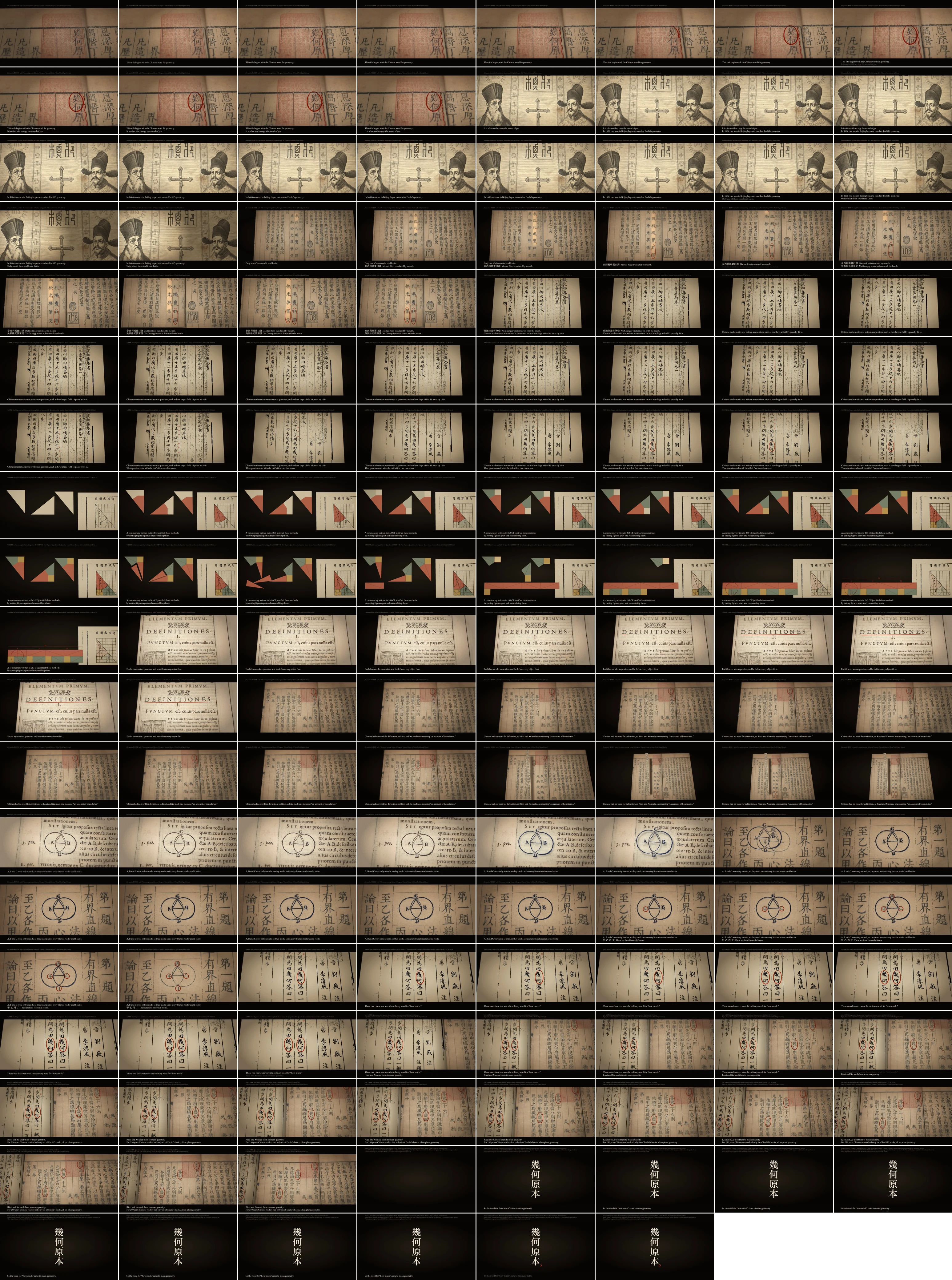
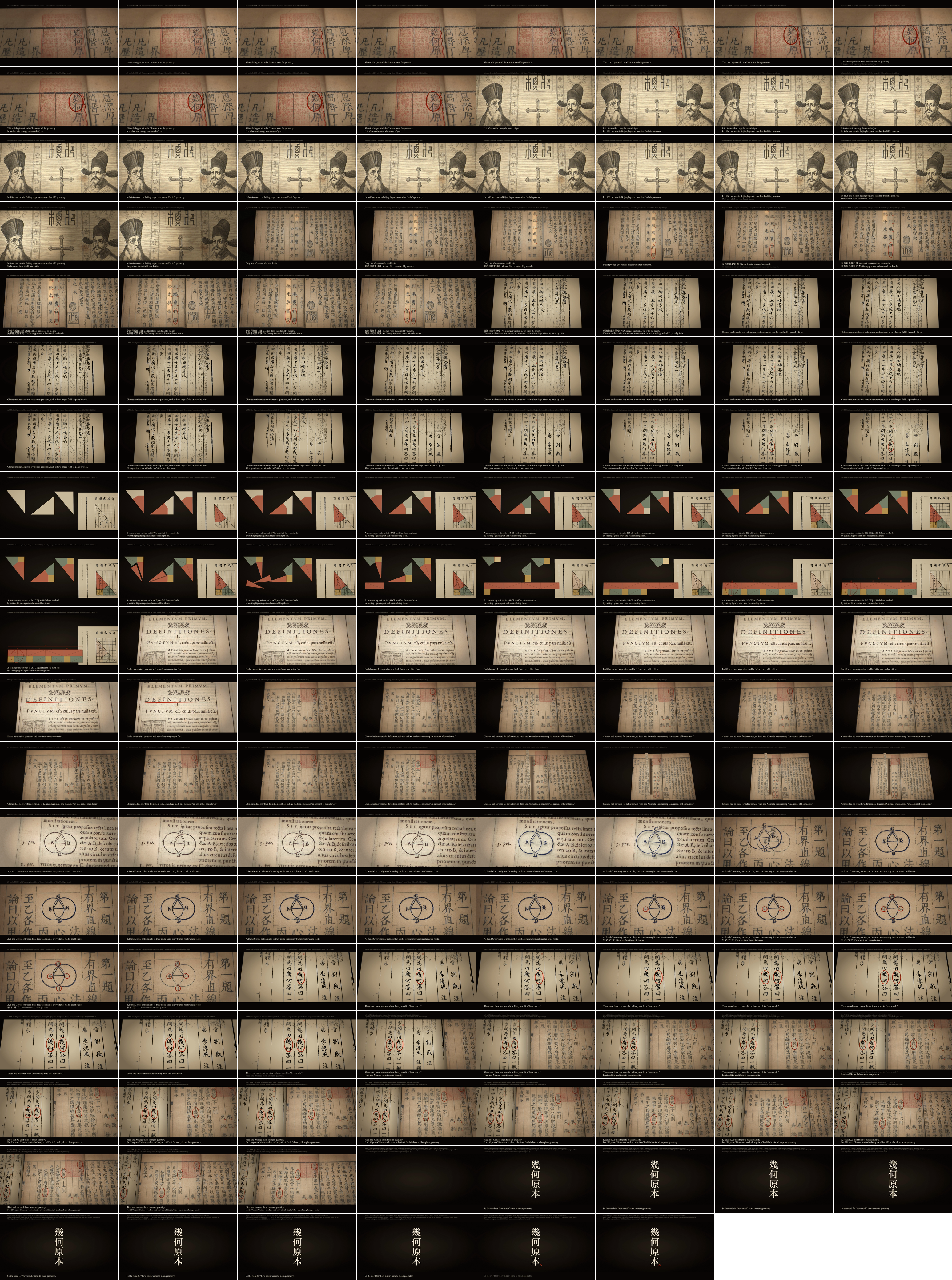
Two frames a second across the v2 cut, each from the middle of its half second, eight to a row: 150 frames. It is the cut that plays above.
Script
The Chinese word for geometry, 幾何, is often said to copy the sound of “geo.” In the 1607 Chinese Euclid it was the ordinary word for “how much.” Only six books of plane geometry existed in Chinese for 250 years, so the word for “how much” came to mean geometry.
| Time | Voice | Line | On screen |
|---|---|---|---|
| 0:00.66 | Narrator | This title begins with the Chinese word for geometry. | The 1607 title column rises under one lamp. The brush rings 幾何, and the ring stays on the paper. |
| 0:03.68 | Narrator | It is often said to copy the sound of geo. | The camera pushes in slowly on the ringed 幾何. |
| 0:06.46 | Narrator | In 1606 two men in Beijing began to translate Euclid’s geometry. | Cut to Kircher’s plate of Ricci and Xu, with both men in the lamp. |
| 0:11.18 | Narrator | Only one of them could read Latin. | On “one” the lamp narrows onto Ricci and stays there. |
| 0:13.12 | Reader | 泰西,利瑪竇,口譯。Subtitle: Matteo Ricci translated by mouth. | Cut to the two credit columns. A circle lands on each character as Yun reads it, and 口譯 is ringed. |
| 0:15.07 | Reader | 吳淞,徐光啓,筆受。Subtitle: Xu Guangqi wrote it down with the brush. | Xu’s column is read the same way and 筆受 is ringed. The two rings hold side by side for 0.5 s. |
| 0:18.12 | Narrator | Chinese mathematics was written as questions, such as how large a field 15 paces by 16 is. | Cut to the Nine Chapters page. Circles land under 十五步 and 十六步 as the numbers are said. |
| 0:24.30 | Narrator | That question ends with the title’s first two characters. | The camera travels down to 問為田幾何, and the brush rings 幾何. |
| 0:28.40 | Narrator | A commentary written in 263 CE justified those methods by cutting figures apart and reassembling them. | Liu Hui’s figure. The regions take their colours, the cuts are drawn, one pair turns into the strip’s first rectangle, the other eleven print in place, and the strip is measured. |
| 0:36.58 | Narrator | Euclid never asks a question, and he defines every object first. | Cut to Clavius’s 1574 Euclid. The brush underlines DEFINITIONES on “defines.” |
| 0:41.30 | Narrator | Chinese had no word for definition, so Ricci and Xu made one meaning “an account of boundaries.” | The 1607 heading 界說 is ringed, and the note under it lifts off the page as a standing slip. |
| 0:48.20 | Narrator | A, B and C were only sounds, so they used a series every literate reader could recite. | Clavius’s lettered figure lifts off as one indigo sheet and settles on the 1607 figure, with A on 甲 and B on 乙. |
| 0:54.33 | Reader | 甲、乙、丙、丁。Subtitle: These are the first four Heavenly Stems. | As Yun says each Stem, its Latin letter sinks into the paper and the brush rings the Stem. |
| 0:57.28 | Narrator | Those two characters were the ordinary word for “how much.” | Back to the Nine Chapters page. A second problem’s 幾何 is ringed, so two questions on one page end the same way. |
| 1:01.20 | Narrator | Ricci and Xu used them to mean quantity. | The 1607 first page slides in beside it, and its 幾何 in 幾何府 is ringed on “quantity.” |
| 1:03.70 | Narrator | For 250 years Chinese readers had only six of Euclid’s books, all on plane geometry. | The camera eases across the 1607 page to its title column, so the ring from line 1 is back in frame. |
| 1:09.98 | Narrator | So the word for “how much” came to mean geometry. | The empty table under the lamp. 幾何原本 arrives in one column, and a vermilion stop lands after 本. |
Times are where each line starts in the final, read from the film's own audio.
Animation script
| Time | Voiceover | Visual | Caption (on screen, not spoken) | Link |
|---|---|---|---|---|
| 0:00–0:04 | (silent) | Globe, pin on Beijing | 39.90° N, 116.37° E · Beijing · 1606 | Make: own render |
| 0:04–0:14 | "In 1606, a Jesuit and a Hanlin Academy scholar sat down in Beijing to put Euclid into a language that had no word for definition, axiom, or proof. One of them could not read Latin. The other had learned geometry from the man who edited the book they were translating." | Kircher plate, push on the two faces, then up to the name cartouches 利瑪竇西泰 and 徐光啟保祿 | Matteo Ricci 利瑪竇, 1552–1610 · Xu Guangqi 徐光啟, 1562–1633 · Kircher, China Illustrata, Amsterdam 1667 | commons.wikimedia.org/wiki/File:Ricci_Guangqi_2.jpg |
| 0:14–0:22 | "The book had come from Rome by sea and by river over twenty-four years. Ricci had tried once before, in the south, and given up. His word for it: it grinds." | Globe arc Rome → Macau → Shaozhou → Beijing, each pin flashing its label as the arc passes; 齟齬 appears over the Shaozhou pin. Cut to the Clavius engraved title page | 41.90° N, 12.48° E · Rome · 1574 · Clavius, Euclidis Elementorum libri XV → 22.19° N, 113.54° E · Macau · 1582 → 24.81° N, 113.60° E · Shaozhou · c. 1590 · with Qu Rukui 瞿汝夔 → Beijing · 1606 | archive.org/details/euclidiselemento01eucl |
| 0:22–0:30 | "The first page records how they worked. 利瑪竇口譯: Ricci translated by mouth. 徐光啟筆受: Xu received it with the brush. The Latin was spoken, never written." | First text page of 卷一, the two credit columns 泰西利瑪竇口譯 and 吳淞徐光啟筆受 lit as each is read | Jihe yuanben 幾何原本 · early 17th-century printing · Library of Congress / National Library of China | loc.gov/resource/gdcwdl.wdl_17216_001/?st=gallery |
| 0:30–0:46 | "The reason Chinese had no ready words for definition or axiom is that its mathematics was built on a different logic. The foundational text, the Nine Chapters, is 246 problems, each in three parts: problem, formula, computation. The general rule is reached from the cases. Euclid works by deduction. He names each object first, states what he will assume about it, and only then proves anything, with every theorem resting on the ones before it." | Split screen. Left: 細草圖說 卷一 opening page, highlight 今有田 → 術曰 → 答曰 in turn. Right: Euclid page from LOC wdl_18198, highlight a definition, then a proposition, then draw arrows from its margin references back up the page | Left: 九章算術, compiled by the 1st century CE · Qing edition, Siku Quanshu · Right: Euclid, Elements · [edition, place, date from the LOC record] | Left: sourcelibrary.org/book/nine-chapters-on-the-mathematical-art-vols-7-9 · Right: loc.gov/resource/gdcwdl.wdl_18198/?sp=7 |
| 0:46–0:58 | "So they named the parts of a proof. A definition became 界說, a boundary account, because a definition is where a word stops. That is also the Latin: definitio, from finis, a boundary. And Euclid's Greek, horos. The book explains the coinage in its first note." | Tight crop on the small double-column note under 界說: 凡造論先當分別解說論中所用名目故曰界說. Overlay the three words stacked: ὅρος · definitio · 界說 | 界說 jièshuō → today 定義 | loc.gov/resource/gdcwdl.wdl_17216_001/?st=gallery |
| 0:58–1:10 | "A, B, C are sounds, and a Chinese reader has no use for them. So the points became 甲, 乙, 丙, the Heavenly Stems, a counting series every literate person could recite. A note under definition twelve adds the rule: an angle is written with three characters and the middle one is the vertex." | Clavius Book I Prop. 1 (two circles, A B C) and the 1607 Prop. 1 (same circles, 甲乙丙) slide together and overlap for one beat. Then the Def. 12 note. Then 甲乙丙 morphs to ∠ABC (optional; drop to end on the note) | 甲乙丙丁戊己庚辛壬癸 · 天干 Heavenly Stems · Book I, Def. 12 | Left: archive.org/details/euclidiselemento01eucl · Right: loc.gov/resource/gdcwdl.wdl_17216_001/?st=gallery |
| 1:10–1:24 | "And the title. 幾何 is usually explained as the sound of geo. It isn't. It was the ordinary word for how much, the question that closes every problem in the Nine Chapters. Ricci and Xu used it for magnitude. Only these six books, all plane geometry, circulated for the next 250 years, and the word for how much narrowed until it meant geometry." | 問為田幾何 highlighted on the Nine Chapters page. Cut to the 幾何府 note on the 1607 page. Then 幾何 alone on black, the gloss under it changing: how much → magnitude → geometry | 幾何 jǐhé · 幾何府 "the department of quantity" · Books VII–XV: Li Shanlan 李善蘭 and Alexander Wylie, 1857 · Engelfriet 1998, pp. 138–42; Ogawa 2011 | Nine Chapters page and LOC gallery as above |
| 1:24–1:28 | (silent) | Globe, pin on Shanghai. Series tag | 31.19° N, 121.43° E · Xujiahui · Shanghai · named for the Xu family | Make: own render |
Coordinates for the globe build
- Rome, Collegio Romano: 41.898° N, 12.480° E
- Macau: 22.194° N, 113.543° E
- Shaozhou (today Shaoguan): 24.810° N, 113.597° E
- Beijing, Jesuit residence near Xuanwumen (site of the later South Cathedral): 39.899° N, 116.371° E. The site is confirmed; the 1606 building footprint is not
- Xujiahui, Xu Guangqi's tomb in Guangqi Park: 31.192° N, 121.434° E
- Alexandria (optional, Euclid c. 300 BCE): 31.200° N, 29.919° E
Image notes
- The LOC scan is catalogued 1606 and may be the 1611 revision. Caption it "early 17th-century printing," not "1607 first edition."
- The two Nine Chapters pages (細草圖說 and the Siku Quanshu volume) are Qing-era editions, two centuries after Ricci. Caption them "Qing edition."
- The 朱冪 青冪 黃冪 circle diagram is a 勾股容圓 figure from a Qing edition of chapter 9; usable as a two-second cutaway in the Nine Chapters beat if wanted.
- LOC wdl_18198 could not be opened for verification; take edition, place, and date from the LOC record for the caption.
- Make: the globe (flat matte, one pin, monospace coordinates) and any typographic beats.
The post
39.90° N, 116.37° E · Beijing · 1606
A Jesuit and a Hanlin Academy scholar sat down in Beijing to put Euclid into a language that had no word for "definition," "axiom," or "proof."
The Jesuit was Matteo Ricci, known in Chinese as Li Madou 利瑪竇. He had learned mathematics in Rome from Christopher Clavius, and he had carried Clavius's Latin edition, Euclidis Elementorum libri XV (Rome, 1574), to Macau in 1582 and north over the next two decades. The scholar was Xu Guangqi 徐光啟. He had passed the highest civil examination in 1604 and read no Latin at all.
Their method is printed at the head of the text: 利瑪竇口譯,徐光啟筆受. Ricci translated by mouth. Xu received it with the brush. Every afternoon from the autumn of 1606, Xu went to Ricci's residence near Xuanwumen. Ricci explained the Latin in spoken Chinese, and Xu turned what he understood into literary Chinese. Nothing was translated on paper; the Latin never met the page. Ricci's preface describes the loop: 求合本書之意,以中夏之文重複訂正,凡三易稿 (seeking to match the sense of the original, correcting it repeatedly in Chinese prose, three drafts in all). Euclid's text went in whole. Clavius's long commentary was sampled.
Ricci had tried once before. Around 1590, in Shaozhou, he worked through Book I with the scholar Qu Rukui. That manuscript is lost. His verdict on the difficulty survives: 言象之粗,而齟齬若是 (this is only the coarse layer of words and figures, and still it grinds like this).
The reason Chinese had no ready words for these things is that its mathematics was built on a different logic. The Nine Chapters on the Mathematical Art 九章算術, compiled by the first century CE, holds 246 problems. Each has three parts: 問, the problem (a field is fifteen paces by sixteen, how large is it); 術, the formula, stated as a procedure; and 答, the computed answer. The reader meets a rule by meeting its cases, and the generality is in the procedure, not in a statement about all fields. Liu Hui's commentary of 263 CE justifies the procedures, including the right-triangle rule, by cutting figures apart and reassembling them. So there was proof. What there was not was Euclid's direction of travel. Euclid works by deduction: he names each object first, states what he will assume about it, and only then proves anything, with every theorem resting on the ones before it. He never asks a question. Chinese mathematics was written from problem to rule. Euclid is written from rule to everything. Ricci and Xu had to build the form before they could fill it.
So they named the parts of a proof. A definition became 界說 jieshuo, "an account of boundaries." The book explains the coinage in its opening note: 凡造論先當分別解說論中所用名目,故曰界說 (whenever one builds an argument, one must first explain the names it uses; hence "boundary accounts"). The choice tracks the Latin: definitio comes from finis, a boundary, and Euclid's Greek horos means the same. Postulates became 求作 qiuzuo, "requested constructions." Common notions became 公論 gonglun, "public propositions."
Each proposition got a fixed layout: 題 (the statement), then 解 (the setup) for a theorem or 法 (the method) for a construction, then 論 (the demonstration). Margin references point back to numbered definitions and axioms. Book I, Proposition 1 ends 如所求, "as was required," a Chinese Q.E.F.
Diagram labels raised a separate problem. A, B, and C are sounds, and a Chinese reader had no use for them. Ricci and Xu used the ten Heavenly Stems, 甲乙丙丁戊己庚辛壬癸, a fixed ordinal series every literate reader could recite. Proposition 1 reads 甲乙直線上,求立平邊三角形: on the straight line jia-yi, construct an equilateral triangle. A note under Definition 12 sets a rule still in force: an angle is named by three characters, and the middle one is the vertex. Write ∠ABC in place of 甲乙丙 and you are following it.
Then the nouns. Point 點, line 線, straight line 直線, curve 曲線, surface 面, plane 平面, right angle 直角, acute angle 銳角, obtuse angle 鈍角, parallel lines 平行線, diagonal 對角線, and triangle 三角形 are all in the 1607 text. All of them are in a Chinese seventh-grade textbook today. The pattern is compression: a common character, one qualifier, and the compound behaves as a technical term.
The words for the architecture of proof did not last. 界說, 求作, 公論, 題, and 論 gave way to 定義, 公設, 公理, 命題, and 證明, which Masahiro Ogawa and An Tae-ok trace largely to Meiji-era Japanese usage. Ogawa argues that 論, an everyday word for "discussion," worked against the translators: it let later readers treat a Euclidean proof as one more argument among many. The names for things survived. The names for the moves did not.
Some survivors drifted. 平角 meant "plane angle" in 1607; today it means a straight angle of 180 degrees. 直線 covered what modern textbooks split into 直線, 射線, and 線段. 比例 was defined in Book V as the relation between two magnitudes, closer to "ratio"; it now means proportion.
And the title. 幾何 jihe is often explained as a sound-borrowing of "geo-." The evidence runs the other way. Neither Euclid's title nor Clavius's contains geometria. The book's opening note files its subject under the 幾何府, the "department of quantity," one of ten categories borrowed from Aristotle. And 幾何 was the ordinary word for "how much," the question that closes problem after problem in the Nine Chapters: 問…幾何. It was a translation of "magnitude." Because only Books I to VI, all plane geometry, circulated for 250 years, the word narrowed until it meant geometry.
The six books were printed in Beijing in 1607. Ricci died there in May 1610. In 1611 Xu revised the text with the Jesuits Sabatino de Ursis and Diego de Pantoja, working from Ricci's annotated copy. Books VII to XV waited until Li Shanlan and Alexander Wylie translated them from Henry Billingsley's 1570 English Euclid, published in 1857.
In this series the episode sits between two other rulebooks. A thousand years earlier, Xuanzang listed five cases in which a Buddhist term should be transliterated rather than translated, one of them being when China had no equivalent. Ricci and Xu met that case on nearly every page and chose to translate. Three centuries later, Yan Fu would reduce the job to 信、達、雅.
If you have worked with late-Qing or Republican textbooks: when did 甲乙丙 labels give way to A, B, C, and did 界說 disappear at the same moment, or separately?
31.19° N, 121.43° E · Xujiahui · Shanghai
Vocabulary table
| Term (trad. / simp.) | Pinyin | Clavius Latin | English | Status today | Note and source |
|---|---|---|---|---|---|
| 幾何 / 几何 | jǐhé | none in the title; 幾何府 ≈ quantitas, magnitudo | quantity → geometry | Modified | Meant "how much / magnitude"; narrowed to "geometry." Ogawa 2011; Engelfriet 1998, pp. 138–42; Siu 1995/96 |
| 幾何學 / 几何学 | jǐhéxué | geometria | geometry (the discipline) | Later form | Not in the 1607 title; 幾何 later became shorthand for 幾何學 |
| 點 / 点 | diǎn | punctum | point | Identical | Def. 1 "點者無分"; Ogawa |
| 線 / 线 | xiàn | linea | line | Identical | Def. 2; Ogawa |
| 直線 / 直线 | zhíxiàn | recta linea | straight line | Modified (narrower) | 有界直線 = what is now a segment; modern textbooks split 直線/射線/線段 (PEP §6.2) |
| 曲線 / 曲线 | qūxiàn | linea curva | curve | Identical | Def. 4 note; Ogawa |
| 面 | miàn | superficies | surface | Identical | Def. 5 "面者止有長有廣"; Ogawa |
| 平面 | píngmiàn | plana superficies | plane | Identical | Def. 7; Ogawa |
| 角 | jiǎo | angulus | angle | Identical | Defs. 8–12 |
| 平角 | píngjiǎo | planus angulus | plane angle → straight angle (180°) | Modified (false friend) | "凡言甲乙丙角皆指平角"; modern 平角 = 180° |
| 直角 | zhíjiǎo | angulus rectus | right angle | Identical | Def. 10; Ogawa |
| 銳角 / 锐角 | ruìjiǎo | angulus acutus | acute angle | Identical | Def. 12; Ogawa |
| 鈍角 / 钝角 | dùnjiǎo | angulus obtusus | obtuse angle | Identical | Def. 11; Ogawa |
| 垂線 / 垂线 | chuíxiàn | perpendicularis | perpendicular | Identical | Def. 10 |
| 三角形 | sānjiǎoxíng | triangulum | triangle | Identical | Prop. I.1 "平邊三角形"; the definitions use 三邊形. Ogawa |
| 四邊形 / 四边形 | sìbiānxíng | figura quadrilatera | quadrilateral | Identical | Book I defs.; later lists of Ricci coinages |
| 平行線 / 平行线 | píngxíngxiàn | parallelae | parallel lines | Identical | Def. 34; Ogawa; LOC catalog note |
| 平行線方形 | píngxíngxiàn fāngxíng | parallelogrammum | parallelogram | Replaced (平行四邊形) | Ji Zhigang 2017 |
| 對角線 / 对角线 | duìjiǎoxiàn | diameter (Euclid's word for a parallelogram's diagonal) | diagonal | Identical | Def. 35; Ogawa. Clavius's exact word to check |
| 圜 → 圓 / 圆 | yuán | circulus | circle | Modified (character) | Book III is titled "論圜" |
| 相似 | xiāngsì | similis | similar | Identical | Book VI, Def. 1; exact wording to check |
| 外切 / 內切 | wàiqiē / nèiqiē | circumscribi / inscribi | circumscribed / inscribed | Modified | Book IV. Modern 內切圓 = inscribed circle; circumscribed circle is now 外接圓; 外切 now mostly means external tangency |
| 比例 | bǐlì | ratio (Book V, Def. 3), proportio | ratio → proportion | Modified | "比例者,兩幾何以幾何相比之理"; modern 比 = ratio, 比例 = proportion |
| 面積 / 面积 | miànjī | area | area | Identical | Ogawa, citing Li & Du and Engelfriet pp. 282–6 |
| 體積 / 体积 | tǐjī | soliditas (to check) | volume | Identical | Ogawa; where it appears in Books I–VI not yet checked |
| 界說 / 界说 | jièshuō | definitio | definition | Replaced (定義) | Ogawa; An 2007 |
| 求作 | qiúzuò | postulatum, petitio | postulate | Replaced (公設); survives in construction problems | Ogawa |
| 公論 / 公论 | gōnglùn | communis notio, axioma | axiom | Replaced (公理) | Ogawa; Engelfriet pp. 148–9 |
| 題 / 题 | tí | propositio | proposition | Replaced (命題) | Ogawa |
| 論 / 论 | lùn | demonstratio | proof | Replaced (證明) | Ogawa; Martzloff 1993 |
| 如所求 | rú suǒ qiú | quod erat faciendum | "as was required" | Replaced | Prop. I.1 text (Ogawa) |
Sources
Primary texts
- Ricci, 譯幾何原本引 (1607); Xu Guangqi, 刻幾何原本序, 幾何原本雜議, 題幾何原本再校本 (1611). Modern edition: 徐光啟全集 vol. 4 (Shanghai, 2010). Transcriptions: ctext.org/wiki.pl?if=en&chapter=870487 and zh.wikisource.org/zh-hant/幾何原本/卷一
- Clavius, Euclidis Elementorum libri XV (Rome: Vincenzo Accolti, 1574). archive.org/details/euclidiselemento01eucl; 1591 Cologne printing, ETH e-rara: e-rara.ch/zut/content/titleinfo/4837753
- Jihe yuanben, Library of Congress / World Digital Library, original at National Library of China: loc.gov/item/2021666487/ (gallery: loc.gov/resource/gdcwdl.wdl_17216_001/?st=gallery). 1611 edition: loc.gov/item/2014514121
- Euclid, Elements, LOC / WDL: loc.gov/resource/gdcwdl.wdl_18198/?sp=7 (edition unverified)
- Nine Chapters, Siku Quanshu and 細草圖說 scans: sourcelibrary.org/book/nine-chapters-on-the-mathematical-art-vols-7-9
- Kircher plate: commons.wikimedia.org/wiki/File:Ricci_Guangqi_2.jpg
Scholarship
- Engelfriet, Peter M. Euclid in China. Sinica Leidensia 40. Brill, 1998. ISBN 978-90-04-10944-5. brill.com/display/title/782
- Ogawa, Masahiro. "Xu Guangqi and the Chinese Translation of Euclid's Elements: Some Problems of Terminology and Their Cultural Context." HERSETEC 5, no. 1 (2011): 13–33. gcoe.lit.nagoya-u.ac.jp/result/pdf/5-1_小川(E).pdf
- Martzloff, Jean-Claude. A History of Chinese Mathematics, trans. S. S. Wilson. Springer, 1997. ISBN 978-3-540-54749-5
- Jami, Catherine, Peter Engelfriet, and Gregory Blue, eds. Statecraft and Intellectual Renewal in Late Ming China. Brill, 2001
- Jami, Catherine. "Western Learning and Imperial Scholarship." EASTM 27 (2007): 146–172. core.ac.uk/download/pdf/228878007.pdf
- Elman, Benjamin A. On Their Own Terms: Science in China, 1550–1900. Harvard University Press, 2005. ISBN 978-0-674-01685-9
- Xu, Yibao. "The first Chinese translation of the last nine books of Euclid's Elements and its source." Historia Mathematica 32, no. 1 (2005): 4–32. doi:10.1016/j.hm.2003.12.002
- D'Elia, Pasquale. "Presentazione della prima traduzione cinese di Euclide." Monumenta Serica 15 (1956): 161–202. doi:10.1080/02549948.1956.11730948
- 纪志刚. 〈从拉丁语到古汉语:汉译《几何原本》卷一"界说"的翻译分析〉, 《自然辩证法通讯》 39, no. 2 (2017): 1–9
- 王宏晨, 萨日娜, 纪志刚. 〈明刊《几何原本》第六卷第五界注释来源探讨〉, 《自然辩证法通讯》 (2025)
- 康明昌. 〈「幾何原本」四百年〉, 《數學傳播》 32, no. 4 (2008): 16–29. math.sinica.edu.tw/media/pdf/d324/32402.pdf
- Siu, Man-Keung. "Success and Failure of Xu Guangqi." Studies of History of Medicine & Science 14 (1995/96): 137–79
- An Tae-ok 安大玉. 《明末西洋科学東伝史》. Tokyo, 2007
- Wang, Wensheng. "Science, Religion and Sino-Western Exchanges." Journal of Chinese History 8, no. 1 (2024): 115–145. doi:10.1017/jch.2022.38
- Chemla, Karine, and Guo Shuchun. Les neuf chapitres. Dunod, 2004 (for the Nine Chapters claims)
Rights
- LOC/WDL Jihe yuanben: no known restrictions. LOC 1611 item: rights not stated. Internet Archive Clavius: check the item's rights field; ETH 1591 printing carries a Public Domain Mark. Kircher plate: public domain. sourcelibrary.org scans: CC BY-SA 4.0 per site watermark.
Fact-check list
Verified against a primary or scholarly source
- Source edition: Clavius 1574, Rome, Accolti (Engelfriet ch. 4; Ogawa; LOC). Caveat: Wang, Sarina, and Ji (2025) argue notes in the 天學初函 printing derive from later Clavius editions.
- Credit line 口譯/筆受 and afternoon sessions (Ogawa; Siu, quoting Ricci's journals). 凡三易稿: Ricci's preface; check against 徐光啟全集 vol. 4.
- Euclid's text kept whole and Clavius's commentary only sampled: Ricci's preface (ctext).
- 界說 gloss and the boundary etymology: Ogawa. 題/解/法/論 layout: Ogawa, citing An 2007. 如所求: Ogawa's quotation of Prop. I.1.
- Three-character angle naming (Def. 12 note) and 平角 = plane angle (Def. 8): Wikisource and Siku text.
- Surviving object terms and replaced proof terms: Ogawa, citing Li & Du 1987, Engelfriet pp. 282–6, An pp. 112–3. China uses 公設 where Japan uses 公準 (Ogawa n. 24).
- 幾何 as "how much / magnitude": Ogawa; Engelfriet pp. 138–42; Siu. The 幾何府 note is in the Book I opening text.
- 1611 revision with de Ursis and Pantoja: Xu's 題幾何原本再校本, per LOC record 2014514121 and D'Elia 1956.
- Books VII–XV: translated 1852–56, published 1857, from Billingsley (Xu Yibao 2005).
- Nine Chapters: 246 problems; Liu Hui's commentary dated 263 CE; 出入相補 justification of the gougu rule (Chemla and Guo 2004; Martzloff 1997). Standard, but added since the last pass.
- Guangqi Park renamed 1983; tomb listed as a national heritage site 1988.
Contested, flag in the post or caption
- Date of the LOC copy: catalogued 1606; Ricci's preface is dated 萬曆丁未 (1607). Use "translated 1606–07, printed 1607."
- Li–Wylie printing year: Ogawa gives 1859; Xu Yibao gives 1857. Prefer 1857.
- The Qu Rukui attempt: c. 1590–91 (Engelfriet pp. 59ff.; MacTutor). The claim that Qu translated "five books" is unsupported.
- "Inductive" as a description of the Nine Chapters: Chemla argues the tradition had its own generality and justification. The post hedges this with the Liu Hui sentence; the script does not.
Unverified, check before publishing
- When Chinese textbooks switched from 甲乙丙 to A, B, C.
- Whether Ricci and Xu used Earthly Branches after the ten Stems ran out.
- Exact Book VI wording for 相似 and Book IV wording for 外切/內切.
- Clavius's exact Latin for "diagonal." Where 體積 appears in Books I–VI.
- Which edition LOC wdl_18198 is.
- The National Library of China copy with Han Yingbi's colophon as the 1607 first printing (reported by shuge.org; check the NLC record).
- Rights statements for the LOC 1611 item and the Internet Archive Clavius scan.