Marks

The speed set is seven General Translation marks in one register, taken from a race-type reference. Two-way and Globe G from the earlier round follow for comparison.

Every mark is one color and takes the ink of whatever it sits on. Each one is shown positive and reversed at a run of heights, the monograms also as an app icon and a favicon, and every file is linked. The current mark closes the page as the reference.

Section 16 rules

The register

The speed set follows one register, taken from a race-type reference. The rules below name it, and a mark that keeps them belongs to the set. The two picture marks at the end of the page predate the register and stay for comparison.

01

Wide letters

Every letter is wider than it is tall. The monogram builds G and T from rectangles on a 120 unit cap, the plate sets GT in Orbitron Black, and the wordmarks set the name in Anybody at width 150, the widest instance of the face.

02

A forward slant

The letters lean forward. The monogram and everything made from it sit under a 12 degree skew, the plate under 14 degrees, and the livery stack uses the italic of its face with a slash at 22 degrees across both lines. Double cut stands upright and is the one exception.

03

One cut

One horizontal cut runs through the letters at mid cap height. On the monogram the cut is 8 units on a 120 unit cap and splits the middle speed bar in two. The livery stack cuts each of its two lines once. Double cut carries two cuts at 40 and 60 percent of the cap height, each 7 percent of the cap thick, and takes its speed from them.

04

Speed bars

Three bars of different lengths lead into the first letter from the left. On the monogram they are the stem of the G combed into bars 20, 80 and 50 units long past the stem, at the top arm, at mid height and at the bottom arm. The dither and the ASCII keep them solid because their density is 1 across the left third of the width. The plate, double cut and the livery stack carry no bars.

05

One color

Every file is one color in currentColor: one path, or one masked group where the letters or the cuts are holes. There is no second tone, no gradient, no stroke and no shadow, so the mark takes the ink of whatever it sits on. The dither and the ASCII get their gray from the density of their cells.

06

Paper and ink

The same file positive and reversed, ink on paper and paper on ink, with no redraw for either ground. The plate is the one mark that brings its own ground, because its letters and its stripes are holes: on paper it is an ink plate, on ink a paper plate. The theme switch swaps the grounds on this page.

Speed 7

Wide letters, a forward slant, one cut through the letters, and speed bars into the first letter.

Picture 2

The picture lives in the letters.

The faces are Michroma, Orbitron and Anybody, from Google Fonts under the SIL Open Font License. scripts/build/speed-marks.mjs converts every string to outlines at build time, so each file is geometry and the site loads none of the three.

Section 2Speed set

Bar monogram

Wide letters, a forward slant, one cut through the letters, and speed bars into the first letter.

Positive, 224px
Reversed, 224px
16243264128
Positive, 16 to 128px
16243264128
Reversed, 16 to 128px
App icon, 128px
General Translation
Favicon, 16px
Thesis
GT from ten rectangles under a 12 degree skew. The stem of the G is combed into three speed bars of different lengths, and one cut runs through both letters at mid height.
Construction
Ten rectangles on a 120 unit cap height under a 12 degree skew. The G is a stem, a top arm, a bottom arm, a chin and a right stem; the T is a crossbar and a stem; the three speed bars run 20, 80 and 50 units past the stem of the G at the top arm, at mid height and at the bottom arm. One 8 unit cut at mid height runs through both letters and splits the middle bar into two lines. The cut is applied to the geometry, so the file is plain polygons in one path, with no font, no mask and no id.
In use
There is no font in the file; the letters are geometry, so the mark holds at 16px and reads in either polarity. At 16px the cut and the thin bars fall to one pixel and the two letters carry the mark; from 32px the three bars read as bars.
Section 3Speed set

Bar monogram lockup

Wide letters, a forward slant, one cut through the letters, and speed bars into the first letter.

Positive, 224px
Reversed, 224px
4896144
Positive, 48 to 144px
4896144
Reversed, 48 to 144px
Thesis
The monogram over the name in Michroma at a fifth of the cap height, letter-spaced to the width of the monogram.
Construction
The monogram unchanged, and GENERAL TRANSLATION in Michroma at 24 units, a fifth of the 120 unit cap, set 46 units under it and letter-spaced so the name spans the width of the monogram, speed bars included. The name is converted to outlines at build time, so the file is two paths and no font.
In use
For sign-in plates, deck openers and anywhere the mark stands alone with room under it. The name is small: its font size is an eighth of the height of the lockup, so a 96px lockup sets the name at 12px, and the monogram alone serves the sizes under that.
Section 4Speed set

Plate

Wide letters, a forward slant, one cut through the letters, and speed bars into the first letter.

Positive, 224px
Reversed, 224px
16243264128
Positive, 16 to 128px
16243264128
Reversed, 16 to 128px
App icon, 128px
General Translation
Favicon, 16px
Thesis
GT in Orbitron Black cut out of a rounded plate under a 14 degree skew, with a hazard stripe clipped to the right end of the plate. The letters and the stripes are holes, so the ground shows through them.
Construction
A 320 by 120 plate with 12 unit corners, skewed 14 degrees about its bottom edge. GT is set in Orbitron Black at 90 units and cut out of the plate through a mask; the hazard stripe is bars 9 units wide on an 18 unit period at 35 degrees, clipped to the right 74 units of the plate and carried as holes of the same evenodd path. The file is one masked path in currentColor.
In use
The one direction that brings its own ground: on paper it is an ink plate, on ink a paper plate. It suits avatars, badges and the CLI banner, where a mark needs an edge of its own. At 16px the stripes merge into a gray end and the letters hold as two open counters; the stripe reads from about 48px.
Section 5Speed set

Double cut

Wide letters, a forward slant, one cut through the letters, and speed bars into the first letter.

Positive, full width
Reversed, full width
162432
Positive, 16 to 32px
162432
Reversed, 16 to 32px
Thesis
GENERAL TRANSLATION in Anybody at width 150, black and upright, with two cuts through the line.
Construction
One line of Anybody Black at width 150, upright, at 100 units. Two cuts at 40 and 60 percent of the cap height, each 7 percent of the cap thick, are subtracted through a mask that spans the whole line. The letters are outlines from the build script; the file is one masked path and no font.
In use
The calmest of the set; the pair of cuts reads as speed without a slant. The line is 25 times wider than its cap, so it is for headers, footers, sleeves and the top of a document, and on this sheet it takes the full width. The cuts close below about 16px of cap height, where they fall under one pixel.
Section 6Speed set

Livery stack

Wide letters, a forward slant, one cut through the letters, and speed bars into the first letter.

Positive, full width
Reversed, full width
4896144
Positive, 48 to 144px
4896144
Reversed, 48 to 144px
Thesis
GENERAL over TRANSLATION in Anybody italics, a cut through each line and one forward slash across both.
Construction
GENERAL in Anybody Black Italic at width 150 and 150 units, over TRANSLATION in the Medium Italic sized to the same width with 2 units of letter spacing and a 40 unit gap between the lines. A cut runs through each line at mid cap height, and one slash at 22 degrees, 9 units wide, crosses both lines at 57 percent of the width. The cuts and the slash are subtracted through a mask; the file is one masked group of two paths.
In use
The loudest direction, for a livery, a jacket or a full-bleed slide. The slash stays one cut wide; wider, it turns into a stripe. Below about 48px the slash and the cuts fall under one pixel and close, so the stack is for large sizes.
Section 7Speed set

Bar monogram, dithered

Wide letters, a forward slant, one cut through the letters, and speed bars into the first letter.

Positive, 224px
Reversed, 224px
4896144
Positive, 48 to 144px
4896144
Reversed, 48 to 144px
Thesis
The monogram rasterised to square cells and printed through the 8 by 8 Bayer screen, solid at the left and thinning to the right.
Construction
The monogram sampled on a grid of 240 by 59 square cells, 16 samples per cell. A cell prints when more than half of it lies inside the monogram and the 8 by 8 Bayer screen passes it against a density that is 1 across the left third of the width and falls in a straight line to 0.18 at the right edge; 5,154 cells print. Every printed cell is one unit square in one path, so the file is one color and one path.
In use
The deck’s dither, on the mark: solid at the left, cells at the right, ink on paper. It sizes by cell, so it is for heights of 59px and up, where a cell is one pixel; below that the cells merge to gray and the mark reads as the monogram with a soft right edge.
Section 8Speed set

Bar monogram in ASCII

Wide letters, a forward slant, one cut through the letters, and speed bars into the first letter.

Positive, 224px
Reversed, 224px
4896144
Positive, 48 to 144px
4896144
Reversed, 48 to 144px
Thesis
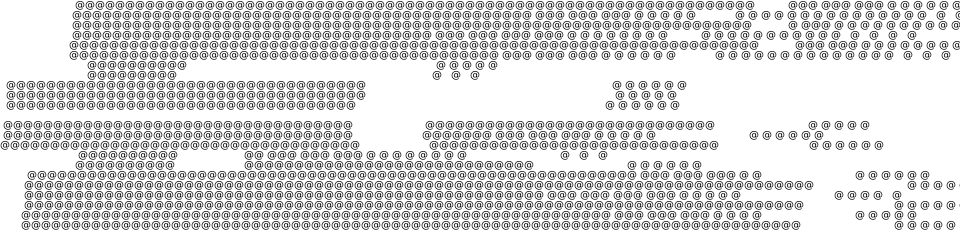
The same grid at the aspect of a monospace cell, one @ per printed cell, solid at the left and dithering away to the right.
Construction
The monogram sampled on a grid whose cells have the aspect of a monospace character, three wide to five tall: 160 columns by 23 lines, one @ per printed cell, the same Bayer screen and the same density fall. The SVG sets each line as text in a monospace stack with textLength, so any monospace face fills the same width; the .txt file is the plain characters with the trailing spaces trimmed.
In use
For a code block, a README or the CLI banner: the .txt file is the characters, 160 columns wide, and the SVG stands in where text cannot be set. The characters need a monospace face; in a proportional face the columns drift and the mark breaks.
Section 9Earlier round

Two-way

The picture lives in the letters.

Positive, 224px
Reversed, 224px
16243264128
Positive, 16 to 128px
16243264128
Reversed, 16 to 128px
App icon, 128px
General Translation
Favicon, 16px
Clean
Construction
Thesis
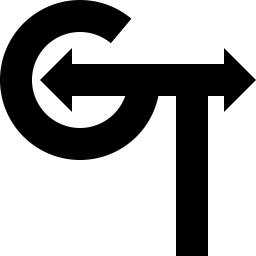
The bar of the G and the crossbar of the T are one stroke, a two-way arrow that starts inside the counter of the G, leaves through the aperture, carries the stem of the T and ends past it. The exchange between two languages is the stroke both letters hang from.
Construction
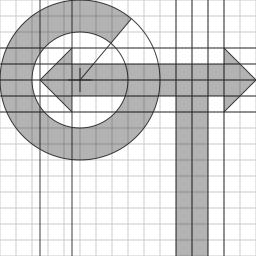
16 unit grid, stroke 32 (2 units). G ring centered (80, 80), outer radius 80, inner 48; terminal cut radially at minus 50 degrees; the spur rises to y 96 where it meets the shaft. Shaft y 64 to 96 from x 72 to 224; triangular heads 32 long and 64 tall, with apexes at (40, 80) inside the counter and (256, 80) past the stem. Stem x 176 to 208 from the shaft down to y 256. The letters are staggered: the G occupies the top left 160 square and the T hangs from the arrow into the bottom right.
In use
At 16px the heads flatten to a 2px bar with pointed ends; the ring, the bar and the long stem still read as G and T on both grounds. The arrow itself appears from about 48px.
Section 10Earlier round

Globe G

The picture lives in the letters.

Positive, 224px
Reversed, 224px
16243264128
Positive, 16 to 128px
16243264128
Reversed, 16 to 128px
App icon, 128px
General Translation
Favicon, 16px
Clean
Construction
Thesis
The counter of the G is a globe drawn by the T standing inside it. The stem of the T is the central meridian running to the south pole, its crossbar spans the disc as a parallel and closes a polar cap, and the bar of the G is the equator from the meridian out through the ring.
Construction
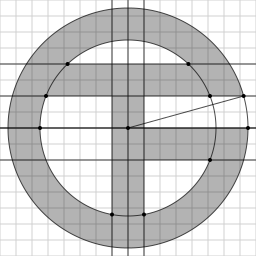
Ring centered (128, 128), outer R 120, inner R 88, stroke 32: a monogram filling the square from 16 to 240. Crossbar y 64 to 96 as a chord from wall to wall, leaving a 24 unit cap above it; stem x 112 to 144 from y 64 down into the inner bottom of the ring; bar y 128 to 160 from the stem to the outer circle. The terminal is the underside of the crossbar extended through the ring at y 96, so the mouth is a 32 unit slot between the crossbar and the bar. One evenodd path: an outer loop plus three holes (the cap, the left counter, the lower right quadrant).
In use
At 16px it reads as a T inside a G ring with a 2px mouth tucked under the crossbar; the cap vanishes, so it is a monogram at small sizes and a globe from 32px up. The weakest letter read of the earlier round: the G depends on the mouth, and the arms of the T merge into the ring.
Section 11Nine together

Presentation

The nine marks together at one height, positive and reversed, so the set reads as a set and the two survivors can be compared with it. The current doubled-line mark follows as the reference.

01 Bar monogram02 Bar monogram lockup03 Plate04 Double cut05 Livery stack06 Bar monogram, dithered07 Bar monogram in ASCII08 Two-way09 Globe G
Positive, the nine at 64px, the widest across the field
01 Bar monogram02 Bar monogram lockup03 Plate04 Double cut05 Livery stack06 Bar monogram, dithered07 Bar monogram in ASCII08 Two-way09 Globe G
Reversed, the nine at 64px, the widest across the field
The current mark, positive
The current mark, reversed

The current mark, the doubled-line GT monogram. It is the reference the marks are measured against, and it is not a candidate.