Tyndale, More, and the English vocabulary of the Bible
English series, installment: The newe Testament, Worms, 1526.
The film
download the MP4 · the credits as text
The Videos session made this film in motion/films/tyndale from the research package below. The final render of the cut, motion/out/tyndale.mp4, plays here from its web copy.
Credits
Tyndale, More, and the English vocabulary of the Bible (motion/films/tyndale), 97.35 s, 1920 x 1080. A General Translation film, translation series. Ship this text with the film wherever it is published (the description field of the post or the video page). Each picture's credit is also on screen while the picture is shown.
Images
- William Tyndale, The newe Testamēt as it was written/ and caused to be writtē/ by them which herde yt (Worms: [Peter Schoeffer], 1526), the only surviving title page (image 5), fol. cxix recto, St John 1 (image 243), fol. xxii verso and fol. xxiii recto, Matthew 16 (images 50 and 51), and fol. ccxiiii verso, Romans 13 (image 434). Source: Württembergische Landesbibliothek Stuttgart, B engl.152601, digital.wlb-stuttgart.de/purl/bsz35126731X. Public Domain Mark 1.0. Changes: cropped (the library's scale bar and the facing pages are outside the crops) and printed through the film's dither screen.
- William Tyndale, the Pentateuch (Antwerp, 1530; the colophon names "Malborow in the lande of Hesse" and "Hans Luft"), the end of Genesis (canvas 180), Exodus 12 (canvas 236), Exodus 25, fol. XLII (canvas 281), the woodcut of the ark, fol. XLIII (canvas 283), and Leviticus 16 (canvas 424). Source: Princeton University Library, William H. Scheide Library 109.2, dpul.princeton.edu/catalog/0r9677704. No Known Copyright (rightsstatements.org NKC 1.0). Changes: cropped (this copy's side notes, some of them supplied in pen and ink facsimile, are outside the crops) and printed through the film's dither screen.
- William Tyndale's letter from Vilvoorde, in Latin, undated (State Archives, Brussels), in the reduced facsimile of Robert Demaus, William Tindale: A Biography, ed. Richard Lovett (London: Religious Tract Society, 1904), page image n566 of archive.org/details/williamtindalebi00dema. Public domain. Changes: cropped (Demaus's printed caption is outside the crop) and printed through the film's dither screen.
- Vilvoorde castle, engraving by Jacobus Harrewijn in Jacques Le Roy, Castella et praetoria nobilium Brabantiae (1696). Source: Wikimedia Commons, File:KasteelVilvoorde.jpg . Public domain. Changes: cropped (the arms and the title are outside the crop) and printed through the film's dither screen.
- The globe is drawn from Natural Earth's 1:50m land (public domain), through world-atlas 2.0.2 (Mike Bostock, ISC licence).
Texts set in type
- The constitution of 1409 (nemo deinceps textum aliquem sacre scripture auctoritate sua in linguam Anglicanam ... transferat) and its translation: Alfred W. Pollard, ed., Records of the English Bible (Oxford University Press, 1911), pp. 79-81. The date line of Cuthbert Tunstall's order of 24 October 1526: John Foxe, Actes and Monuments (1563), in Pollard, pp. 131-135. Thomas More, A dyaloge (1529), book 3, chapter 8, in Pollard, p. 128. The rules for the translators of 1604, rule 3, in Pollard, p. 53.
- John 1:1 in Greek, as in Erasmus's printed New Testament.
- "playnly layde before their eyes in their mother tonge": Tyndale's prologue "W. T. To the Reader" (1530), in J. I. Mombert, ed., William Tyndale's Five Books of Moses (1884), p. 3. The Vulgate's and Luther's readings (phase, id est transitus domini; capro emissario; dem freybock; Gnaden stuel, as Mombert divides it at Exodus 25:17): Mombert's apparatus, pp. 200, 238-239 and 345.
- The Wycliffite readings: Josiah Forshall and Frederic Madden, eds., The Holy Bible ... by John Wycliffe and his followers (Oxford, 1850), vol. 1, p. 218, and vol. 4, pp. 43 and 329. The 1611 reading of Matthew 16:18: The English Hexapla (London: Samuel Bagster, 1841).
- The two King James figures, in the words of the abstract: Jon Nielson and Royal Skousen, "How Much of the King James Bible Is William Tyndale's? An Estimation Based on Sampling," Reformation 3 (1998): 49-74, doi:10.1179/ref_1998_3_1_004.
- The earliest evidence for passover, scapegoat and mercy seat: the Oxford English Dictionary's entry factsheets, read on 2026-10-09 and 10.
- Tyndale's request for his Hebrew Bible, grammar and dictionary: Demaus, 1904, p. 538.
Type: Inter (Rasmus Andersson) and Geist Mono (Vercel), SIL Open Font License 1.1. Voices: ElevenLabs (Frederick Surrey, narrator; Jane, reader). Music: ElevenLabs Music API.
The anchor is the translated book as printed in the target language, as in the Euclid installment (Jihe yuanben, Beijing, 1607): the small octavo New Testament that Peter Schoeffer printed at Worms in 1526, identified as his from its types and illustrations. Its title page, which survives only in the Stuttgart copy, reads "The newe Testamēt as it was written/ and caused to be writtē/ by them which herde yt" and names neither translator nor printer. Three copies survive: the British Library's (C.188.a.17, formerly Bristol Baptist College, complete except for the title leaf), St Paul's Cathedral's (incomplete) and the Württembergische Landesbibliothek's in Stuttgart, the only copy with its title page. Its companion is the Pentateuch of 1530, five books printed in Antwerp under the false imprint "Malborow in the lande of Hesse/ by me Hans Luft". For most of the words this episode follows, it is the Oxford English Dictionary's earliest evidence. Thomas More is in the title because he attacked the words themselves, and because the 1611 translators settled one of his objections in his favour.
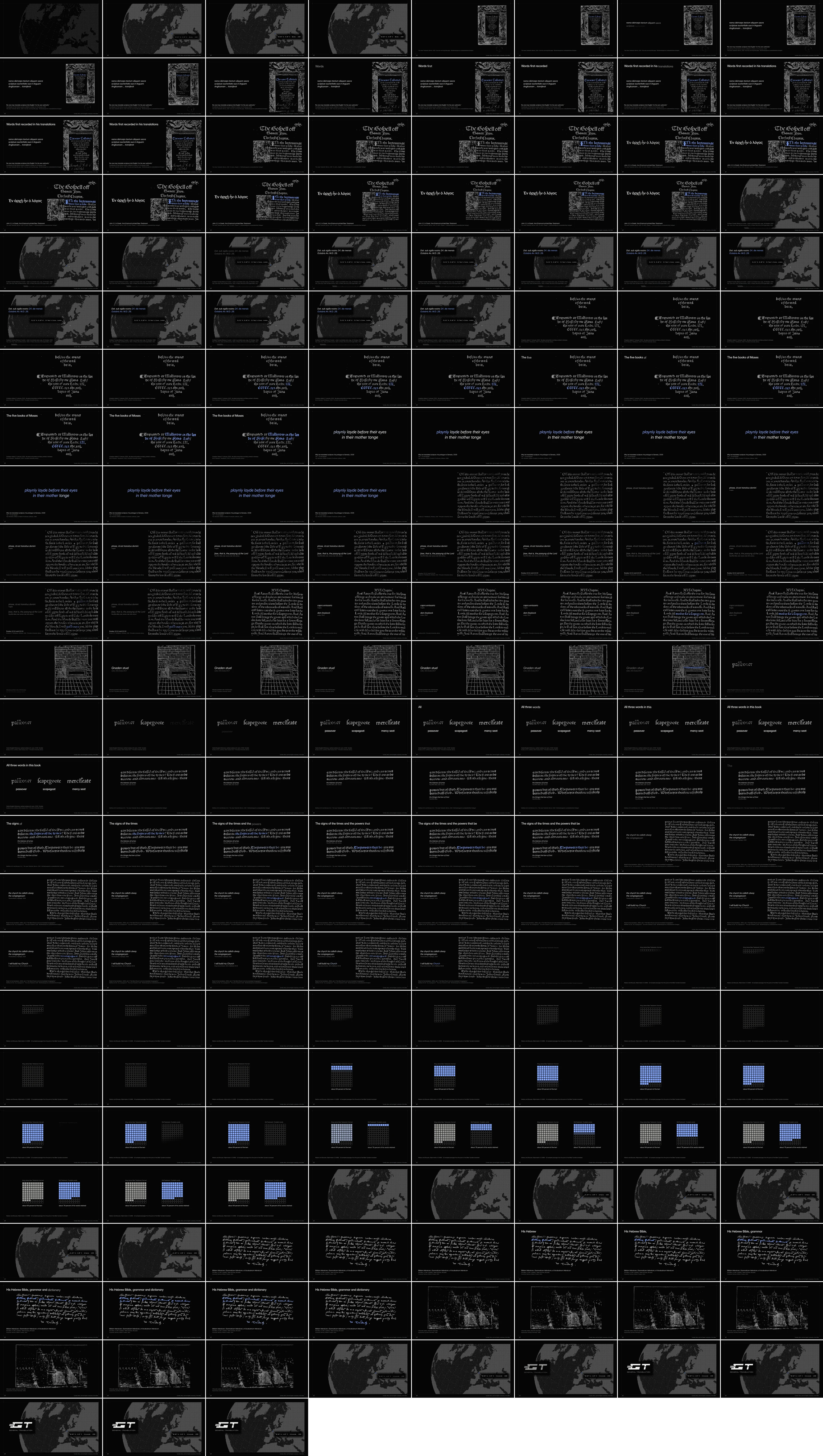
Contact sheet
Two frames a second across the cut, each from the middle of its half second, eight to a row: 195 frames. It is the cut that plays above.
Script
William Tyndale translated scripture into English while church law forbade it. His New Testament, translated from the Greek, was printed at Worms in 1526 and burned in London; his Pentateuch of 1530, printed under a false imprint, is where the Oxford English Dictionary first records passover, scapegoat and mercy seat. Thomas More attacked his choice of congregation for church, the King James translators kept church, and a 1998 sampling study estimated how much of his wording the King James Version kept. He was arrested in 1535 and executed at Vilvoorde in 1536.
| Time | Voice | Line | On screen |
|---|---|---|---|
| 0:00.18 | Narrator | William Tyndale translated scripture into English while church law forbade it, and English still uses words first recorded in his translations. | The globe, a pin on Worms; then the only surviving title page of the 1526 New Testament (Stuttgart), its title lit, and the Latin of the constitution of 1409 set beside it. Heading: Words first recorded in his translations. |
| 0:09.24 | Narrator | He translated the New Testament from the Greek, and it was printed at Worms in 1526. | St John, chapter 1, in the Stuttgart copy: “IN the begynnynge / was that worde” lights and the Greek of John 1:1 sets beside it; on “printed” the camera eases back to the page. |
| 0:15.74 | Narrator | Copies reached England, and the Bishop of London had them collected and burned at St Paul's Cross. | The globe: an arc from Worms to London, a pin on St Paul’s Cross; the date line of Tunstall’s order of 24 October 1526, its date lit; on “burned” the globe pushes in on London. |
| 0:22.52 | Narrator | In exile he learned Hebrew, and in 1530 he published the five books of Moses under a false imprint. | The colophon at the end of Genesis (Princeton): the year lights, then “Malborow in the lande of Hesse” and “Hans Luft”. Heading: The five books of Moses. |
| 0:29.61 | Reader | playnly layde before their eyes in their mother tonge | The clause of the 1530 prologue “W. T. To the Reader” set as type, each word lit as the reader says it, under the caption “Why he translated scripture: his prologue to Genesis, 1530”. |
| 0:34.06 | Narrator | Where the Latin Bible had phase and explained it as the passing of the Lord, Tyndale wrote passover. | Exodus 12 in the 1530 print: the Vulgate’s “phase, id est transitus domini” and the Wycliffite “fase, that is, the passyng of the Lord” set beside it, then “passeouer” lights, and the verb “passe ouer” seven lines lower. |
| 0:41.20 | Narrator | The goat sent into the wilderness became the scapegoat, and Luther's German Gnadenstuhl became the mercy seat. | Leviticus 16: “another for a scapegoote” lights beside “capro emissario” and Luther’s “dem freybock”; then the woodcut of the ark, its lid lit, beside Luther’s “Gnaden stuel” (Exodus 25:17). |
| 0:47.82 | Narrator | The Oxford English Dictionary first records all three words in this book. | The three words as printed in 1530, passeouer, scapegoote and merciseate, over passover, scapegoat and mercy seat. Heading: All three words in this book. |
| 0:52.66 | Narrator | His New Testament has phrases still in use, such as the signs of the times and the powers that be. | Matthew 16:3 and Romans 13:1 in the 1526 print, each phrase lit over its Wycliffite reading. Heading: The signs of the times and the powers that be. |
| 0:59.22 | Narrator | Thomas More attacked his choice of congregation for church, and in 1611 the King James translators kept church. | Matthew 16:18 in the 1526 print, “my congregaciō” lit; More’s “the chyrch he calleth alway the congregacyon”; the King James “I will build my Church”, Church lit. |
| 1:06.92 | Narrator | A 1998 sampling study estimates that Tyndale's contribution to the King James New Testament is about 84 percent of the text. | A grid of 100 cells for the King James New Testament’s text fills to 84: about 84 percent of the text. |
| 1:15.96 | Narrator | In the Old Testament, about 76 percent of his words were retained. | A second grid, for Tyndale’s Old Testament words, fills to 76, and the first steps back to grey. |
| 1:21.52 | Narrator | He was arrested in Antwerp in 1535. | The globe, a pin on Antwerp. |
| 1:25.10 | Narrator | In prison he asked for his Hebrew Bible, grammar and dictionary. | His letter from Vilvoorde in Demaus’s facsimile: Bibliā hebraicā, grāmaticā hebraicā and vocabulariū hebraicū light on their words, then the signature. Heading: His Hebrew Bible, grammar and dictionary. |
| 1:30.76 | Narrator | In 1536 he was strangled and burned at Vilvoorde. | Vilvoorde castle, where he was held, in Harrewijn’s engraving of 1696; on “at” the close cuts in: the globe, the pin landing on Vilvoorde. |
| 1:33.35 | No voice | The globe, the pin on Vilvoorde, 1536, and the General Translation lockup. |
Times are where each line starts in the final, read from the film's own audio.
Animation script
N is the narrator. R is a second voice that reads one short phrase from Tyndale's own prologue.
| Time | Voiceover | Visual | Caption (on screen, not spoken) | Link |
|---|---|---|---|---|
| 0:00–0:08 | N, from 0:00.3: "William Tyndale translated scripture into English while church law in England forbade it, and English still uses words first recorded in his translations." | Globe, pin on Worms, for the first two seconds. Then a cut to the only surviving title page, the Stuttgart copy, under one light: "The newe Testamēt as it was written/ and caused to be writtē/ by them which herde yt", in a woodcut border, with no translator's name. On "forbade" the Latin clause of 1409 sets in type across the page: nemo deinceps textum aliquem sacre scripture auctoritate sua in linguam Anglicanam ... transferat | 49.63° N, 8.36° E · Worms · 1526 → The newe Testament · Worms · 1526 · the only surviving title page · Württembergische Landesbibliothek Stuttgart → Constitution of the Oxford council, ratified in London on 14 January 1409: no one may translate scripture into English "on his own authority", and no translation may be read until a bishop or a provincial council approves it | Globe: make, own render · digital.wlb-stuttgart.de/content/urn:nbn:de:bsz:24-digibib-bsz35126731X9/jpg/max/00000005.jpg (crop out the library's scale bar) · Latin and translation: Pollard 1911, pp. 79–81, archive.org/details/recordsoftheengl028111mbp · "first recorded": the OED's earliest evidence (section 3), which is not proof that he coined a word |
| 0:08–0:15 | N: "He translated the New Testament from the Greek, and it was printed at Worms in 1526." | Globe arc London → Cologne → Worms, each pin flashing its label as the arc passes. At Cologne the arc pauses over a stack of printed quires signed A to K. Then the first page of St John in the British Library copy, its woodcut of St John writing, with his eagle, coloured by hand; the Greek of John 1:1, Ἐν ἀρχῇ ἦν ὁ λόγος, sets in type above "In the begynnynge was that worde" | 51.51° N, 0.10° W · London · 1523 → 50.94° N, 6.96° E · Cologne · 1525 · printing stopped at quire K → 49.63° N, 8.36° E · Worms · 1526 · assigned to the press of Peter Schoeffer from its types · St John, chapter 1 · British Library C.188.a.17 · John 1:1 in Greek, from Erasmus's printed New Testament | Make: globe, quires and Greek type. Cologne account: Cochlaeus, 1549, in Pollard 1911, pp. 99–108 · Erasmus's Greek: Tyndale Society, "Tyndale's translations and writings" · commons.wikimedia.org/wiki/File:Tyndale_Bible_-_Gospel_of_John.jpg (or the uncoloured Stuttgart page, image 243) |
| 0:15–0:20 | N: "The Bishop of London had copies collected and burned at St Paul's Cross." | Tunstall's order set in type, its date line lit: Dat. sub sigillo nostro 24. die mensis Octobris An. M.D. 26. Globe pin on St Paul's Cross | Cuthbert Tunstall, Bishop of London · order to surrender every copy within thirty days · 24 October 1526 · text: John Foxe, Actes and Monuments, 1563 · 51.51° N, 0.10° W · St Paul's Cross, London | Pollard 1911, pp. 131–135 (Foxe's Latin and English) · the burning at a sermon at St Paul's Cross at the end of October 1526: Shamir 2013, p. 367 |
| 0:20–0:28 | N: "In exile he learned Hebrew, and in 1530 he published the five books of Moses under a false imprint." | The colophon at the end of Genesis in the Princeton copy, set in gothic type, with "Malborow in the lande of Hesse" and "Hans Luft" lit | The end of Genesis · colophon dated 17 January 1530 · the place and printer are false; printed in Antwerp · Princeton University Library | iiif-cloud.princeton.edu/iiif/2/b2%2Fae%2Fe0%2Fb2aee0d2cb99477eacf98b0dd1e70a24%2Fintermediate_file/full/full/0/default.jpg (canvas 180, an original leaf) · Hebrew learned abroad: Slater 1906, pp. 17–18, by his inference that Tyndale could not have learned it in England |
| 0:28–0:30 | R: "in their mother tonge" | The prologue line "playnly layde before their eyes in their mother tonge" set in type in the film's own face. In the Princeton copy the prologue leaves are later facsimiles, so do not show them as the 1530 print | "W. T. To the Reader" · prologue to Genesis · 1530 | Text: Mombert 1884, archive.org/details/williamtyndalesf00tynduoft |
| 0:30–0:47 | N: "Where the Latin Bible had phase and explained it as the passing of the Lord, Tyndale wrote passover. The goat sent into the wilderness became the scapegoat, and Luther's Gnadenstuhl became the mercy seat. The Oxford English Dictionary first records all three words in this book." | The Princeton page of Exodus 12, in roman type: "the Lordes passeouer" (12:11) lit, then, seven lines lower on the same page, the verb it was made from, "I will passe ouer you" (12:13). Above it, set in type, the Vulgate's phase, id est transitus domini and the Wycliffite fase, that is, the passyng of the Lord, each dimming as "passeouer" lights. Leviticus 16, "another for a scapegoote" lit, with capro emissario and Luther's freybock above. The Exodus woodcut "The forme of the arke of wittnesse", its lid lit on "mercy seat", with Gnadenstuel above and "a merciseate of pure golde" from Exodus 25:17 below | Exodus 12:11 and 12:13 · Vulgate "phase, id est transitus domini" · Wycliffite Bible, later version, made from the Latin, late 14th century: "fase, that is, the passyng of the Lord" → Leviticus 16:8 · Vulgate "capro emissario" · Luther, 1523: "freybock" → Exodus 25:17 · Luther, 1523: "Gnadenstuel" · woodcut, Exodus, fol. XLIII · OED, earliest evidence for passover, scapegoat and mercy seat: this book, 1530 | Princeton canvases 236 (Exodus 12; "passeouer" is on line 14 of the page and "passe ouer you" on line 21), 424 (Leviticus 16), 281 (Exodus 25:17) and 283 (the ark woodcut); see Image notes · Wycliffite: archive.org/details/holybiblecontain01wycluoft (p. 218) · Vulgate and Luther: Mombert 1884 apparatus, pp. 200, 238–239, 345 |
| 0:47–0:55 | N: "His New Testament has phrases still in use, such as the signs of the times and the powers that be." | Fry's facsimile of the 1526 page of Matthew 16, "the sygnes of the tymes" lit, with the Wycliffite the tokenes of tymes set above. Then Romans 13, "The powers that be" lit, with tho thingis that ben of God above | Matthew 16:3 · Romans 13:1 · The newe Testament, 1526 · Wycliffite Bible: "the tokenes of tymes" · "tho thingis that ben of God" | archive.org/details/firstnewtestame00tyndgoog/page/n93/mode/1up · archive.org/details/firstnewtestame00tyndgoog/page/n477/mode/1up · archive.org/details/holybiblecontain04wycluoft (pp. 43, 329) · Matthew 16 was already printed in the Cologne sheets of 1525 (Arber's facsimile, p. 50, archive.org/details/firstprintedengl00arberich/page/n127/mode/1up); the caption names 1526 because the page shown is the Worms print. The Google scans of Fry carry a black band across the top of the page; crop it |
| 0:55–1:08 | N: "Thomas More attacked his choice of congregation for church, and in 1611 the King James translators kept church. A 1998 sampling study estimates that about 84 percent of their New Testament is Tyndale's wording." | The facsimile's Matthew 16:18, "my congregaciõ" lit. More's sentence set in type: the chyrch he calleth alway the congregacyon. Then rule 3 of 1604 in type: the Word Church not to be translated Congregation. Then the 1611 reading, "my church". Then a row of 100 cells for the King James New Testament that fills to 84 | Thomas More, A dyaloge, 1529, book 3, chapter 8 · rules for the translators, 1604, rule 3 · Matthew 16:18: "my congregacion" (1526), "my church" (1611) · Nielson and Skousen, Reformation 3 (1998), from 18 sampled passages · New Testament: Tyndale's contribution about 84 percent of the text · Old Testament: about 76 percent of his words retained | archive.org/details/firstnewtestame00tyndgoog/page/n94/mode/1up · Pollard 1911, pp. 53–55 and 126–131 · doi.org/10.1179/ref_1998_3_1_004 (the two figures as the abstract words them; section 5, item 21) |
| 1:08–1:21 | N: "He was arrested in Antwerp in 1535. In prison he asked for his Hebrew Bible, grammar and dictionary. In 1536 he was strangled and burned at Vilvoorde." | Globe arc Antwerp → Vilvoorde, with the 1696 engraving of the castle held small. Tyndale's letter in Demaus's facsimile, the line asking for the three Hebrew books lit, then the signature, "W Tindalus". Then John Foxe's woodcut of the execution, held | 51.22° N, 4.40° E · Antwerp · 1535 → 50.92° N, 4.42° E · Vilvoorde castle, as engraved in 1696 · his letter, in Latin, undated · "Bibliam Hebraicam, Grammaticam Hebraicam, et Vocabularium Hebraicum" · facsimile: Demaus, 1904 · woodcut: John Foxe, Actes and Monuments, 1563 | commons.wikimedia.org/wiki/File:KasteelVilvoorde.jpg · archive.org/details/williamtindalebi00dema/page/n566/mode/1up · Foxe woodcut: see Image notes |
| 1:21–1:25 | (silent) | Globe, pin on Vilvoorde. Series tag | 50.92° N, 4.42° E · Vilvoorde · 1536 | Make: own render |
Coordinates for the globe build
- Worms, cathedral of St Peter: 49.630° N, 8.360° E (OpenStreetMap way 94168520). Peter Schoeffer's print shop is not located, so the pin marks the city centre
- London, St Paul's Cross memorial in St Paul's Churchyard: 51.514° N, 0.098° W (node 1163955070). The medieval preaching cross stood in the churchyard; this point is near its site and is not a surveyed spot
- Cologne, cathedral precinct: 50.941° N, 6.957° E (way 872741563, the street Domkloster). Cochlaeus does not name the printer whose work was stopped in 1525; Pollard calls him a Cologne printer "probably connected in some way with the important printing house of Peter Quentell" (p. 4). The shop is not located
- Antwerp, Grote Markt: 51.221° N, 4.400° E (way 26495372). The English House and Thomas Poyntz's house, where Tyndale was arrested, are not located
- Vilvoorde, the area of the castle: 50.924° N, 4.423° E, between the Tuchthuis (way 147947749, at 50.924° N, 4.422° E) and Kasteelstraat (50.925° N, 4.425° E). The Flemish heritage inventory (relict 70576) says the ducal castle, built in 1375 to 1380 and demolished in 1774, stood "in deze omgeving" (in this area) on the right bank of the Zenne, and that the Tuchthuis, begun in 1776 and opened on 11 February 1779 from its stones, was built on the left bank. The castle's footprint was not located, so the pin marks the area. Tyndale was held in the castle; the place of execution is not recorded
- Vilvoorde, William Tyndale memorial, Mechelsesteenweg (optional): 50.932° N, 4.424° E (node 10709368641). The heritage inventory (relict 70474) says it was put up in 1913 on the Koemarkt (now Franklin Rooseveltlaan) and moved to this place about 1990, so it marks neither the castle nor the execution
- Marburg (optional; the false "Malborow" of the colophon): 50.809° N, 8.770° E (relation 4086240, Markt)
- Little Sodbury Manor (optional; Tyndale was tutor there in 1522 to 1523): 51.544° N, 2.348° W (way 600480762)
- Stuttgart, Württembergische Landesbibliothek (optional; the copy with the title page): 48.777° N, 9.185° E (way 10075279)
Image notes
- Three copies of the 1526 New Testament survive, and two can be shown.
- Stuttgart, Württembergische Landesbibliothek, B engl.152601, is the only copy with its title page. The catalogue: "Die Württembergische Landesbibliothek Stuttgart besitzt von drei bekannten Exemplaren das einzige vollständige mit Titelblatt. Dieses Stuttgarter Exemplar wurde im Herbst 1996 im Bestand der Bibelsammlung identifiziert." It was digitized in 2011 to 2012, and its METS record carries the Public Domain Mark 1.0 (digital.wlb-stuttgart.de/mets/urn:nbn:de:bsz:24-digibib-bsz35126731X9.xml). Page images: digital.wlb-stuttgart.de/content/urn:nbn:de:bsz:24-digibib-bsz35126731X9/jpg/max/000000NN.jpg (2842 × 3682 px;
jpg/default/gives 1500 × 1943). Image 5 is the title page, 7 begins Matthew, 243 John, 405 Romans, 556 1 Timothy, 580 1 Peter, 610 Hebrews, 694 the epilogue "To the Reder" and 697 the errata. Every image has the library's scale bar on the right; crop it. The title page carries a later inscription in Latin, read on image 5 as "Monasterÿ B·M·V· in Schönthal" (of the monastery of the Blessed Virgin Mary at Schöntal; ÿ stands for ij), and the stamp of the royal library ("KÖNIGLICHE ... BIBLIOTHEK"). Werrell gives the history they record, the Cistercian abbey of Schöntal and King Friedrich I's library, but does not quote them. Keep them. Its woodcuts are not coloured. - British Library, C.188.a.17, formerly Bristol Baptist College, lacks only the title leaf. The catalogue: imprint "Worms? printed by Peter Schoeffer? 1526?"; "The edition without marginal notes printed with Schwabacher types at Worms, and assigned to the press of Peter Schoeffer"; "Ruled in red, with marginal references in MS., and with woodcut miniatures representing the Apostles and others, initial letters, and paragraph marks coloured by hand." The British Library has no digitized copy online: its catalogue record (MMS 990041141120109251, read through the catalogue's public search) lists a physical item only, "Stored at St Pancras - London (Restricted Material)". Its first page of St John, with the coloured woodcut of St John writing, is on Commons as
File:Tyndale_Bible_-_Gospel_of_John.jpg(720 × 1168 px,{{PD-Art|PD-old-100}}, a crop of the uploader's first version), taken from the library's former online gallery page bl.uk/onlinegallery/sacredtexts/tyndale_lg.html (now HTTP 403; archived copy web.archive.org/web/20170728081033/http://www.bl.uk:80/onlinegallery/sacredtexts/tyndale_lg.html), which captions it "William Tyndale's New Testament, Worms (Germany), 1526. Gospel of John (beginning) / British Library C.188.a.17", prints "Copyright © The British Library Board" and offered a larger image for sale. Its parent page calls the copy "one of only two complete copies surviving", which the missing title leaf contradicts; do not repeat it. PD-Art is the US position on a faithful photograph of a 1526 page; the British Library claims copyright in its photograph. For a release in the UK, license the image from the British Library or use the Stuttgart page instead. - St Paul's Cathedral: the Cathedral's page (stpauls.co.uk/tyndales-new-testament) says its "true nature was unappreciated when it was acquired in 1710", that "the leaves of the Gospels and epistles had been deliberately intermixed to disguise the contents of the book", and that in the 19th century they were put back in order and the volume rebound. It is on show in "A dangerous calling: 500 years of William Tyndale's New Testament", from 5 June 2026 until February 2027. No image is offered under any licence. Do not use it.
- Francis Fry's facsimile of 1862 was "reproduced in lithographic facsimile from tracings of the original" (British Library catalogue, reprints note). It is a lithograph traced from the Bristol copy, and it is black and white. Pages: n50 (Matthew 1), n58 (Matthew 5, "maynteyners of peace"), n93 (Matthew 16:3, fol. xxii verso), n94 (Matthew 16:18, fol. xxiii recto), n206 (Luke 4:18, fol. lxxix recto), n286 (John 1), n344 (John 18:28, "eate Pascha", fol. cxlviii recto) and n477 (Romans 13:1), at archive.org/details/firstnewtestame00tyndgoog/page/nNNN/mode/1up. Images are served at 677 × 1210 or 2414 × 4544 px; the item's TIFF zip (about 98 MB) has them all. The Google scan lays a black band across the top of several pages (n93, n206 and n477 among them); crop it. Caption it "Francis Fry's traced facsimile, 1862, of the British Library copy". Prefer the Stuttgart photographs, and use Fry where the film needs a page from the British Library copy.
- The print has "congregaciõ" at Matthew 16:18, with a tilde for the final n. Show the print as it is and spell out "congregacion" in a caption.
- The Cologne fragment of 1525: British Library G.12179, "Cologne : Peter Quentell?", quarto, 31 leaves (A2 to H4), lacking the title page and sheets I and K (catalogue, as read by the image check). Edward Arber's facsimile of 1871, "Photo-lithographed from the unique fragment, now in the Grenville collection, British museum", is at archive.org/details/firstprintedengl00arberich (NOT_IN_COPYRIGHT). Optional for the Cologne beat. Pages read on the page images: p. 23 (page image n100, fol. v), Matthew 5:9, "Blessed are the maynteyners of peace"; p. 24 (n101), Matthew 5:13 and 5:18, "one *Iott/ or one tytle of the lawe", with the margin note "Iott. Is as moche too saie as the leest letter. for so is the leest letter that the grekes or the hebrues haue/ called"; p. 50 (n127), Matthew 16:3, "the sygnes of the tymes", and 16:18, "I wyll bylde my cōgregacion". These readings are the Cologne printing of 1525, a year before the Worms text.
- The 1530 Pentateuch: Princeton University Library, William H. Scheide Library 109.2 (STC 2350, ESTC S1193), record dpul.princeton.edu/catalog/0r9677704. Rights: "No Known Copyright" (rightsstatements.org/vocab/NKC/1.0/). IIIF manifest: figgy.princeton.edu/concern/scanned_resources/46733274-1c6a-4955-a156-ced0161b3fd6/manifest (768 canvases, about 5000 × 7200 px). Original leaves used, each read on the scan:
- canvas 176, the table of words at the end of Genesis, in gothic type, with "Iehovah is goddes name/ nether is any creature so called" (the entry ends at the top of canvas 177): iiif-cloud.princeton.edu/iiif/2/44%2F6e%2F06%2F446e068eb029402d8dfd57a423e6c60c%2Fintermediate_file/full/full/0/default.jpg
- canvas 180, the Genesis colophon, in gothic type: iiif-cloud.princeton.edu/iiif/2/b2%2Fae%2Fe0%2Fb2aee0d2cb99477eacf98b0dd1e70a24%2Fintermediate_file/full/full/0/default.jpg
- canvas 236, Exodus 12:6 to 15, in roman type, with "vnleuēded bread" (12:8), "the Lordes passeouer" (12:11), "I will passe ouer you" (12:13) and Tyndale's margin gloss on the name: iiif-cloud.princeton.edu/iiif/2/08%2F90%2F26%2F089026b8c7064519a3d89e1889abb6c4%2Fintermediate_file/full/full/0/default.jpg
- canvas 281, fol. XLII, Exodus 25:17, "a merciseate of pure golde" (the same page spells it "mercy seate" and "mercyseate" from 25:18 on): iiif-cloud.princeton.edu/iiif/2/00%2Fcb%2Fc1%2F00cbc12c518d4e47a50686e48b37a41c%2Fintermediate_file/full/full/0/default.jpg
- canvas 282, Exodus 25:30, with the margin gloss "Shevvbred because it vvas alvvay in the presence and sight of the Lorde": iiif-cloud.princeton.edu/iiif/2/5a%2F3b%2Fce%2F5a3bce941f944d698c4cc5363ce1f773%2Fintermediate_file/full/full/0/default.jpg
- canvas 283, fol. XLIII, the woodcut "The forme of the arke of wittnesse with his staues and two cherubyns": iiif-cloud.princeton.edu/iiif/2/30%2F19%2Fcb%2F3019cb7e32d44be4a3485dac40212c3d%2Fintermediate_file/full/full/0/default.jpg
- canvas 284, the woodcut "The table of shewbreed with the loves of breed vpponit, and his other vessels": iiif-cloud.princeton.edu/iiif/2/15%2F1d%2F81%2F151d81fbe7ff4d96aadb630ffb22af69%2Fintermediate_file/full/full/0/default.jpg
- canvas 390, Leviticus 7:37, "of burntoffrynges, of meatoffrynges, of synne offrynges, of trespaceoffrynges": iiif-cloud.princeton.edu/iiif/2/2e%2Fbe%2F2b%2F2ebe2bfeba1c49fcb3657f0572bba97a%2Fintermediate_file/full/full/0/default.jpg
- canvas 424, Leviticus 16:6 to 15, "another for a scapegoote": iiif-cloud.princeton.edu/iiif/2/5c%2F9a%2Fff%2F5c9affab1eb043d88c448cd6ea1a845b%2Fintermediate_file/full/full/0/default.jpg
- In this copy the first nine leaves ([A]1 to [A]8 and B1), which hold the Genesis title page and the prologue "W. T. To the Reader", and three divisional titles are later facsimiles. The copy note reads "First 9 leaves ([A]1-[A]8, B1) and three divisional titles in facsimile." Do not show them as the 1530 print.
- The same copy note goes on: "Approximately 36 leaves remargined at fore-edge with shoulder-notes supplied in excellent pen and ink facsimile, a few leaves supplied from a shorter copy and remargined at foot." It does not list the leaves. The side notes on canvases 236 (Passover) and 282 (shewbread) look like type at full resolution and no repair seam was seen, but on canvas 236 the note's "y" of "very" runs into the next line, and three words differ from Mombert's reprint of another copy: canvas 236 has "remebraunce", "ether siginfied" and "benefices", where Mombert (pp. 200–201) prints "remēbraunce", "ether signified" and "benefites". The shewbread note on canvas 282 matches Mombert (p. 239) word for word. Treat every side note in this copy as possibly a hand facsimile: show the printed text column, and quote the side notes as text with this caveat until another copy (Mombert's, or a library's scan) confirms them.
- The record also describes the Exodus cuts as "Full-page woodcut illustrations in Exodus based on cuts by Hans Holbein"; see the next note for Mombert's comparison with Vorsterman.
- The record's printer field names "Hoochstraten, Johannes, printer", and its exhibition title names "Martin De Keyser and Joannes Grapheus". Caption the printing "Antwerp" with no printer.
- The Internet Archive item
tyndale-pentateuchis a private user's upload of the same images, tagged Public Domain Mark by the uploader; cite Princeton. - The Exodus woodcuts are eleven cuts of the tabernacle and its furniture, from fol. XLIII on. Mombert found them identical to the cuts in Willem Vorsterman's Dutch folio Bible of 1528, so caption them as woodcuts printed in the 1530 Exodus and make no claim that they were cut for it.
- Mombert's 1884 reprint is set in modern roman type and is a text source. Its photo-engraving of the 1530 title border is public domain if a title page is wanted.
- Tyndale's letter: Demaus (1904) prints a reduced facsimile on page image n566 of archive.org/details/williamtindalebi00dema (Harold B. Lee Library, BYU, scan; public domain by date). The original is in the State Archives in Brussels (Arblaster). The letter is undated and unaddressed (Demaus, p. 535: "neither date nor superscription"); Demaus dates it to the winter of 1535 and names as its addressee the castle's governor, the Marquis of Bergen-op-Zoom. He writes that there is "not the slightest doubt" of either, but both are his inferences from the letter's contents. Caption it "Letter in Latin, undated · State Archives, Brussels · facsimile: Demaus, 1904".
- Vilvoorde castle no longer stands. Two public-domain views are on Commons, both small:
File:KasteelVilvoorde.jpg, an engraving by Jacobus Harrewijn in Jacques Le Roy, Castella et praetoria nobilium Brabantiae (1696), 862 × 457 px; andFile:Kasteel-vilvoorde-vitzthumb-boens-burggraaff.jpg, after Paul Vitzthumb, printed in G. P. Van den Burggraaf, Collection des anciennes portes de Bruxelles (1823), 837 × 583 px. Demaus's 1904 title page has an engraved "Vilvorde Castle" with no source given. Caption any of them with its date, 160 years or more after Tyndale. - Foxe's woodcut. Its printed heading is "¶ The description and manner of the burning of Maister Wylliam Tyndall."; a scroll from the figure reads "Lord opē the king of Englands eies." Do not set the scroll's words in a caption. No scan with an open licence was found:
- the John Rylands Library, University of Manchester, 1563 edition, p. 519 (formerly Earl Spencer's copy, reference number 19900), 3344 × 4932 px: manifest luna.manchester.ac.uk/luna/servlet/iiif/m/Manchester~91~1~423615~188501/manifest. The manifest names "The University of Manchester Library" as rights holder and gives no licence. The Library's licensing page (library.manchester.ac.uk/services/digitisation-services/copyright-and-licensing/) publishes its digital collection images under CC BY-NC-SA 4.0 and asks anyone who wants "to license the images for commercial uses" to contact it. The item page sits behind a reCAPTCHA and was not opened, but the IIIF image itself (luna.manchester.ac.uk/luna/servlet/iiif/Manchester~91~1~423615~188501/full/!1024,1024/0/default.jpg) loads, and on it checking pass 1 read the heading and the scroll as quoted above. The scan carries the library's colour bar and scale on the right; crop them. A General Translation film is commercial use, so license it from the Library;
- Commons
File:Foxe's_Book_of_Martyrs_-_Tyndale.jpg, 1079 × 910 px,{{PD-old-100}}, scanned from The Horizon Book of the Elizabethan World (American Heritage / Houghton Mifflin, 1967), p. 73, which credits the Folger Shakespeare Library; cropped without the heading; - Atla Digital Library, dl.atla.com/concern/works/pn89dd03f , 1060 × 851 px (its manifest canvas says 640 × 480), "Copyright Not Evaluated", contributed by SMU Bridwell Library and Ohio State University Libraries; the edition is not stated.
- Avoid
File:Tyndale-martyrdom.png(640 × 479 px), sourced only as "From an Elizabethan edition of Foxe's Martyrs". The licence check found it matches the 1563 block, so it is not a re-cut, but it is small and unsourced. - Portraits: no portrait from life survives. The National Portrait Gallery's entry for NPG 1592, "Called William Tyndale" (archived copy web.archive.org/web/20260321125050/https://www.npg.org.uk/collections/search/portrait/mw06444/Called-William-Tyndale; the live page is behind a bot check), says "There is no authentic portrait of Tyndale" and derives the familiar type, through Henry Holland's Herwologia (1620), from a portrait of John Knox used in the French edition of Beza's Icones. Demaus's frontispiece is that 1620 engraving, which he calls "the earliest known Portrait". The Tyndale Society Journal No. 44 (December 2014), p. 5, prints a note by Mary Clow that the Hertford College hall portrait "is not of William Tyndale" and is "Most probably" John Knox. Use no portrait.
- Avoid
File:Tyndale_New_Testament.jpg(CC BY-SA 4.0, by Coldupnorth), a photograph of a British Library display case whose label identifies the book as the 1534 Antwerp edition, C.23.a.8, Anne Boleyn's copy, not the 1526 print; andFile:Tyndale_Bible_Stevage.jpeg(CC BY-SA 3.0, by Steve Bennett), captioned "A Tyndale Bible" at the Bodleian but showing an illuminated manuscript, not a printed book (the licence check reads its words as the Wycliffite Psalms). Avoid also 19th-century pictures of Tyndale translating or preaching, and modern statues. - Make: the globe (flat matte, one pin, monospace coordinates), the Cologne quires, the Latin, Greek, Wycliffite and Luther readings and the prologue line set in type, and the 100-cell bar for the King James figure.
The post
49.63° N, 8.36° E · Worms · 1526
In 1526 a printer at Worms finished a small New Testament in English. Its title page did not name the translator. He was William Tyndale, an English priest who had left England two years earlier, and the book was forbidden in England before the first copy arrived.
The rule it broke was more than a century old. A constitution adopted by a church council at Oxford and ratified in London in January 1409 ordered "that no one henceforth on his own authority translate any text of Holy Scripture into the English or other language", and that no such translation be read "until the translation itself shall have been approved by the diocesan of the place or if need be by a provincial council." In 1523 Tyndale went to London to seek a place in the service of Cuthbert Tunstall, Bishop of London. He brought the king's comptroller, Sir Harry Gilford, an oration of Isocrates that he had translated from Greek into English, and Gilford spoke to the bishop for him. In Tyndale's account, "my lorde answered me, his house was full". Tyndale wrote later that he "understode at the laste not only that there was no rowme in my lorde of londons palace to translate the new testament, but also that there was no place to do it in all englonde." He left England in 1524.
He began printing at Cologne in 1525. The fullest account comes from an opponent, the Catholic controversialist Johann Cochlaeus, writing in 1549. The printers had three thousand copies in the press and had reached the quire signed K when Cochlaeus told Hermann Rinck, a Cologne patrician, and Rinck had the city council stop the work. Tyndale and his assistant, William Roye, took the printed sheets up the Rhine to Worms. One copy of the Cologne sheets survives in the British Library. It has thirty-one leaves, with Tyndale's prologue and Matthew as far as chapter 22. At Worms, Peter Schoeffer printed the whole New Testament as a small octavo without the Cologne marginal notes. The book was identified as Schoeffer's work from its types and illustrations. Three copies survive, in the British Library, in St Paul's Cathedral and in the Württembergische Landesbibliothek in Stuttgart, where the library identified its copy in 1996. The Stuttgart copy has the only surviving title page.
Tyndale translated from the Greek New Testament that Erasmus had printed, with the Latin Vulgate, Erasmus's Latin and Luther's German as aids. In an epilogue he asked learned readers to excuse the roughness of the work, "howe that I had no man to counterfet/ nether was holpe with englysshe of eny that had interpreted the same". He called the book "a thing begunne rather then fynnesshed" and promised a revision.
Copies reached England in 1526. On 24 October the Bishop of London ordered every copy in his diocese delivered to his vicar-general within thirty days, and at the end of the month copies were burned at a sermon at St Paul's Cross. Cochlaeus adds, as something that was said, that Tunstall told a great sermon audience in London he had found more than two thousand corruptions in the book. In a letter dated 24 February, almost certainly of 1527, the bishop's chaplain Robert Ridley complained that "by this translation shal we losse al thies Christian wordes, penance, charite, confession, grace, prest, chirche". In 1529 Thomas More named three words "of gret weyght". Where the church said priest, Tyndale wrote senior, for church he wrote congregation, and for charity he wrote love. More gave them in his own spelling as "senyours", "the congregacyon" and "loue". The 1526 print spells them "seniours" or "senyours", "congregacion" and "love". Tyndale answered in 1531 that where he "found this word ecclesia" he "interpreted it by this word congregation".
By then he had learned Hebrew. The five books of Moses carry a colophon at the end of Genesis, dated 17 January 1530, that gives the place and printer as "Malborow in the lande of Hesse/ by me Hans Luft". Both names are false, and the books were printed in Antwerp. Genesis and Numbers are in a gothic type and the other three books in a roman type. Bibliographers name either one printer, Johannes Hoochstraten, or two, Merten de Keyser and Joannes Grapheus. In June 1530 a royal proclamation ordered every printed English New or Old Testament handed in to the bishop. In 1906 John Rothwell Slater compared the Pentateuch with the Hebrew, the Vulgate and Luther's German of 1523. He found a few renderings where Tyndale follows the Hebrew against every other version, and he concluded that Tyndale probably drafted from Luther and checked his draft against the Hebrew throughout. Slater called it the first version in English made from the Hebrew.
Most of the words in this story are first recorded in the Pentateuch. In Exodus 12 the Vulgate calls the feast "phase, id est transitus domini", and the later version of the Wycliffite Bible, made from the Latin in the late fourteenth century, says "fase, that is, the passyng of the Lord". His word is a noun formed from the English verb "pass over". Exodus 12:11 reads "it is the Lordes passeouer", and two verses later, on the same page, "I will passe ouer you". His margin explains the name: "The lambe was called passeouer that the very name itself shuld put them in remembraunce what it signified." In Leviticus 16, Aaron casts lots over two goats, "one lotte for the Lorde, and another for a scapegoote". The second goat is the one "on which the lotte fell to scape", and it is let "goo fre in to the wildernesse". The Vulgate calls it "capro emissario", the goat sent away, and Luther calls it "dem freybock". For the gold lid of the ark, the Vulgate's propitiatorium, Tyndale wrote "merciseate", after Luther's Gnadenstuhl. For the loaves set out before God, the Vulgate's "panes propositionis", he wrote "shewbred", after Luther's Schaubrot, and his margin gives the reason: "Shewbred because it was alway in the presence and sight of the Lorde." Where the Vulgate and Luther give God's name in Exodus 6:3 as Adonai and HERRE, he printed "Iehouah". His table of words at the end of Genesis explains the name: "Iehovah is goddes name/ nether is any creature so called." The same note tells the reader that "as oft as thou seist LORde in great letters", the Hebrew has Iehovah. The Oxford English Dictionary's earliest evidence for Passover, scapegoat, mercy seat, shewbread, Jehovah, taskmaster, birthright, unleavened, network, peace offering and heave offering is this book.
The New Testament of 1526 is the dictionary's earliest source for stumbling-block, busybody, castaway, seashore and jot. The Cologne sheets of 1525 already print jot at Matthew 5:18, "one Iott/ or one tytle of the lawe", with a margin note that explains the word: "Is as moche too saie as the leest letter." The phrases of the 1526 text include "the sygnes of the tymes", which the Cologne sheets also have and where the Wycliffite text has "the tokenes of tymes", and "the powers that be", "eate, drynke and be mery" and "filthy lucre". The 1526 text does not have passover. For the Jewish feast it uses "ester", the English name of the Christian feast at the same season: "after .ij. dayes shalbe ester". Once, at John 18:28, it keeps the Latin word: "that they myght eate Pascha". His revision of 1534 kept "ester" in most places, though it calls the lamb "the paschall lambe" at Matthew 26:17 and John 18:28 and "the pascall lambe" at Mark 14:12. The King James translators of 1611 used passover in the Gospels and left "Easter" once, at Acts 12:4.
Several words in popular lists of Tyndale's coinages are older than he is. The dictionary's earliest evidence for beautiful is from about 1443, for peacemaker from before 1425, for long-suffering from 1496 and for atonement from 1513, in the writing of Thomas More. Some of his best-known phrases first appear in the 1534 revision. The 1526 text has "Blessed are the maynteyners of peace" and "Fyght a good fyght of fayth", and the 1534 text has "Blessed are the peacemakers" and "Fyght the good fyght of fayth". The phrases "salt of the erthe" and "the twynklyng of an i3e" are already in the later Wycliffite version, at Matthew 5:13 and 1 Corinthians 15:52.
The King James translators were told in 1604 to follow the Bishops' Bible, to use "Tindoll's" translation and four others where they agreed "better with the Text", and to keep "the old Ecclesiastical Words", "viz. the Word Church not to be translated Congregation". The 1611 text kept church. Tyndale's "elders", from his revision, and his "repent" stayed as well. In 1998 Jon Nielson and Royal Skousen proposed a method for determining how much of the 1611 text each earlier English version contributed. From eighteen sampled passages, all from the parts of the Bible Tyndale translated, they concluded that his contribution to the King James New Testament is about 84 percent of the text, and that in the Old Testament about 76 percent of his words were retained. Earlier estimates had run from 18 percent to up to 90 percent. The estimate rests on eighteen passages and covers only the parts he translated. The 1611 translators worked from the Bishops' Bible, and Alfred Pollard judged in 1911 that the later Protestant versions of the books Tyndale translated "must be looked upon as revisions of his, not as independent translations."
Tyndale was back in Antwerp by late 1529, and in 1534 he lodged with the English merchant Thomas Poyntz while he revised his New Testament. In the spring of 1535 an Englishman named Henry Phillips arranged his arrest. He was held in the castle of Vilvoorde, north of Brussels. A letter in his hand survives in the archives in Brussels. It asks for a warmer cap, a warmer coat and a lamp in the evening, and above all for his Hebrew Bible, Hebrew grammar and Hebrew dictionary, "ut eo studio tempus conteram", so that he could spend his time in that study. Theologians from Leuven examined him for heresy. He was degraded from the priesthood in August 1536 and then strangled and burned at Vilvoorde. The traditional date is 6 October 1536. A Brabant account book records a payment to the castle's lieutenant for keeping him 501 days, and the historian Paul Arblaster reads it as placing the execution in early September.
In this series, Matteo Ricci and Xu Guangqi built Chinese terms for Euclid from common characters, and Eliezer Ben-Yehuda built Hebrew nouns from roots and patterns. Many of the words first recorded in Tyndale's translations join two plain English words: pass and over, scape and goat, mercy and seat, task and master, birth and right.
If you have the Oxford English Dictionary's full entry for broken-hearted: does its 1526 quotation come from the 1526 text, which at Luke 4:18 reads "to heale them which are troubled in there hertes", or from the revision of 1534, which reads "to heale the broken harted"?
50.92° N, 4.42° E · Vilvoorde
Vocabulary table
Books: NT 1526 is The newe Testament (Worms, 1526); P 1530 is the Pentateuch (Antwerp, 1530); NT 1534 is the revised New Testament (Antwerp, 1534); KJV is the King James Version (1611). Earlier English: WB is the Wycliffite Bible, translated from the Latin Vulgate in the late fourteenth century (EV, the earlier version; LV, the later version), as printed by Forshall and Madden (1850). Readings of the Vulgate (V) and of Luther's Das Alte Testament of 1523 (L) are from Mombert's apparatus (1884). Quotations keep the spelling of the edition or of the leaf, with the printer's contractions written out: the 1530 leaf of Leviticus 16:8 prints "ād another for a scapegoote", and the quotation reads "and". The As printed column keeps the contractions. Mombert prints the 1530 virgule (/) as a comma and supplies some punctuation from Matthew's Bible, so a 1530 quotation has his punctuation unless it cites a Princeton canvas. The small roman type of the 1530 margins prints w as vv, and the post writes w. OED: the Oxford English Dictionary's public entry summary, read on 2026-10-09 and 10, with the entry's revision status; the OED quotations themselves were not seen, so each verse below is where the word was found in the 1526 or 1530 text. Status today: In use; KJV term (in the King James Version, now mainly in biblical or religious use); Replaced (the KJV or later English changed it); Older than Tyndale (in English before him).
| Word or phrase | As printed | Book and verse | Year | Earlier English and the source text | Status today | Evidence and source |
|---|---|---|---|---|---|---|
| Passover | passeouer | P 1530, Exodus 12:11, "it is the Lordes passeouer"; the verb in 12:13, "I will passe ouer you"; Tyndale's margin: "The lambe vvas called passeouer that the very name itself shuld put them in remebraunce vvhat it signified" (Princeton scan, canvas 236; Mombert, p. 200, from another copy, prints "remēbraunce", and the two copies differ in two later words of the note: see Image notes on this copy's side notes) | 1530 | WB LV "fase, that is, the passyng of the Lord"; V "phase, id est transitus domini". NT 1526 calls the feast "ester" (once "Pascha", John 18:28) | In use | OED: earliest evidence 1530, Tyndale; formed by conversion from the phrasal verb "pass over"; entry revised June 2005 |
| scapegoat | scapegoote | P 1530, Leviticus 16:8, "one lotte for the Lorde, and another for a scapegoote"; 16:10, "the goote on which the lotte fell to scape" | 1530 | WB LV "the goot that schal be sent out"; V "capro emissario"; L "dem freybock" | In use | OED: earliest evidence 1530, Tyndale; "modelled on a Hebrew lexical item"; entry not fully revised |
| mercy seat | merciseate, mercyseate | P 1530, Exodus 25:17, "a merciseate of pure golde"; "mercy seate" and "mercyseate" from 25:18 (Princeton scan, canvas 281) | 1530 | WB LV "a propiciatorie of clenneste gold"; EV "a propiciatorye, that is, a place of purchasyng mercy"; V propitiatorium; L "Gnaden stuel" (so divided in Mombert at 25:17; "Gnadenstuel" at Leviticus 16:14). NT 1526, Romans 3:25, has "a seate of mercy" | KJV term | OED: earliest evidence 1530, Tyndale; "modelled on a German lexical item"; entry revised September 2001 |
| Jehovah | Iehouah; Iehovah in the table of words | P 1530, Genesis 15:2, "LORde Iehouah what wilt thou geue me" (the only one found in Genesis, and the first); Exodus 6:3, "in my name Iehouah was I not knowne vnto them"; the table of words at the end of Genesis: "Iehovah is goddes name/ nether is any creature so called. And it is as moch to saye as one that is of him self and dependeth of nothinge" (Princeton scan, canvas 176) | 1530 | WB EV "my name Adonay Y shewyde not to hem" (Exodus 6:3; LV "my greet name Adonai"); V "Adonai"; L "HERRE" | KJV term ("JEHOVAH", Exodus 6:3) | OED: earliest evidence 1530, Tyndale; entry not fully revised. The same table says that "as oft as thou seist LORde in great letters ... it is in hebrewe Iehovah". The Exodus 6:3 margin note "Iehouah is the name of god, wherwith no creature is named" is from Matthew's Bible of 1537 (Mombert's apparatus, M. M. N.) |
| shewbread | shewbred | P 1530, Exodus 25:30, "shewbred before me allwaye"; Tyndale's margin: "Shevvbred because it vvas alvvay in the presence and sight of the Lorde" (Princeton scan, canvas 282; Mombert, p. 239, prints the same words); the woodcut caption "The table of shewbreed" | 1530 | WB LV "looues of proposicioun"; V "panes propositionis"; L "schawbrod". NT 1526, Matthew 12:4, has "the halowed loves" | KJV term | OED: earliest evidence 1530, Tyndale; "modelled on a German lexical item"; entry not fully revised. Tyndale's margin explains the name |
| taskmaster | taskemasters | P 1530, Exodus 1:11, "he sette taskemasters ouer them" | 1530 | WB LV "maistris of werkis" (EV "maystris of werkis") | In use | OED: earliest evidence 1530, Tyndale; entry not fully revised |
| birthright | byrthrighte | P 1530, Genesis 25:31, "sell me this daye thy byrthrighte" | 1530 | WB EV "Sel me the ry3tis of thi fyrst getyng"; LV "Sille to me the ri3t of the first gendrid childe" (vol. 1, p. 128; 3 is the edition's yogh) | In use | OED: earliest evidence 1530, Tyndale; entry revised March 2020 |
| unleavened | vnleuēded | P 1530, Exodus 12:8, "with vnleuended bread"; again at 12:15 (Princeton scan, canvas 236) | 1530 | NT 1526 has "swete breed" (Mark 14:1, Luke 22:1) | In use | OED: earliest evidence 1530, Tyndale; entry revised June 2017 |
| network | networke | P 1530, Exodus 38:4, "a brasen gredyren of networke" | 1530 | WB EV "the gredyrne of it in manere of a nett"; LV "the brasun gridile therof, bi the maner of a net" | In use, with later senses | OED: earliest evidence 1530, Tyndale; entry revised September 2003. The only "networke" found in the 1530 text |
| peace offering, heave offering | peaceoffringes, heueoffrynge | P 1530, Exodus 20:24, "thy peaceoffringes"; Exodus 25:2, "an heueoffrynge" | 1530 | WB LV "pesible sacrifices"; LV "the firste fruytis"; L "Hebopffer" | KJV terms | OED: earliest evidence 1530, Tyndale, for both; peace offering revised September 2005, heave-offering not fully revised and "probably also" modelled on German |
| sin offering, trespass offering, meat offering, wave offering | synneofferynge, synneoffrynge, synne offrynge; trespaceoffrynge; meateoffrynge, meatoffrynge; waueoffrynge | P 1530: first at Exodus 29:14, "For it is a synneofferynge", and Exodus 29:41, "the meateoffrynge" (Mombert); then for example Leviticus 4:24; Leviticus 7:37 ("of burntoffrynges, of meatoffrynges, of synne offrynges, of trespaceoffrynges", Princeton scan, canvas 390); Exodus 29:24, "a waueoffrynge" | 1530 | KJV terms | The OED's earliest evidence for sin-offering, trespass-offering and meat offering (the last a revised entry, March 2001) is 1535 (the Coverdale Bible), but the 1530 Pentateuch already prints all three. Possible antedatings; the OED quotations were not seen. No separate OED entry was found for wave offering | |
| jot | iott; Iott in the Cologne sheets | NT 1526, Matthew 5:18, "one iott/ or one tytle of the lawe shall not scape". The Cologne sheets of 1525 already print "one *Iott/ or one tytle of the lawe", with the margin note "Iott. Is as moche too saie as the leest letter. for so is the leest letter that the grekes or the hebrues haue/ called" (Arber's facsimile, p. 24) | 1525 (Cologne sheets), 1526 | WB EV "oon i, that is leste lettre, or titil"; LV "o lettir or o titel" | In use ("not one jot") | OED: earliest evidence 1526, Tyndale; borrowed from Latin iota; entry not fully revised. The Cologne sheets are a possible antedating to 1525; the OED quotation was not seen |
| stumbling block | stomblinge blocke | NT 1526, Romans 14:13, "thatt no man putt a stomblinge blocke/ or an occasion to faule in his brothers waye" | 1526 | WB LV "that 3e putte not hirtyng, or sclaundre" | In use | OED: earliest evidence 1526, Tyndale; entry not fully revised |
| busybody | busybody | NT 1526, 1 Peter 4:15, "as a busybody in wother mens matters" | 1526 | WB LV "a disirere of othere mennus thing" | In use | OED: earliest evidence 1526, Tyndale; entry revised March 2012 |
| castaway | castawaye | NT 1526, 1 Corinthians 9:27, "I my silfe shulde be a castawaye" | 1526 | WB EV "I my silf be maad reprouable" (LV "repreuable") | In use | OED (castaway, adj. and n.): earliest evidence 1526, Tyndale; entry not fully revised |
| seashore | see shore | NT 1526, Hebrews 11:12, "the sonde of the see shore which is innumerable" | 1526 | WB EV "soond, that is at see side"; LV "grauel that is at the see side" | In use | OED: earliest evidence 1526, Tyndale; entry not fully revised |
| let there be light | let there be lyghte | P 1530, Genesis 1:3, "Than God sayd: let there be lyghte and there was lyghte" | 1530 | WB LV "Li3t be maad"; EV "Be maad li3t" | In use; KJV "Let there be light" | Not in WB. The OED's date for the phrase was not checked |
| Am I my brother's keeper? | am I my brothers keper? | P 1530, Genesis 4:9, "I cannot tell, am I my brothers keper?" | 1530 | WB EV "whether am I the keper of my brother?"; LV "whether Y am the kepere of my brothir?" | In use; KJV the same | The question is already in WB. The possessive "my brothers keper" is Tyndale's |
| the fat of the land | the fatt of the londe | P 1530, Genesis 45:18, "ye shall eate the fatt of the londe" | 1530 | WB LV "the merow of the lond" (EV "the mary of the loond") | In use; KJV "the fat of the land" | Not in WB. OED not checked |
| a stranger in a strange land | a straunger in a straunge lande | P 1530, Exodus 2:22, "I haue bene a straunger in a straunge lande" | 1530 | WB EV "A comlyng Y was in a straunge loond"; LV "comelyng in an alyen lond" | In use; KJV the same | "Strange land" is already in WB EV; the repeated "straunger ... straunge" is Tyndale's |
| let my people go | let my people goo | P 1530, Exodus 5:1 | 1530 | WB EV "Leeue my puple" (LV "Delyuere thou my puple") | In use; KJV the same | Not in WB in this form. OED not checked |
| the signs of the times | the sygnes of the tymes | NT 1526, Matthew 16:3, "can ye not discerne the sygnes of the tymes?"; already in the Cologne sheets of 1525, "can ye not discerne the *sygnes of the tymes" (Arber's facsimile, p. 50) | 1525 (Cologne sheets), 1526 | WB LV "the tokenes of tymes" (EV "tokenys") | In use; KJV the same | Not in WB. Fry facsimile, fol. xxii verso. OED not checked |
| the powers that be | the powers that be | NT 1526, Romans 13:1, "The powers that be/ are ordeyned off God" | 1526 | WB "tho thingis that ben of God, ben ordeyned" | In use; KJV the same | Not in WB. OED not checked |
| eat, drink and be merry | eate/ drynke and be mery | NT 1526, Luke 12:19 | 1526 | WB LV "ete, drynke, and make feeste" | In use; KJV "eat, drink, and be merry" | Not in WB. OED not checked |
| filthy lucre | filthy lucre | NT 1526, 1 Timothy 3:3, "not geven to filthy lucre"; also Titus 1:7, 1:11 and 1 Peter 5:2 | 1526 | WB "foul wynnyng" (1 Timothy 3:8, Titus 1:7) | In use; KJV the same | Not in WB. OED not checked |
| the spirit is willing, but the flesh is weak | The spirite ys willynge/ but the flesshe is weeke | NT 1526, Matthew 26:41 | 1526 | WB LV "the spirit is redi, but the fleisch is sijk" | In use; KJV "the spirit indeed is willing, but the flesh is weak" | Not in WB. Luther's German has the same words in later editions; his 1522 wording was not checked |
| Blessed are the peacemakers | peacemakers | NT 1534, Matthew 5:9 | 1534 | NT 1526 "Blessed are the maynteyners of peace", as in the Cologne sheets of 1525 (Arber's facsimile, p. 23); WB LV "Blessid ben pesible men" | In use; KJV the same | The phrase is from the 1534 revision (Hexapla). The word is older: OED, earliest evidence before 1425 |
| fight the good fight | Fyght the good fyght of fayth | NT 1534, 1 Timothy 6:12 | 1534 | NT 1526 "Fyght a good fyght of fayth"; WB EV "Stryue thou a good strif of feith"; LV "Stryue thou a good strijf of feith" | In use; KJV "Fight the good fight of faith" | From the 1534 revision (Hexapla) |
| broken-hearted | the broken harted | NT 1534, Luke 4:18, "to heale the broken harted" | 1534 | NT 1526 "to heale them which are troubled in there hertes" | In use; KJV "the broken hearted" (1611; modern editions "the brokenhearted") | The OED gives its earliest evidence as 1526, Tyndale, but the 1526 text has "troubled in there hertes" (Fry facsimile, fol. lxxix recto). The earliest Tyndale instance found is 1534 |
| beautiful, long-suffering, fisherman, peacemaker | beautifull; longe sufferynge; fisshermen; peacemakers | NT 1526, Acts 3:2 ("the gate of the temple called beautifull"); Galatians 5:22 ("longe sufferynge"); Luke 5:2 ("the fisshermen"); NT 1534, Matthew 5:9 ("peacemakers") | 1526, 1534 | Older than Tyndale | OED earliest evidence: beautiful about 1443 (Pecock); long-suffering (noun) 1496; fisherman 1441; peacemaker before 1425. Often credited to Tyndale in popular lists | |
| atonement | atonement; attonement | NT 1526, 2 Corinthians 5:18, "the office to preache the atonement"; P 1530, Leviticus 16:6, "make an attonement" | 1526, 1530 | KJV 2 Corinthians 5:18 has "reconciliation" (1611 "the ministerie of reconciliation") | Older than Tyndale; KJV term in Leviticus | OED: earliest evidence 1513, in the writing of Thomas More; formed from "at" and "onement" |
| two-edged | two edged | NT 1526, Hebrews 4:12, "sharper then eny two edged swearde" | 1526 | WB LV "more able to perse than any tweyne eggid swerd"; EV "than al tweyne eggid swerd" | In use | The OED dates two-edged to 1526, Tyndale. WB already has the compound "tweyne eggid" (twain-edged) |
| the salt of the earth; the twinkling of an eye; flowing with milk and honey; a law unto themselves | the salt of the erthe; the twincklynge of an eye; floweth with mylke and hony; a lawe vnto them selves | NT 1526, Matthew 5:13 (also in the Cologne sheets of 1525, Arber's facsimile, p. 24), 1 Corinthians 15:52, Romans 2:14; P 1530, Exodus 3:8 | 1526, 1530 | WB LV "3e ben salt of the erthe"; LV "in the twynklyng of an i3e" (EV "in the smytinge of an y3e"); EV "a loond that flowith mylk and hony" (LV "flowith with milk and hony"); EV and LV "ben lawe to hem silf" | In use | Older than Tyndale: all four are already in WB, the first two in the later version only |
| congregation (for church) | congregaciõ | NT 1526, Matthew 16:18, "apon this roocke I wyll bylde my congregacion"; already in the Cologne sheets of 1525, "I wyll bylde my cōgregacion" (Arber's facsimile, p. 50) | 1525 (Cologne sheets), 1526 | WB LV "Y schal bilde my chirche" (EV "I shal bilde my churche") | Replaced: KJV "church" | More, A dyaloge, 1529, book 3, chapter 8; rule 3 of 1604, "the Word Church not to be translated Congregation". The KJV New Testament uses "congregation" once, at Acts 13:43, for a synagogue gathering |
| senior, then elder (for priest) | seniours, senyours; elders | NT 1526, 1 Timothy 5:17, "The seniours that rule wele"; NT 1534, "The elders that rule wel" | 1526, 1534 | KJV kept "elders" | More, 1529: "he neuer calleth them prestes but alway senyours" | |
| love (for charity) | love | NT 1526, 1 Corinthians 13:1, "and yet had no love" | 1526 | WB "I haue not charite" | Replaced in this chapter: KJV "charity" | More, 1529: "charyte he callyth all loue loue" (so printed in Pollard, p. 128) |
| repent (for do penance) | Repent | NT 1526, Matthew 3:2, "Repent/ the kyngdome of heven is at honde" | 1526 | WB "Do 3e penaunce" (EV and LV) | KJV kept it: "Repent yee" (1611; modern editions "Repent ye") | Ridley, 1527, lists "penance" among the words lost |
| Easter (for the Passover) | ester | NT 1526, Matthew 26:2, "after .ij. dayes shalbe ester"; Acts 12:4; once "Pascha" instead, at John 18:28, "that they myght eate Pascha" (Fry facsimile, fol. cxlviii recto, page image n344; Offor) | 1526 | WB LV "aftir pask" (Acts 12:4; EV "aftir paske") | Replaced: KJV "passover" in the Gospels, "Easter" kept only at Acts 12:4 | NT 1534 keeps "ester" at Matthew 26:2, Mark 14:1, Luke 22:1, John 2:13, Acts 12:4 and 1 Corinthians 5:7 ("ester lambe"), but has "paschall lambe" at Matthew 26:17 and John 18:28 and "pascall lambe" at Mark 14:12, where NT 1526 has "ester lambe" (Matthew 26:17, Mark 14:12) and "Pascha" (John 18:28) (Hexapla; Offor) |
Sources
Primary texts
- Tyndale, The newe Testamēt as it was written/ and caused to be writtē/ by them which herde yt (Worms: [Peter Schoeffer], 1526), STC 2824, VD16 B 4570. Copies: Württembergische Landesbibliothek Stuttgart, B engl.152601, digitized, digital.wlb-stuttgart.de/purl/bsz35126731X; British Library C.188.a.17 (formerly Bristol Baptist College), catalogue record MMS 990041141120109251 (imprint "Worms? printed by Peter Schoeffer? 1526?"); St Paul's Cathedral Library, stpauls.co.uk/tyndales-new-testament. Text: George Offor, ed., The New Testament of Our Lord and Saviour Jesus Christ: published in 1526 ... reprinted verbatim (London: Samuel Bagster, 1836), archive.org/details/newtestamentofo00tynd. Page images: Francis Fry, The first New Testament printed in the English language (1525 or 1526) (Bristol, 1862), a lithographic facsimile traced from the Bristol copy, archive.org/details/firstnewtestame00tyndgoog (page images n50, Matthew 1; n58, Matthew 5; n93, Matthew 16:3, fol. xxii verso; n94, Matthew 16:18, fol. xxiii recto; n206, Luke 4:18, fol. lxxix; n286, John 1; n344, John 18:28, fol. cxlviii recto; n477, Romans 13:1)
- The Cologne fragment (1525): British Library G.12179. Edward Arber, The First Printed English New Testament (London, 1871), photo-lithographed facsimile, archive.org/details/firstprintedengl00arberich (p. 23, page image n100, Matthew 5:9; p. 24, n101, Matthew 5:13 and 5:18 with the "Iott" note; p. 50, n127, Matthew 16:3 and 16:18)
- John Foxe, Actes and Monuments (London: John Day, 1563), the woodcut of Tyndale's execution, p. 519: John Rylands Library, University of Manchester, luna.manchester.ac.uk/luna/servlet/iiif/m/Manchester~91~1~423615~188501/manifest
- Tyndale, the Pentateuch (Antwerp, 1530), STC 2350: "Emprented at Malborow in the lande of Hesse/ by me Hans Luft/ the yere of oure Lorde .M.CCCCC.xxx. the .xvij. dayes of Ianuarij." (Princeton copy, canvas 180). Text: J. I. Mombert, ed., William Tyndale's Five Books of Moses called the Pentateuch, being a verbatim reprint of the edition of M.CCCCC.XXX (New York: A. D. F. Randolph; London: S. Bagster, 1884), archive.org/details/williamtyndalesf00tynduoft , with the Vulgate, Luther (1523) and Matthew's Bible (1537) in its apparatus; Tyndale's account of Tunstall is in "W. T. To the Reader", p. 5. Page images: Princeton University Library, William H. Scheide Library 109.2, dpul.princeton.edu/catalog/0r9677704 , IIIF manifest figgy.princeton.edu/concern/scanned_resources/46733274-1c6a-4955-a156-ced0161b3fd6/manifest (see Image notes; the first nine leaves of this copy are facsimiles)
- Tyndale's revised New Testament (Antwerp, 1534) and the King James Version (1611): The English Hexapla (London: Samuel Bagster, 1841), archive.org/details/englishhexaplaex00schouoft. King James counts checked in the standard text, Project Gutenberg eBook #10, gutenberg.org/ebooks/10
- The Wycliffite Bible: Josiah Forshall and Frederic Madden, eds., The Holy Bible ... made from the Latin Vulgate by John Wycliffe and his followers, 4 vols. (Oxford, 1850). Vol. 1, archive.org/details/holybiblecontain01wycluoft; vol. 4, archive.org/details/holybiblecontain04wycluoft
- Alfred W. Pollard, ed., Records of the English Bible: The Documents Relating to the Translation and Publication of the Bible in English, 1525–1611 (London: Oxford University Press, 1911), archive.org/details/recordsoftheengl028111mbp. Used for: the introduction on the Cologne and Worms printings (pp. 4–6); the constitution of 1408/9 (no. I, pp. 79–81); Cochlaeus's account, 1549 (no. VI, pp. 99–108; the sentence on Tunstall's sermon, which begins "Ferunt", is in the Latin on p. 103 and is left out of Pollard's translation); Edward Lee to Henry VIII, 2 December [1525] (no. VII, pp. 108–110); Tyndale's preface to The Parable of the Wicked Mammon, 1528, on William Roye (no. XII); Robert Ridley to Henry Gold, 24 February [1527] (no. XIII, pp. 122–125); More's Dialogue, 1529, book 3, chapter 8 (no. XIV, pp. 126–131); Tunstall's prohibition, from Foxe 1563 (no. XV, pp. 131–135; the Latin is dated 24 October 1526 and Foxe's English "the xxiii. of October"); Hall's chronicle on Augustine Packington, 1548 (no. XVII, pp. 150–152); the royal proclamation of June 1530 (no. XXII, pp. 163–169); the rules for the translators, 1604 (introduction, pp. 53–55)
- Tyndale, An Answer to Sir Thomas More's Dialogue, ed. Henry Walter (Cambridge: Parker Society, 1850), archive.org/details/ananswertosirtho00tynduoft (dates of the Dialogue, Answer and Confutation in Walter's introduction; Tyndale on "congregation", p. 13)
- Tyndale's letter from Vilvoorde, Latin, undated: Robert Demaus, William Tindale: A Biography, ed. Richard Lovett (London: Religious Tract Society, 1904), pp. 535–538, with a reduced facsimile, archive.org/details/williamtindalebi00dema (page image n566)
- Oxford English Dictionary, entries for Passover, scapegoat, Jehovah, mercy seat, shewbread, taskmaster, network, birthright, unleavened, heave-offering, peace offering, sin-offering, trespass-offering, stumbling-block, busybody, castaway, seashore, jot, two-edged, apostleship, broken-hearted, beautiful, atonement, atone, long-suffering, fisherman, peacemaker, loving kindness, fleshpot, tender-hearted, burnt offering, first fruit, whoremonger and Pentateuch, oed.com/dictionary/<entry>?tl=true , factsheets read 2026-10-09 and 10 (see
research/oed-factsheets.md)
Scholarship
- Nielson, Jon, and Royal Skousen. "How Much of the King James Bible Is William Tyndale's? An Estimation Based on Sampling." Reformation 3 (1998): 49–74. doi:10.1179/ref_1998_3_1_004. Abstract read via OpenAlex, api.openalex.org/works/https://doi.org/10.1179/ref_1998_3_1_004. The article itself was not opened: it is closed access (OpenAlex and Semantic Scholar list no open copy), and Taylor & Francis returned HTTP 403 to the checking pass on 2026-10-10. Every statement of its method and limits in this brief is the abstract's
- Huntington, Ray L., and W. Jeffrey Marsh. "Revisiting William Tyndale, Father of the English Bible." Religious Educator 12, no. 2 (2011): 13–33. rsc.byu.edu/vol-12-no-2-2011/revisiting-william-tyndale-father-english-bible (restates the 84 and 76 percent figures, citing Nielson and Skousen, p. 73)
- Mansbridge, Ronald. "The Percentage of Words in the Geneva and King James Versions taken from Tyndale's translation." Tyndale Society Journal No. 3 (December 1995): 10. tyndale.org/journals/tsj03/mansbridge.html (an informal count of nine chapters, whose own row totals do not quite give its printed percentages; corroboration only)
- Slater, John Rothwell. The Sources of Tyndale's Version of the Pentateuch. PhD thesis, University of Chicago. Chicago: University of Chicago Press, 1906. archive.org/details/sourcesoftyndale00slatuoft (pp. 17–18, why Tyndale knew no Hebrew when he left England; pp. 52–54, the conclusions)
- Shamir, Avner. "Bible Burning in Reformation England." Historisk Tidsskrift 113, no. 2 (2013): 367–392. doi:10.7146/ht.v113i2.56652, tidsskrift.dk/historisktidsskrift/article/view/56652 (p. 367: in October 1526 the Bishop of London called in the copies, "and by the end of the month a sermon was held at St. Paul's Cross ... and a few copies were burnt"; p. 371: "The details of the book burning of late October 1526 ... are not known")
- For the date of the Oxford constitutions: Henry Ansgar Kelly, The Middle English Bible: A Reassessment (Philadelphia: University of Pennsylvania Press, 2016), chapter 5, "The Provincial Constitutions of 1407", pp. 71–81 ("The Oxford constitutions were passed in November 1407, and then, two further convocations later, were confirmed at the meeting in London in January 1409"; read from the chapter summary on the archived JSTOR contents page, web.archive.org/web/20190519021816/https://www.jstor.org/stable/j.ctv2t4cgc); Susan Powell, "Evidence for the Licensing of Books from Arundel to Cromwell," in Simon Horobin and Linne R. Mooney, eds., Middle English Texts in Transition (York Medieval Press, 2014), pp. 134–158, doi:10.1017/9781782042792.010 ("issued in the convocation of November 1407 and repeated in that of January 1409"); Ian Forrest, "English provincial constitutions and inquisition into Lollardy," in Mary C. Flannery and Katie L. Walter, eds., The Culture of Inquisition in Medieval England (Boydell and Brewer, 2013), eprints.gla.ac.uk/330773/ ("drafted in 1407 and promulgated in 1409")
- Tyndale Society Journal No. 44 (December 2014), p. 5: Mary Clow's note on the Hertford College portrait, tyndale.org/journals/tsj44/TSJ44.pdf
- Hammond, Gerald. "William Tyndale's Pentateuch: Its Relation to Luther's German Bible and the Hebrew Original." Renaissance Quarterly 33, no. 3 (1980): 351–385. doi:10.2307/2860912 (abstract only read)
- Arblaster, Paul. "An Error of Dates?" Tyndale Society, tyndale.org/journals/tsj25/arblaster.html , adapted from Paul Arblaster, Gergely Juhász and Guido Latré, eds., Tyndale's Testament (Turnhout: Brepols, 2002), pp. 176–177. ISBN 2-503-51411-1
- West, Morris. "The Bristol 1526 Tyndale Testament: its Origin and its History." Reformation 1 (1996): 113. tyndale.org/journals/reformj01/west.html
- Werrell, Ralph. "Stuttgart Tyndale Bible." Tyndale Society Journal No. 7 (July 1997): 26. tyndale.org/journals/tsj07/werrell.html
- Martin, Jan J. "William Tyndale, John Foxe, and the 'Boy That Driveth the Plough'." Religious Educator 17, no. 2 (2016): 86–105. rsc.byu.edu/vol-17-no-2-2016/william-tyndale-john-foxe-boy-driveth-plough
- Biblia Sacra (database of Bibles printed in the Low Countries, CC BY), editions 1530.Gen.eng.MdK.a, 1530.Ex.eng.JGr.a, 1530.Lev.eng.JGr.a, 1530.Numb.eng.MdK.a, 1530.Deut.eng.JGr.a: bibliasacra.nl/edition/1530.Gen.eng.MdK.a/ (and the same path for the others). Cites M. E. Kronenberg, "De geheimzinnige drukkers Adam Anonymus te Bazel en Hans Luft te Marburg ontmaskerd," Het Boek 8 (1919): 240–280, and Paul Valkema Blouw, "Early protestant publications in Antwerp, 1526–1530: the pseudonyms Adam Anonymus in Basel and Hans Luft in Marlborow," Quaerendo 26 (1996): 94–110
- The Tyndale Society, "Timeline", "Tyndale's translations and writings", "His last months of freedom" and "His betrayal and death", tyndale.org/william-tyndale-menu/m-timeline (and sibling pages); "Tyndale500", tyndale.org/tyndale500/diary-of-events ("2026 is the Quincentenary (500th anniversary)" of the 1526 New Testament)
- Daniell, David. William Tyndale: A Biography. New Haven: Yale University Press, 1994; chapter 11, "Tyndale's Pentateuch," pp. 283–315, doi:10.12987/9780300183887-013. Further reading; not opened for any claim above
- Places: Flemish heritage inventory (Inventaris Onroerend Erfgoed), "Tuchthuis", inventaris.onroerenderfgoed.be/dibe/relict/70576 , and "Arduinen gedenkteken voor William Tyndale", inventaris.onroerenderfgoed.be/dibe/relict/70474; nl.wikipedia, "Kasteel van Vilvoorde"; OpenStreetMap Nominatim (see
research/geo.md)
Rights
- Stuttgart 1526 New Testament (B engl.152601): Public Domain Mark 1.0 in the library's METS record (
<mods:accessCondition type="use and reproduction" xlink:href="https://creativecommons.org/publicdomain/mark/1.0/">Public Domain Mark 1.0</mods:accessCondition>); an archived viewer page adds "Bildrechte: Württembergische Landesbibliothek" (web.archive.org/web/20160909011745/http://digital.wlb-stuttgart.de/sammlungen/sammlungsliste/werksansicht/?no_cache=1&tx_dlf%5Bid%5D=3705&tx_dlf%5Bpage%5D=1). The library's archived terms of 2021 (web.archive.org/web/20211127060518/http://digital.wlb-stuttgart.de/index.php?id=34) let public-domain items be copied and used commercially without asking, with credit requested; TIFFs ordered from the library need its consent to publish and carry fees. The JPEGs used here need no permission. Credit "Württembergische Landesbibliothek Stuttgart". The live purl and terms pages sit behind a bot check and were not opened. - British Library 1526 John page on Commons:
{{PD-Art|PD-old-100}}, credit "British Library Board"; the British Library's own page printed "Copyright © The British Library Board" (archived copy above). Public domain in the US as a faithful photograph of a 1526 page. Whether such a photograph is protected in the UK is not settled here, and the British Library claims copyright: license it from the Library (Images Online) for a UK or commercial release, or use the Stuttgart page, which needs no permission. The British Library's CC0 photographs of the copy's 18th-century binding on Commons (... Spine (c188a17).jpgand... Upper cover (c188a17).jpg, from its bookbindings database) are optional. - Fry 1862 facsimile (Google scan of the Harvard copy): Internet Archive "possible-copyright-status: NOT_IN_COPYRIGHT". Its first page is Google's notice asking for non-commercial use; that is a request, not a licence, and the facsimile is public domain. The same status is recorded for Offor 1836 (Princeton Theological Seminary copy), Mombert 1884 (Toronto copy), the English Hexapla 1841 and Slater 1906. Forshall and Madden 1850, Pollard 1911 (Pollard died in 1944), Demaus 1904 and the Parker Society edition of 1850 are public domain by date.
- Princeton 1530 Pentateuch (Scheide 109.2): "No Known Copyright" (rightsstatements.org NKC/1.0) in the record (dpul.princeton.edu/catalog/0r9677704.json) and the IIIF manifest (
"license": "http://rightsstatements.org/vocab/NKC/1.0/"). Princeton's special collections policy (archived, web.archive.org/web/20251118080542/https://library.princeton.edu/about/policies/special-collections-copyright-credit-and-citation-guidelines) asks no permission and no fee and requests credit. Credit "Princeton University Library". The Internet Archive copy's Public Domain Mark is its uploader's own tag (a private upload of 2026-03-15, 72 ppi); use Princeton's images. - St Paul's Cathedral copy: no image under any licence, and its terms of use (stpauls.co.uk/terms-of-use) forbid reproduction without written consent; not used. Cologne fragment: Arber's 1871 facsimile, NOT_IN_COPYRIGHT (University of California copy on the Internet Archive).
- Foxe's 1563 woodcut: the woodcut is public domain, but no scan with an open commercial licence was found. The Manchester scan names "The University of Manchester Library" as rights holder, and the Library publishes its images under CC BY-NC-SA 4.0, which does not cover a commercial film: license it from the Library. The Atla copy is "Copyright Not Evaluated"; the Commons copy is
{{PD-old-100}}, scanned from a 1967 book. For a UK or commercial release, license Manchester's scan; the Commons copy is the fallback for a US release. The Acts and Monuments Online facsimiles (© 2011 The University of Sheffield) were blocked and are not used. - Portraits: none used.
- Vilvoorde castle views on Commons (1696 and 1823): public domain (
File:KasteelVilvoorde.jpg,{{PD-old-100}};File:Kasteel-vilvoorde-vitzthumb-boens-burggraaff.jpg,{{PD-art|PD-old-70}}, from a Google Books scan). Both are small. Usable for any release. - Portrait (not used): NPG 1592 is "© National Portrait Gallery, London", licensed through the Gallery.
- The Commons display photographs (not used):
File:Tyndale_New_Testament.jpgCC BY-SA 4.0 andFile:Erasmus_1516_title_page.JPGCC BY-SA 3.0 carry share-alike terms that may attach to the film;File:Tyndale_Bible_Stevage.jpegdoes not show a Tyndale. - Biblia Sacra records: "Creative Commons CC BY" (bibliographic data only; nothing from it is shown).
- Oxford English Dictionary: © Oxford University Press. The brief quotes only the one-sentence factsheet statements; reproduce no OED quotations or definitions.
- In copyright, text sources only: Arblaster, Juhász and Latré, Tyndale's Testament (Brepols, 2002); Daniell's biography and editions; the journal articles cited; the British Library's modern facsimiles of the 1526 New Testament. Quote briefly, set as type and credited. The Tyndale Society pages are its own text.
- Luther's 1522 New Testament page images on Commons (from the Württembergische Landesbibliothek Stuttgart, Public Domain Mark) and the CC BY-SA 3.0 photograph of Erasmus's 1516 title page (
File:Erasmus_1516_title_page.JPG, by "Concord") are optional and unused.
Fact-check list
Verified against a primary or scholarly source
- The 1408/9 constitution: adopted by the provincial council at Oxford and ratified at St Paul's, London, on 14 January 1408/9; no one to translate scripture into English "on his own authority", and no such translation to be read until "approved by the diocesan of the place or if need be by a provincial council" (Pollard, no. I, pp. 79–81, Latin and translation). Edward Lee's letter of 2 December [1525] cites the "constitutions prouincall" against English Bibles (Pollard, no. VII).
- Tyndale's movements: born 1491 to 1494, probably in Gloucestershire; BA 1512 at Magdalen Hall, Oxford, and MA 1515 (the timeline says from Oxford University; the Society's FAQ gives 1488 to 1494 for the birth); London 1523; left England 1524; Cologne 1525; Worms 1526; back in Antwerp from late 1529 ("Tyndale's translations and writings"); lodging with Thomas Poyntz from the summer of 1534; arrested in the spring of 1535 through Henry Phillips (Tyndale Society timeline and pages). His own account of Tunstall ("W. T. To the Reader", 1530, Mombert, p. 5): he hoped "to come to this mannes service", brought Sir Harry Gilford, the king's comptroller, "an oration of Isocrates which I had translated out of greke in to English", and was told "his house was full"; he stayed in London "almoste an yere" and found "no rowme in my lorde of londons palace to translate the new testament ... no place to do it in all englonde". The prologue does not say that he asked Tunstall to support a translation.
- Cologne: three thousand copies in the press, stopped at quire K on Cochlaeus's information through Hermann Rinck and the city council; the two Englishmen took the printed quires up the Rhine to Worms (Cochlaeus 1549, in Pollard, no. VI, translation pp. 107–108; Cochlaeus does not name the two or the printer, and Pollard's introduction, p. 4, names "Tyndale and his amanuensis, William Roy"). Cochlaeus left three accounts, of 1533, 1538 and 1549, "the fullest" being the last (Pollard, p. 4, n. 1). Roye's role: Tyndale, 1528: help "both to write and to helpe me to compare the textes together" (Pollard, no. XII). The surviving Cologne fragment: 31 leaves, prologue and Matthew to the middle of chapter 22, with marginal notes, bequeathed by Thomas Grenville (Pollard, introduction, pp. 4–5).
- Worms: an octavo, identified as Peter Schoeffer's from its types and illustrations, without the Cologne marginal notes (Pollard, pp. 5–6). Tyndale's name is not on the Stuttgart title page, the only one that survives (Werrell). Tyndale's own reason for leaving his name off: Christ's counsel "to doo theyr good deades secretly" (preface, 1528, Pollard, no. XII). The British Library copy is complete except for the title page and was sold by Bristol Baptist College to the British Library by an agreement of 21 April 1994 (West). Three copies survive (Pollard 1911 names Bristol and St Paul's; the Württembergische Landesbibliothek's catalogue says it identified the Stuttgart copy, the only complete one with a title page, in autumn 1996). The British Library catalogue assigns the edition "to the press of Peter Schoeffer" from its Schwabacher types.
- Sources of the translation: primarily the Greek, with Luther's German, the Vulgate and Erasmus's Latin as aids (Pollard, pp. 5–6); the Greek text "in so far as Erasmus had been able to compile this" (Tyndale Society, "Tyndale's translations and writings"; also Huntington and Marsh 2011). The 1526 epilogue: "I had no man to counterfet ..." and "a thing begunne rather then fynnesshed" (Offor).
- Suppression: Tunstall's order, thirty days to surrender all copies (Foxe 1563 in Pollard, no. XV), dated in the Latin "24. die mensis Octobris" 1526 and in Foxe's English "the xxiii. of October" (Pollard, p. 135; the script and post use the Latin date); copies burned at a sermon at St Paul's Cross at the end of October 1526, "a few copies" in Shamir's account, whose details "are not known" (Shamir 2013, pp. 367, 371; Tyndale Society); Tunstall's "more than two thousand" corruptions, which Cochlaeus reports as hearsay ("Ferunt ...", "supra duo Milia deprauationum atque peruersitatum"), in the Latin only (Pollard, p. 103; Pollard's translation leaves the sentence out); Ridley's letter of 24 February [1527] (Pollard, no. XIII); the royal proclamation of June 1530 and the instrument of 24 May 1530 naming "the translation also of Scripture corrupted by William Tyndall, as well in the Olde Testamente as in the Newe" (Pollard, no. XXII).
- More and Tyndale: More's Dialogue, dated 1528 on its title page and published in the summer of 1529, book 3, chapter 8, names "prestys", "chyrch" and "charyte" rendered "senyours", "congregacyon" and "loue" (Pollard, no. XIV, p. 128; Walter 1850). Those are More's spellings; the 1526 print has "seniours" or "senyours", "congregacion" and "love" (Offor). Tyndale's Answer, printed about spring 1531, defends "congregation" for ecclesia (Parker Society, 1850, p. 13). More's Confutacyon printed 1532.
- The Pentateuch: the Genesis colophon of 17 January 1530 with the false "Malborow" and "Hans Luft"; printed in Antwerp; Genesis and Numbers gothic, Exodus, Leviticus and Deuteronomy roman; Kronenberg (1919) attributed the Hans Luft books to Hoochstraten, Valkema Blouw (1996) to de Keyser and Grapheus (Biblia Sacra, five edition records). Eleven woodcuts of the tabernacle in Exodus, beginning with "The forme of the arke of wittnesse" on fol. XLIII (Mombert, p. xxxviii, who found them "doubtless identical" to the cuts in Vorsterman's Dutch Bible of 1528; spelling as on the Princeton leaf, canvas 283, where Mombert prints "witnesse"). Princeton's record gives the printer as Hoochstraten, names "Martin De Keyser and Joannes Grapheus" in its exhibition title, and describes the cuts as "based on cuts by Hans Holbein"; it cites STC 2350 and ESTC S1193.
- Tyndale used the Hebrew, with Luther's German, the Septuagint and the Vulgate; Slater's conclusion that he probably drafted from the German and checked against the Hebrew; "the first version in English made from the Hebrew" (Slater 1906, pp. 52–54). That he learned Hebrew only after leaving England is Slater's inference: "neither from Christians, Jews, nor books did Tyndale learn anything of Hebrew in England" (pp. 17–18); the Tyndale Society says only that he "somehow managed to learn Hebrew".
- The 1526 and 1530 readings in section 3 were found in Offor and Mombert, and the Wycliffite, Vulgate and Luther readings in Forshall and Madden and in Mombert's apparatus (
research/primary-texts.md). These are editions read through OCR. A second check against the same editions and the Princeton leaves corrected spellings and punctuation in several quotations, Wycliffite readings in five rows, and two attributions (the Exodus 6:3 margin note, which is from Matthew's Bible of 1537, and the Wycliffite question at Genesis 4:9). Read any reading again in its edition before it goes on screen. Checking pass 1 read every Wycliffite reading in section 3 again in Forshall and Madden (all match; it added EV and LV labels and restored the yogh at Genesis 25:31, "ry3tis" and "ri3t", which the OCR had turned into j), the 1534 and 1611 readings in the Hexapla, and the 1526 readings in Offor, Fry's page images and, for Matthew, Arber's facsimile of the Cologne sheets of 1525. Luke 4:18 in 1526 checked on the facsimile page (fol. lxxix recto), and John 18:28, "eate Pascha", on fol. cxlviii recto. On the original 1530 leaves in the Princeton copy: the table of words at the end of Genesis, with the gloss "Iehovah is goddes name/ nether is any creature so called" (canvases 176 and 177); the Genesis colophon, with virgules, "Malborow in the lande of Hesse/ by me Hans Luft/" (canvas 180); Exodus 12:8, 12:11 and 12:13 with the margin gloss "The lambe vvas called passeouer that the very name itself shuld put thē in remebraunce vvhat it signified" (canvas 236; the gloss differs from Mombert's in three words, and this copy's side notes may be pen facsimiles: see Image notes and item 31); Exodus 25:17, "merciseate" (canvas 281); the shewbread gloss "Shevvbred because it vvas alvvay in the presence and sight of the Lorde" (canvas 282, the same in Mombert, p. 239); the woodcuts of the ark and of the table of shewbread (canvases 283 and 284); Leviticus 7:37 (canvas 390); Leviticus 16:6 to 15 (canvas 424). - Every OED date and revision status in section 3 (
research/oed-factsheets.md). - 1534 and 1611 readings: "peacemakers", "Fyght the good fyght", "the broken harted", and "ester" kept in most places in 1534, with "paschall lambe" at Matthew 26:17 and John 18:28 and "pascall lambe" at Mark 14:12 (Hexapla); "church", "elders", "charity" (1 Corinthians 13), "Repent yee" (1611; modern editions "Repent ye"), "the feast of the Passeouer", and "Easter" only at Acts 12:4 in the King James text (Hexapla and the standard text, which also has "congregation" once in the New Testament, at Acts 13:43, and "passover" in all four Gospels, 1 Corinthians 5:7 and Hebrews 11:28).
- The 1604 rules 1, 3 and 14 (Pollard, pp. 53–55).
- Nielson and Skousen: 18 sampled passages from the parts of the Bible Tyndale translated; New Testament about 84 percent; Old Testament about 76 percent; earlier estimates from 18 percent (Butterworth) to up to 90 percent (Westcott) (abstract, verbatim, rechecked through OpenAlex by checking pass 1; the article is closed access and was not opened).
- Prison and death: the letter, in Latin, signed "W. Tindalus", asking for warmer clothes, a lamp and "Bibliam Hebraicam, Grammaticam Hebraicam, et Vocabularium Hebraicum" (Demaus 1904, pp. 535–538, with facsimile; Arblaster places it in the Brussels State Archive); the deputization of Ruard Tapper on 5 August 1536, the degradation shortly after, the 501 days of keep in the Comptes des Confiscations, and the Leuven theologians (Arblaster); strangled and then burned (Tyndale Society).
Contested, flag in the post or caption
- The date of execution. Traditionally 6 October 1536. Arblaster argues that "the traditional commemoration of Tyndale's execution on 6 October has no basis", explains it as Foxe listing Tyndale in his calendar "as the sixth martyr whom he thought had died in the month of October", notes that Hall and Bale put the execution in September (of 1535, "a year early"), and, from 501 days of keep and an arrest during the Bergen op Zoom fair (probably 24 April 1535), places it on about 6 September 1536. The Tyndale Society gives "late September or early October, 1536", and Daniell, as quoted by Wikipedia, "one of the first days of October 1536". The script says only "in 1536".
- The date of the arrest. The Tyndale Society says "the spring of 1535". Arblaster argues that it fell while the English merchants were at the Bergen op Zoom fair, between Easter (28 March) and 15 May 1535, probably on 24 April, so that any later May date is too late. Dates in late May given elsewhere were not checked. The script says only "in 1535".
- The date of the Oxford council: Pollard gives 1408, with ratification in London on 14 January 1408/9. Nicholas Watson's standard study is titled "Censorship and Cultural Change in Late-Medieval England: Vernacular Theology, the Oxford Translation Debate, and Arundel's Constitutions of 1409" (Speculum 70, no. 4, 1995: 822–864, doi:10.2307/2865345; the article was not opened), and modern scholarship dates the Oxford meeting to 1407: "The Oxford constitutions were passed in November 1407" and confirmed in London in January 1409 (Kelly 2016, chapter 5), and Powell (2014) and Forrest (2013) give 1407 for the Oxford meeting and 1409 for the London one. Pollard's "1408" is therefore probably a year late. The script and captions use the London ratification, January 1409, which every source agrees on; the post says "adopted by a church council at Oxford" with no year.
- The printer of the 1530 Pentateuch: Hoochstraten (Kronenberg 1919, STC) or de Keyser and Grapheus (Valkema Blouw 1996). Caption it "printed in Antwerp" with no printer's name.
- How independent the Pentateuch is of Luther. Slater (1906): a first draft from the German, checked against the Hebrew. Hammond (1980) reopened the question; his conclusion was not read. The script says only that Tyndale learned Hebrew and that some words follow Luther's.
- The King James figure. Its limits: eighteen passages; only the books Tyndale translated (for the Old Testament these are usually taken to include Joshua to 2 Chronicles, first printed in Matthew's Bible of 1537, which Pollard says "has been conjectured with every appearance of reason to be Tyndale's continuation of his translation"; the abstract does not list the books); the 76 percent is phrased in the abstract as Tyndale's words "retained", the 84 percent as his "contribution ... of the text", and the two may not be the same measure, so the caption and the post now give each in the abstract's terms; the method beyond the abstract was not read, so the brief states no detail of it (how passages were chosen, how words were counted or matched). That the later Bibles carried his wording to 1611 is Pollard's judgment, not the study's ("must be looked upon as revisions of his", Pollard, p. 6). Popular sources also give "83 percent": Daniell's The Bible in English (2003), p. 448, as cited by Wikipedia, and Juhász (2010), as a search snippet, report 83 percent, the second as the figure for the whole Bible; neither was opened. Daniell's "nine-tenths" (via Mansbridge) is another figure. Use 84 and 76 with the citation, never 83 or 90. Gergely Juhász's chapter (The King James Bible after Four Hundred Years, Cambridge, 2010, pp. 100–123) is reported in a search snippet to call the figures "only indicative" because the sample is small and the passages were chosen for their familiarity; the chapter was not opened (academia.edu returned HTTP 403), so this criticism stays out of the film.
- The ploughboy saying. First printed by Foxe in 1563 (p. 570), 27 years after Tyndale's death ("nearly" thirty, in Martin's words), with no definitive source; the idea appears in Erasmus's Paraclesis of 1516 (Martin 2016). Not used in the script; if used, attribute it to Foxe.
- The British Library's price: "one million pounds" (Werrell, Tyndale Society); the British Library's former gallery page (archived copy of 3 November 2017, web.archive.org/web/20171103181025/http://www.bl.uk:80/onlinegallery/sacredtexts/tyndale.html, opened by checking pass 1) says it bought the copy in 1994 for a little over a million pounds, and that Lord Oxford had paid 20 guineas for it in the 18th century. West gives no price. Not used.
- OED "broken-hearted": the OED's earliest evidence is dated 1526, Tyndale, but the 1526 text reads "troubled in there hertes" at Luke 4:18, and "broken harted" is first found in the 1534 revision. The OED quotation was not seen. Likewise "two-edged" (OED 1526) has a Wycliffite antecedent, the compound "tweyne eggid" (twain-edged) at Hebrews 4:12, and "sin-offering", "trespass-offering" and "meat offering" (OED 1535) are already in the 1530 Pentateuch as printed by Mombert. All three are on the original leaves of the Princeton copy (Leviticus 7:37, canvas 390: "of burntoffrynges, of meatoffrynges, of synne offrynges, of trespaceoffrynges"; Leviticus 16, canvas 424: "synne offrynge", "synneofferynge"). The OED quotations were not seen, so call them possible antedatings. The earliest places in the 1530 text are Exodus 29:14, "For it is a synneofferynge", and Exodus 29:41, "the meateoffrynge" (Mombert). In the same way "jot" (OED 1526) is already in the Cologne sheets of 1525, "one *Iott/ or one tytle of the lawe", with a margin note that glosses it (Arber's facsimile, p. 24), and so are "the sygnes of the tymes" and "my cōgregacion" (p. 50). The Cologne quarto was stopped in the press, and whether its sheets were ever issued is not known (Pollard, p. 5), so the brief keeps 1526 as the book these words are printed in and names the Cologne sheets as the first printing.
Unverified, check before publishing
- Image rights still open (checking pass 1 opened each holder's page; see section 4, Rights): the Foxe woodcut has no scan with an open commercial licence (Manchester publishes its images under CC BY-NC-SA 4.0 and licenses commercial use; license it); the British Library claims copyright in its photograph of the John page, which Commons treats as PD-Art (license it for a UK or commercial release, or use Stuttgart); St Paul's offers no image and forbids reproduction without consent. The National Portrait Gallery's "There is no authentic portrait of Tyndale" is now confirmed on an archived copy of its NPG 1592 page (Image notes).
- Which edition of Erasmus's Greek Tyndale used (often given as the third, 1522, after Daniell; not checked). The script says only "translated from the Greek", its caption names Erasmus's printed New Testament with no edition, and the post says "the Greek New Testament that Erasmus had printed".
- Luther's exact 1522 wording at Matthew 26:41; the OED's dates for the phrases in section 3 (only single words were checked in the OED; phrases have no factsheet of their own).
- David Daniell's statements are quoted here at second hand only: "one of the first days of October 1536" (via Wikipedia) and "nine-tenths" of the King James New Testament (via Mansbridge). Neither was checked in Daniell's books, and neither is used. The 1530 Passover gloss ends with an attack on "oure domme God the Pope"; quote only its first clause.
- The footprint of Vilvoorde castle (the heritage inventory places it near the Tuchthuis, on the other bank of the Zenne) and the place of execution; the exact site of St Paul's Cross; the English House in Antwerp. The Vilvoorde memorial is checked: 1913, moved about 1990 (inventory, relict 70474).
- Henry Phillips's motives and backers (unknown, per the Tyndale Society) and Foxe's report of the last words at the stake. Neither is used.
- The side notes of the Princeton copy. Its copy note says about 36 leaves were "remargined at fore-edge with shoulder-notes supplied in excellent pen and ink facsimile" and does not list them. The Passover note on canvas 236 differs from Mombert's reprint in three words ("remebraunce", "siginfied", "benefices" against "remēbraunce", "signified", "benefites"); the shewbread note on canvas 282 matches Mombert. Until another copy confirms canvas 236's note, quote the Passover gloss in Mombert's wording (as the post now does) and do not show that margin as the 1530 print.
- Catalogue numbers: STC 2824 for the Worms octavo and STC 2823 for the Cologne fragment were checked only against a project listing (University of Virginia, Tyndale abbreviations) and search results; VD16 B 4570 was not checked (the VD16 page did not render without scripts).