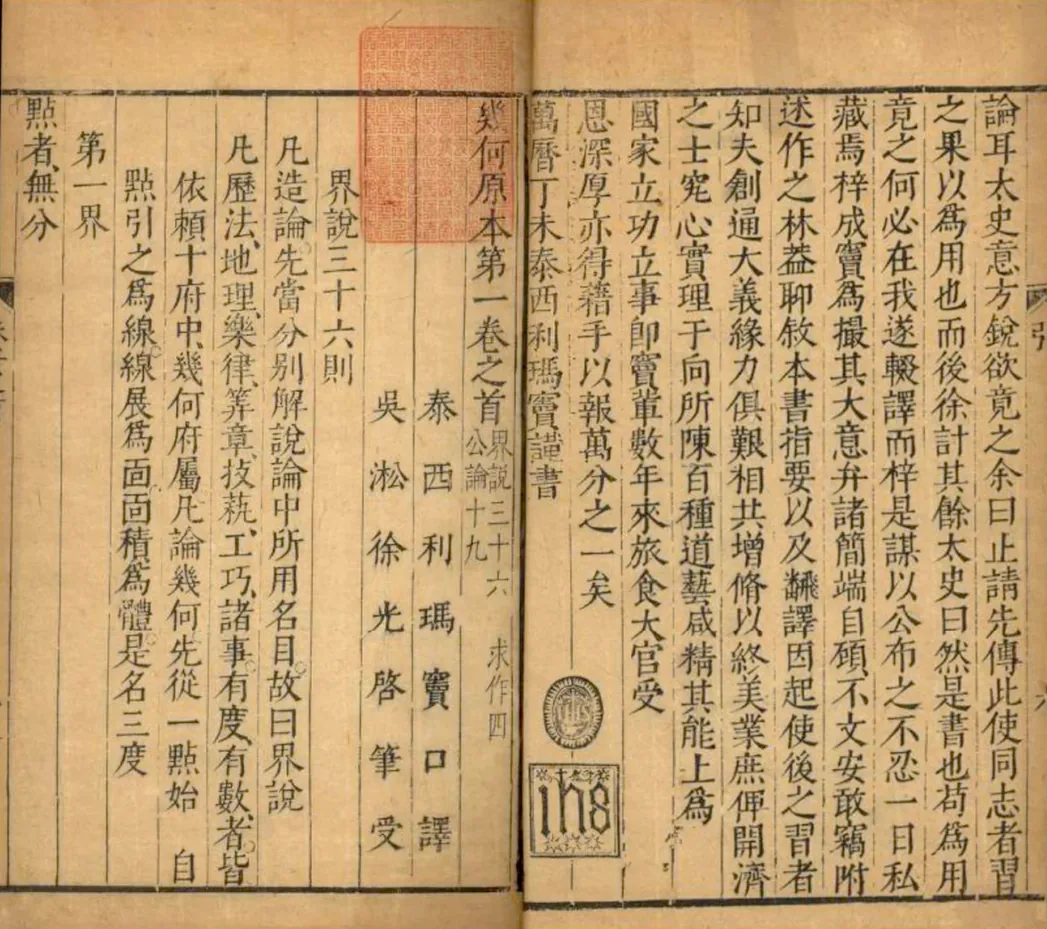
東西文理,又自絕殊;字義相求,仍多闕略。
The patterns of writing in East and West are utterly different, and when we seek words to match meanings, much is still missing.
— Matteo Ricci, preface to Jihe yuanben, 幾何原本 (1607)
Nearly 2,000 years after Euclid wrote his mathematical treatise Elements, a Jesuit and a Ming Dynasty scholar finally began to translate the work into Chinese.
The former was a missionary from the Papal States, now the Marche region of modern-day Italy. Matteo Ricci carried a Latin edition of Euclid’s Elements with him for nineteen years as he worked his way inland from Macau in 1582, eventually becoming the first European allowed to enter the Forbidden City. His copy was edited by his former teacher in Rome, Christopher Clavius, and had itself been translated by way of Arabic.
The latter was a Chinese scholar-official, Xu Guangqi (徐光啟), who had recently become a member of the Hanlin Academy (翰林院). He was also newly baptized as a Roman Catholic on account of Ricci’s influence. Xu would later lead the Chongzhen calendar reform, systematically introducing European mathematics and astronomy to China.
The pair began working together on a translation of Elements in the autumn of 1606. They worked by discussion. Ricci’s grasp of literary Chinese was not equal to Elements, and Xu could not read Latin. So Ricci explained each Latin passage in spoken Chinese, and Xu then wrote down the translations in classical Chinese.
Very few texts have been passed to the modern world through a more serpentine path than Euclid’s Elements.
They finished the first six books on plane geometry and published Jǐhé Yuánběn, 幾何原本, in 1607. It was the first Chinese translation of Euclid. Albeit an incomplete one. The two had planned to complete the remaining nine books, but circumstances intervened; Ricci died.
The complete translation of Euclid’s Elements took another 250 years to finish. It was again translated by discussion, this time by a British missionary and Chinese mathematician in Shanghai, using an English translation brought over from London.
We think of math as universal, a study of immutable truths. History makes clear, however, that methods vary. At the first translation of Euclid’s Elements, the Chinese language did not have terms for axiom, proof, definition, or theorem as mathematical concepts. The foundational text of Chinese mathematics was written in problems and procedures, rather than theorems; it was concerned with methods and numerical applications rather than theory and geometric figures.
Very few texts have been passed to the modern world through a more serpentine path than Euclid’s Elements. We know little about the author, who hand-wrote on papyrus scrolls in Alexandria. The Greek was first translated into Arabic in Baghdad, under the patronage of the caliph, then Latin by way of an Arabic edition likely obtained by a traveler in Antioch, then carried by sea to Macau and overland to Peking over nineteen years, where it required two people from the Western and Eastern traditions to translate the nuanced mathematical concepts into Chinese.
This is the story of this enchanting text and its many translations.
First, explore the first eight definitions from Book I, in all the languages this piece will cover.
- 1.A point is that which has no part.
- 2.A line is breadthless length.
- 3.The extremities of a line are points.
- 4.A straight line is a line which lies evenly with the points on itself.
- 5.A surface is that which has length and breadth only.
- 6.The extremities of a surface are lines.
- 7.A plane surface is a surface which lies evenly with the straight lines on itself.
- 8.A plane angle is the inclination to one another of two lines in a plane which meet one another and do not lie in a straight line.
Στοιχεία
Euclid wrote Στοιχεία, known as Elements, circa 300 BCE in Ancient Greece. It was a hand-copied scroll, only fragments of which survive. We know very little about the author. Elements is undoubtedly one of the most important works of Western history. It established a system of definitions, axioms, and propositions, “which has served as a model of rigorous mathematical reasoning for more than two thousand years, and perhaps will last forever,” as mathematician Chuanming Zong writes.
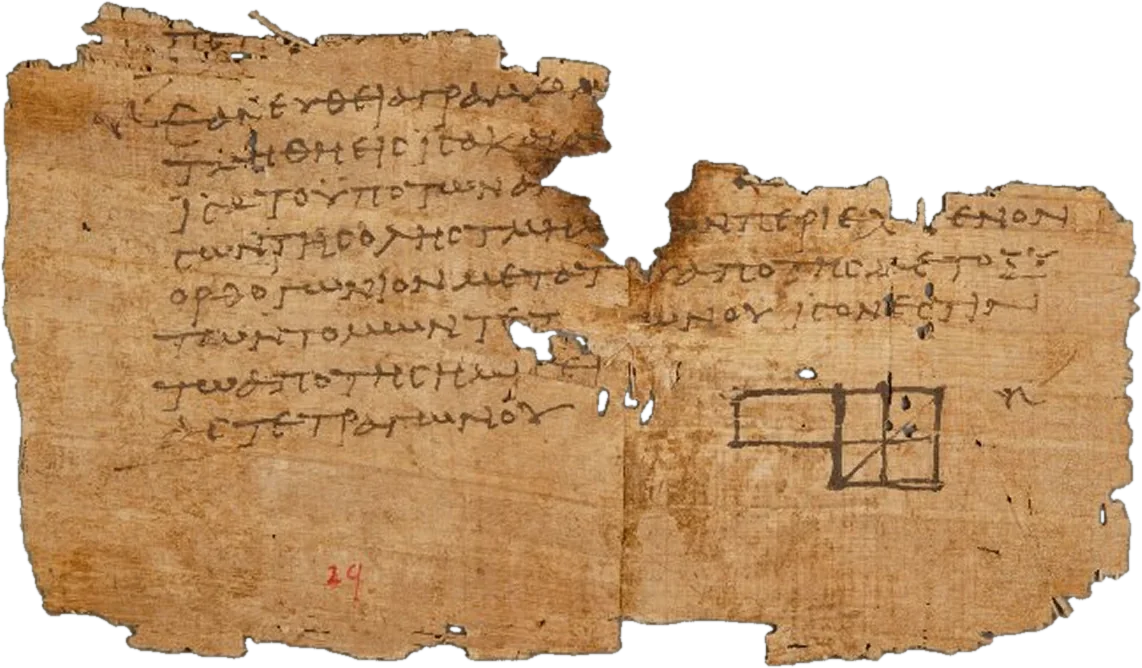
Elements is a 13-book treatise on plane and solid geometry and number theory which includes the Pythagorean theorem, Thales's theorem, the Euclidean algorithm, the proof that primes are infinite, and the five regular solids.
Very few texts have been passed to the modern world through such a complex path of editions, translations, revisions, and abridgements.
The original text is particularly hard to recover, even more so than other ancient Greek works of literature, philosophy, and history. Because Euclid's Elements was used as a textbook (at that, the world’s oldest continuously-used math textbook), teachers felt free to make liberal additions, corrections, and omissions.
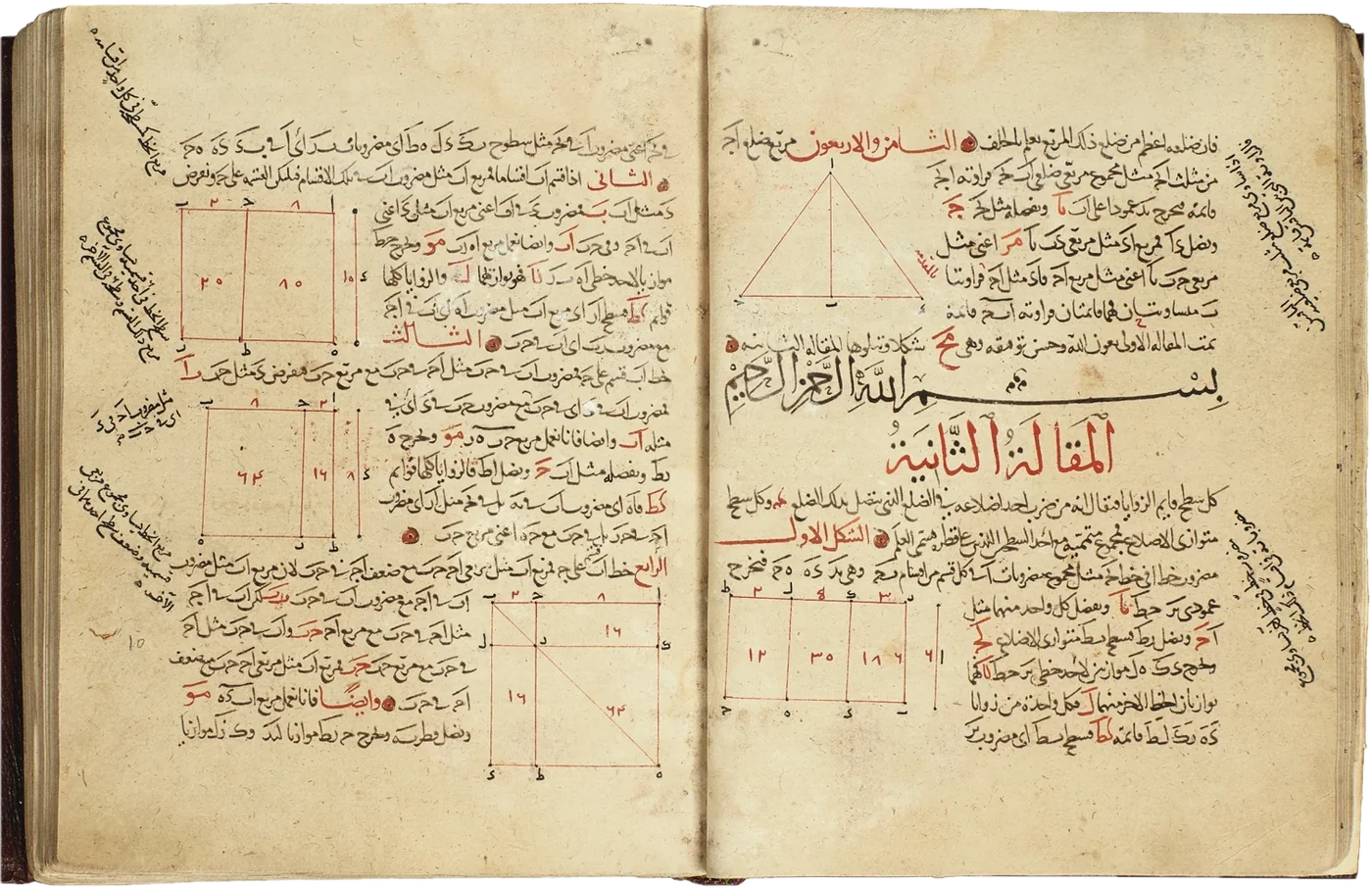
The first translation of Elements was made in Arabic by the mathematician al-Ḥajjāj (الحجّاج بن يوسف بن مطر) in 9th-century Baghdad, around 800 CE.
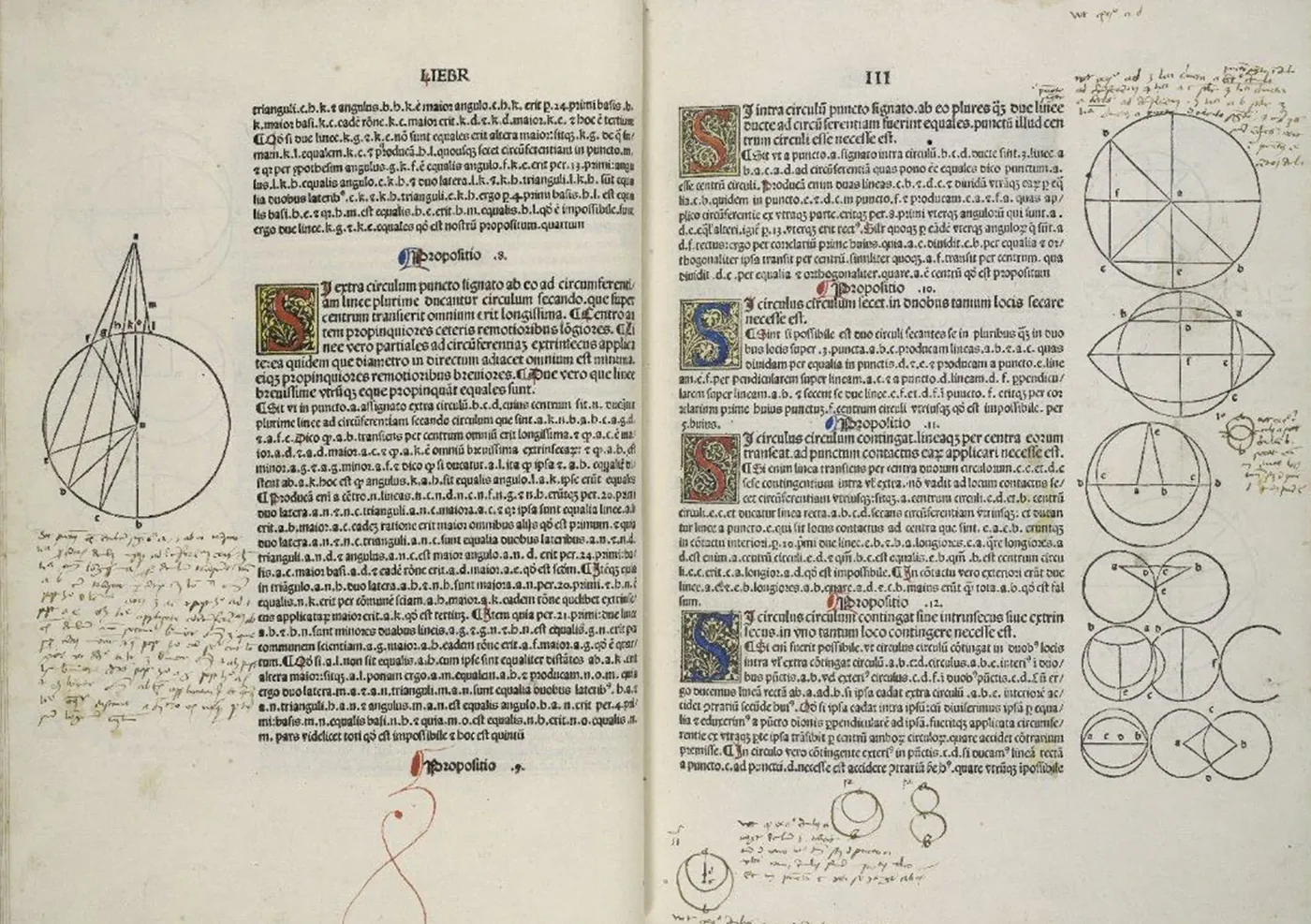
The Arabic translation was then used for the Latin translation, made by Adelard of Bath in 1130 (a copy he likely obtained while travelling in Antioch, in modern-day Türkiye). Medieval Europe thus became acquainted with Euclid through Latin translations of Arabic translations of the original ancient Greek. The Latin from Arabic translation was also used for the first printed edition of Elements, which included a note that the geometrical diagrams were particularly difficult to print.
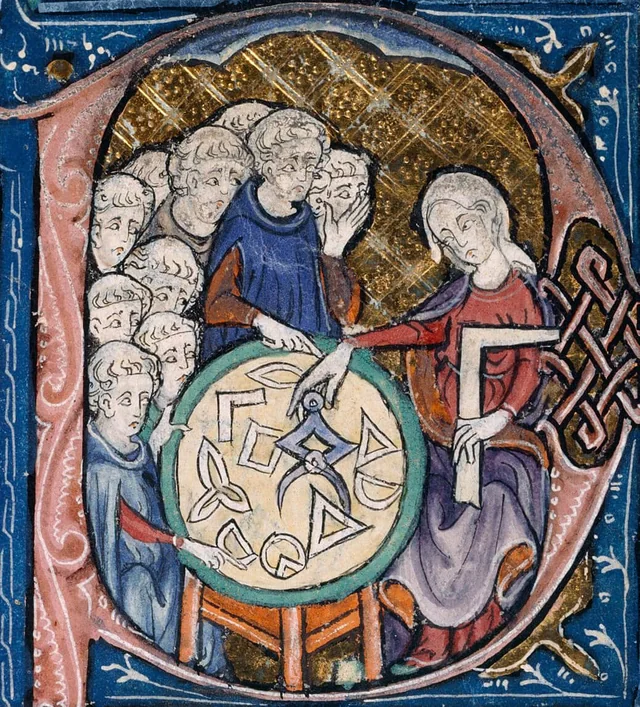
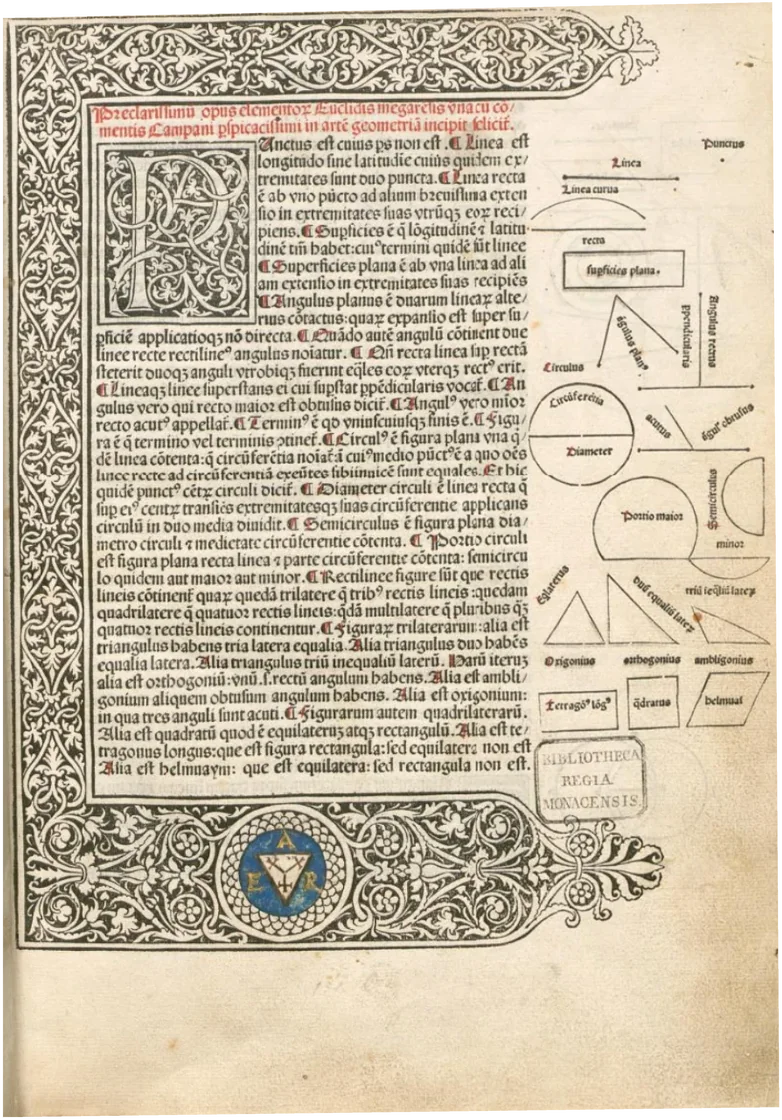
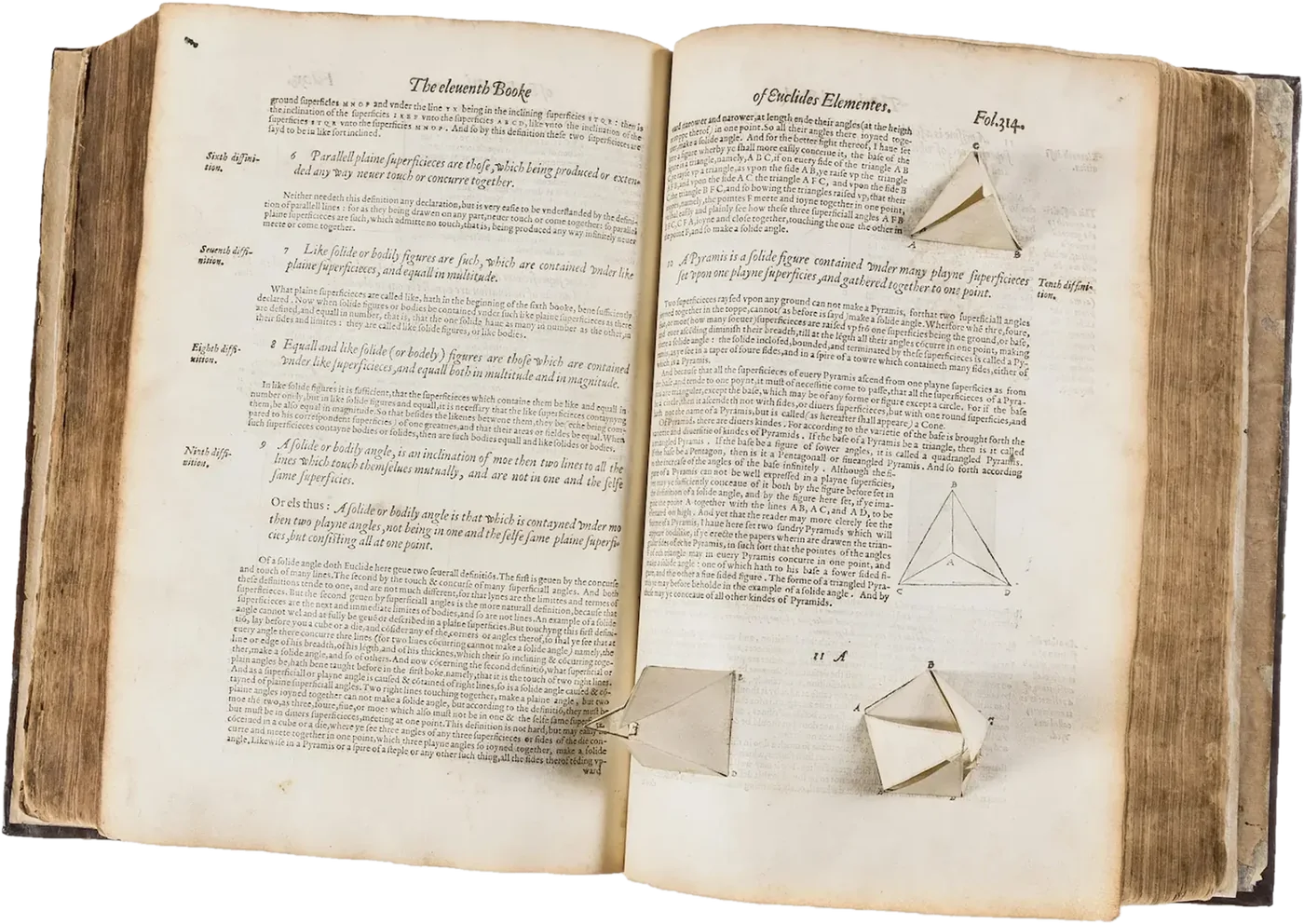
Conveying the mathematical depth of Euclid’s work, with its koan-like sentences and dense logical intricacy, is a challenge in itself. The earliest English translation in 1570 by Henry Billingsley (a character who will appear later) included hand-glued, three-dimensional paper pop-up models to help readers visualize geometric solids in Book XI.
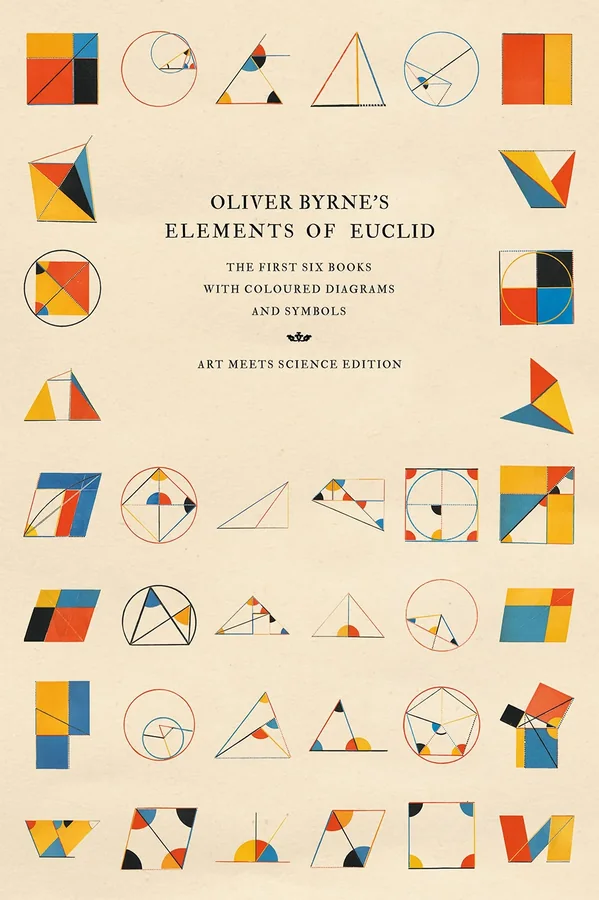
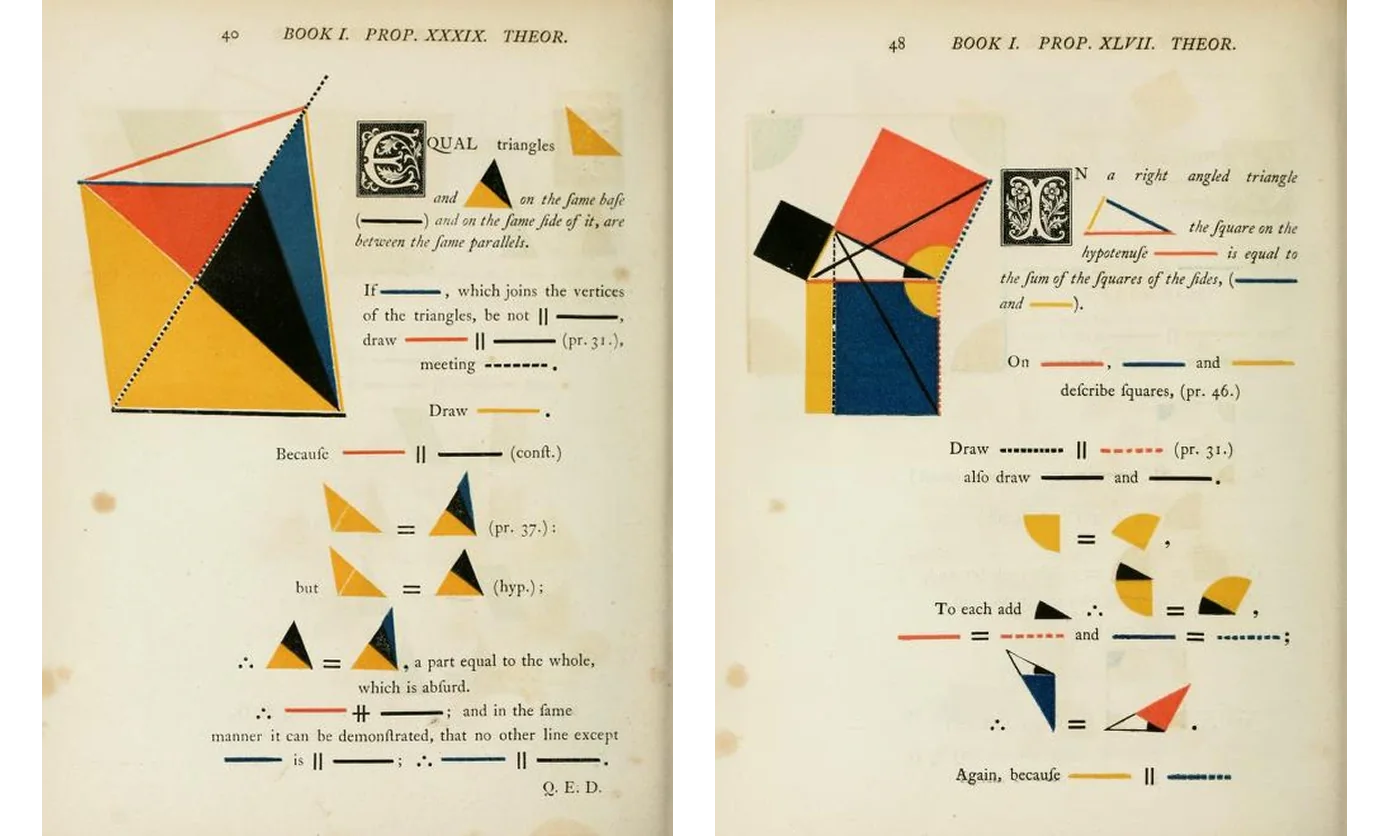
And Oliver Byrne’s 1847 edition became a landmark of Victorian book design, using primary colors to visually demonstrate geometric proofs. The elegant designs look incredibly modern and even seem to prefigure the work of decades-later Bauhaus and De Stijl artists, Piet Mondrian and László Moholy-Nagy among them.
Journey to Peking
While Marco Polo is more famous for his travels in China, Matteo Ricci was the most important person to bring Western culture, science, and religion to China. He was the first Westerner invited into the Forbidden City. He drew the first world map in China, brought mechanical clocks to the court, and taught astronomy and science. After his death, he was the first foreigner to be granted a burial site in Peking by imperial decree.
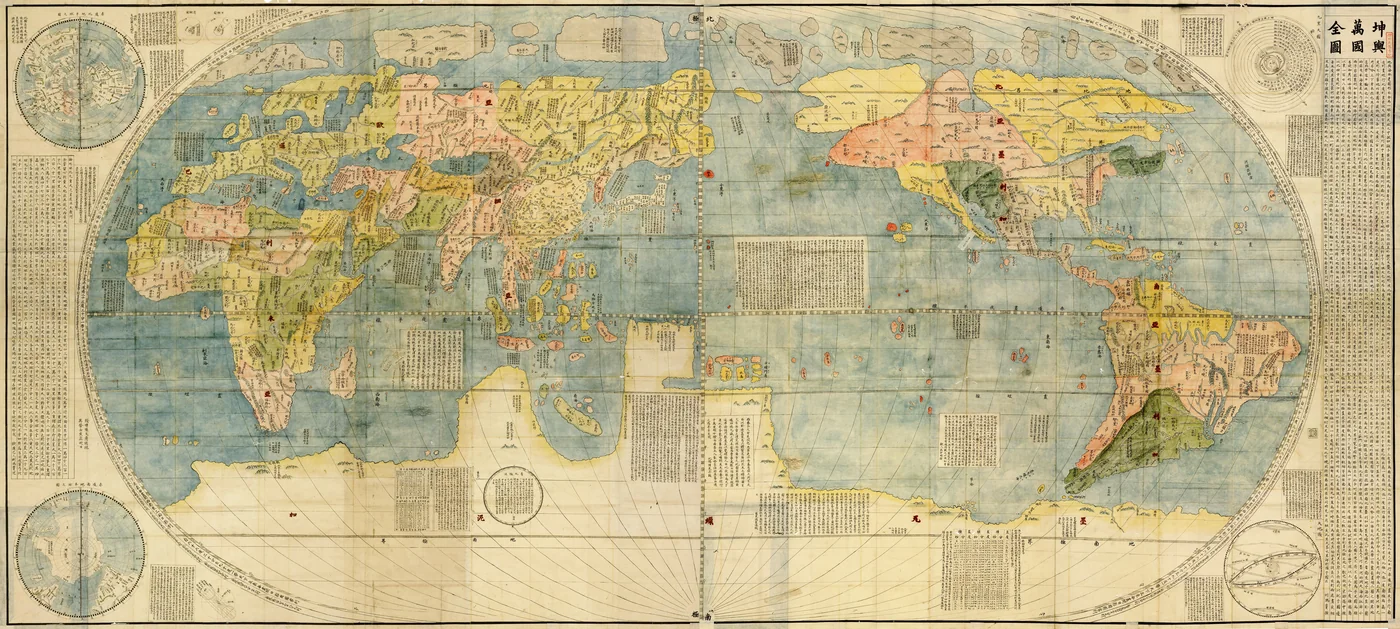
Yet his entry to the cloistered country was not easy. It took him nearly twenty years to be allowed to settle in the capital. When he landed at Macau, a Portuguese trading post at the mouth of the Pearl River, in 1582, foreigners were not permitted to live in the country’s interior. For every step inland, he needed an official’s patronage, which lasted only as long as that official’s posting. He moved slowly towards Peking, adopting the Chinese language, dress, and cultural customs along the way, as well as the Chinese name 利瑪竇 (Li Madou). He moved from Macau (澳門) to Zhaoqing (肇慶), Shaozhou (韶州), Nanchang (南昌), Nanjing (南京), and finally Peking (北京) in 1601.
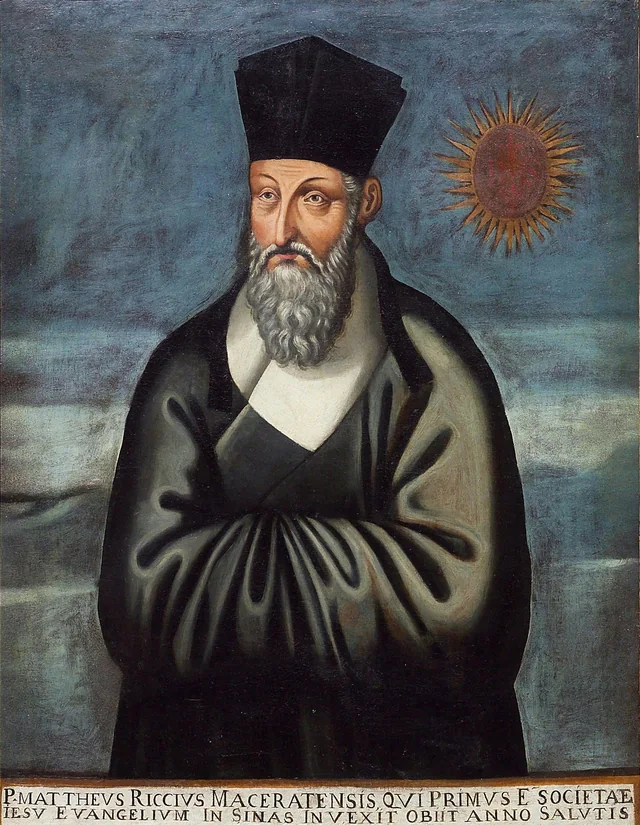
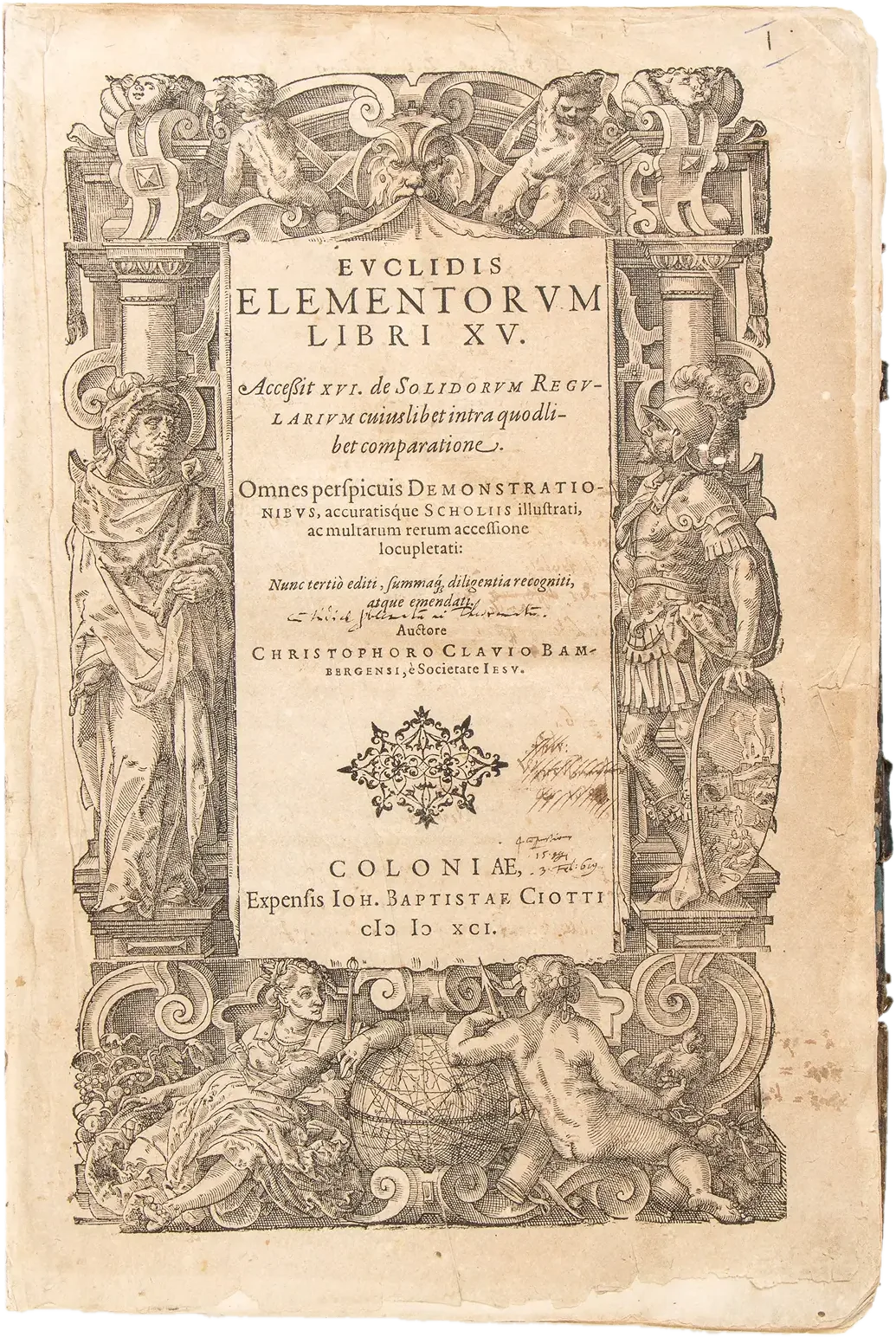
Over these twenty years, Ricci traveled with his precious books — among them his copy of the 1574 Latin translation of Euclid’s Elements, edited by his former mathematics and astronomy teacher Christopher Clavius.
He first met Xu Guangqi (徐光啟) in Nanjing. In 1604, Xu succeeded in the Imperial Examination (科舉) and became a member of the Hanlin Academy (翰林院), after which the two became close friends.
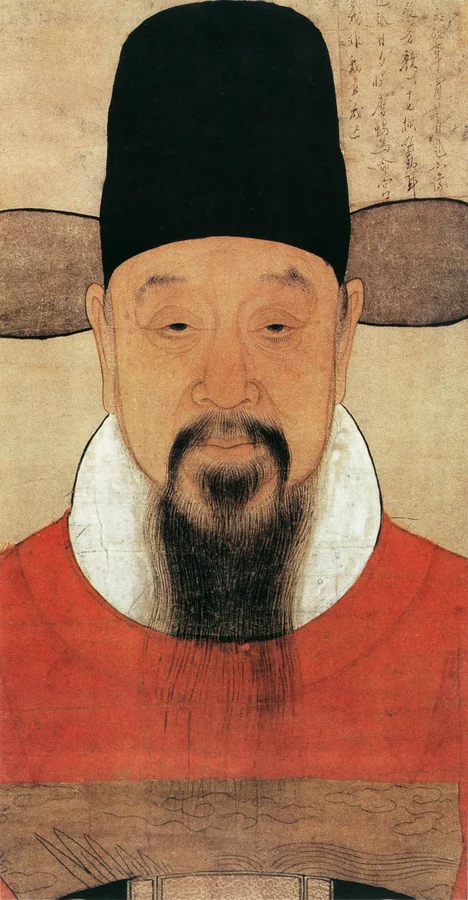
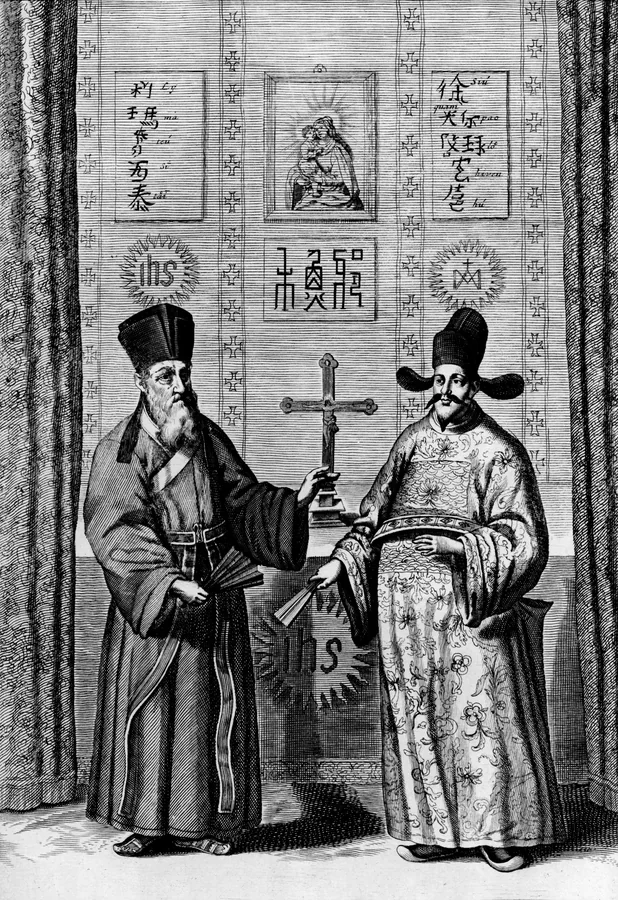
In the autumn of 1606, they began to translate Ricci’s Latin translation of Euclid’s Elements.
Even as a text alone (to say nothing of the mathematical concepts), translating Latin to classical Chinese posed a huge challenge. The two languages exist on far branches of the language tree with divergences in grammar, morphology, style, and structure. The patterns of writing in East and West are utterly different from each other (東西文理又自絕殊), wrote Ricci.
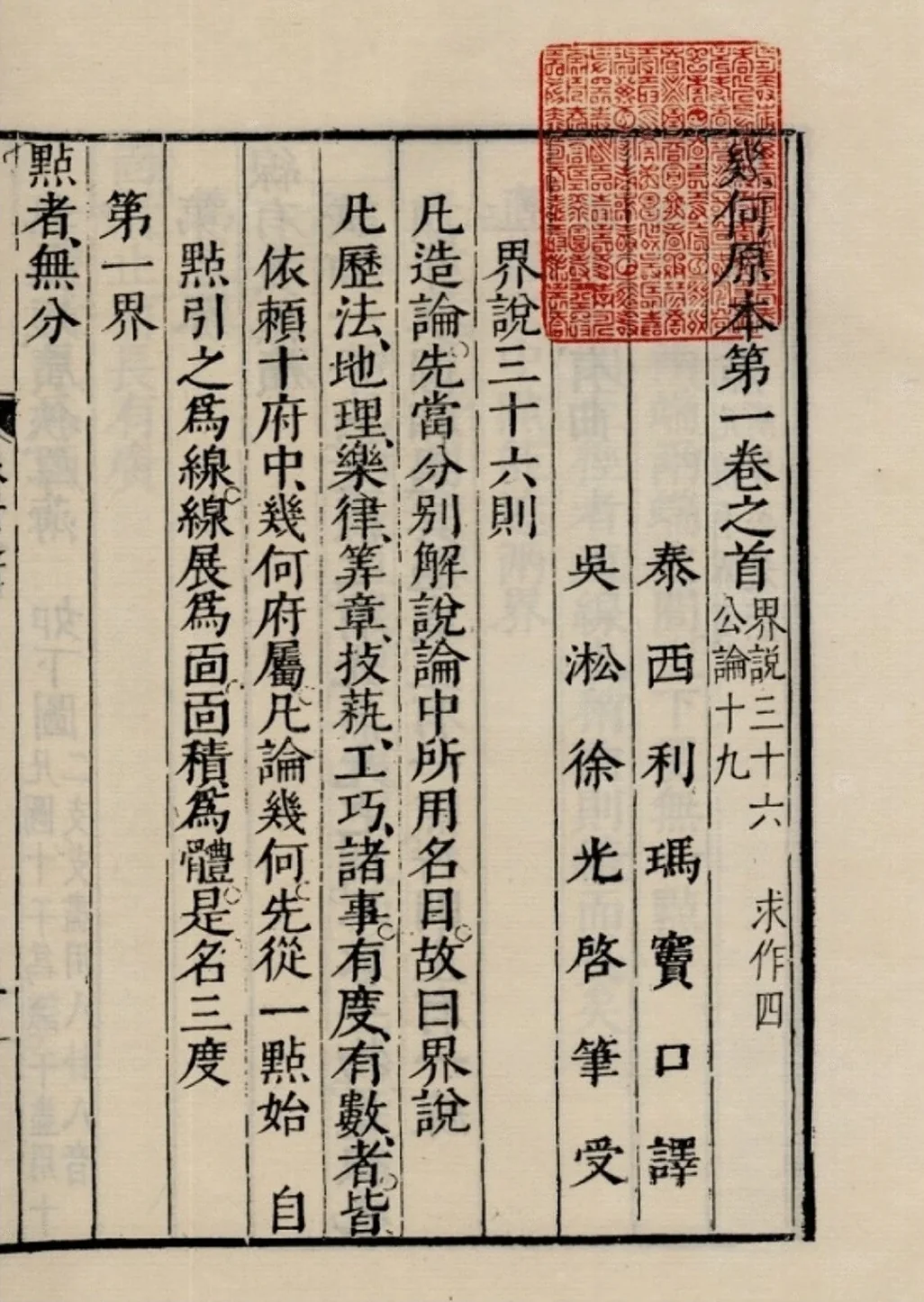
The pair's method is printed under the title of the text: 泰西利瑪竇口譯,吳淞徐光啟筆受 (orally translated by Li Madou of the Far West, received with the brush by Xu Guangqi of Wusong.) Ricci explained the Latin in spoken Chinese, which Xu then formulated into classical Chinese.
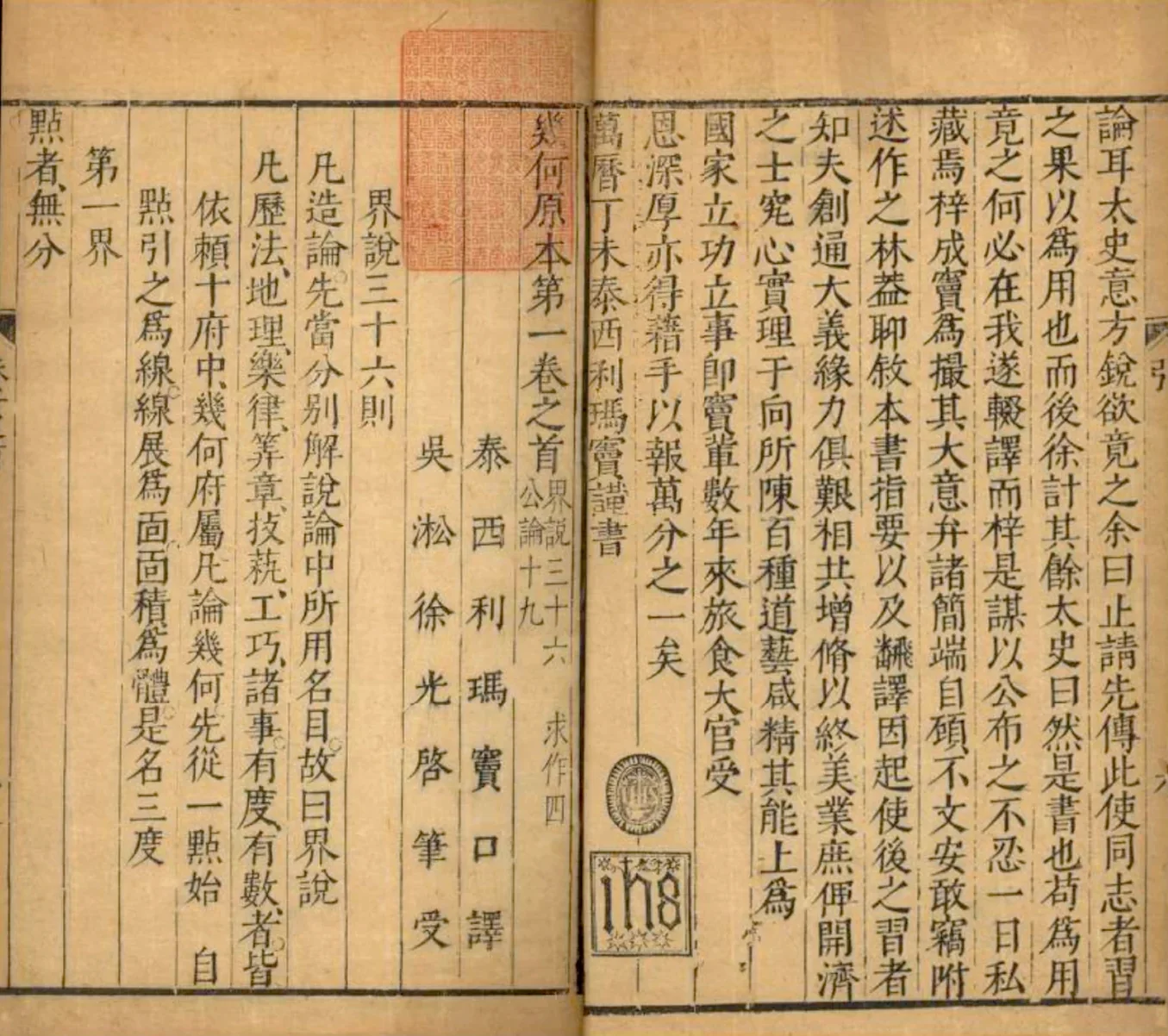
They finished the first six books of Euclid’s Elements and published them under the Chinese name Jihe Yuanben (幾何原本) a year later. They decided to study the Chinese public's reception before translating the rest of the text. But Ricci died in 1610 before they could complete their translation.
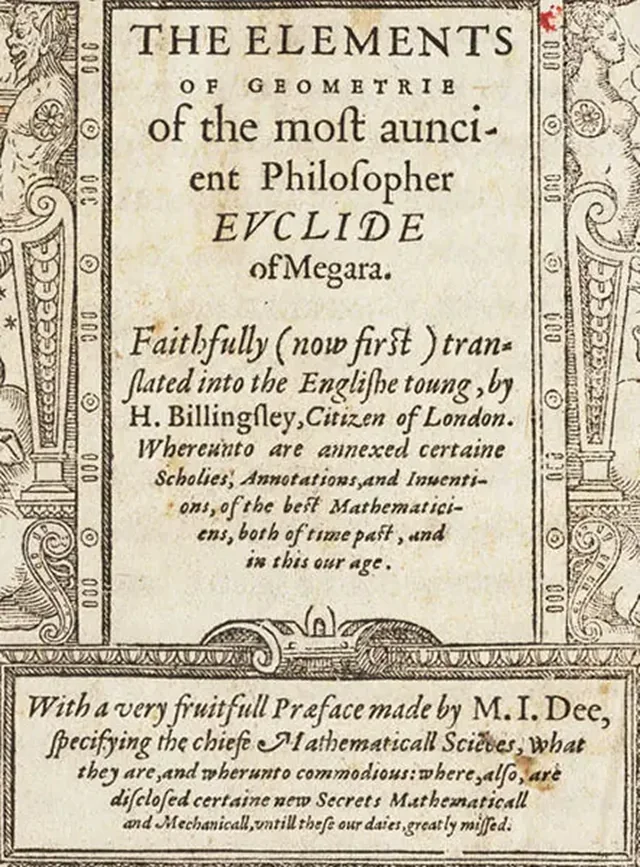
It took another 250 years to translate the remaining nine books into Chinese. The British missionary Alexander Wylie and the Chinese mathematician Li Shanlan finally completed the translation in 1857, in Shanghai. They used the same method of oral transmission and discussion to translate the text. This time, they used a copy from London printed in English, which was translated by Henry Billingsley from the original Greek.
(Billingsley himself is a fascinating case. He was a wealthy merchant, chief Customs Officer, and later Lord Mayor of London. Scholars originally doubted he made the landmark translation himself. But his original study with his own handwriting, an expertly-annotated Greek edition of Euclid’s Elements, was identified in 1879 in the Princeton University Library.)
The translation of Euclid's Elements was thus finally completed in Chinese more than two thousand years after it was originally written.
幾何原本
Of course, the Chinese had their own mathematics system. They developed arithmetic and elementary geometry more or less at the same time as Euclid. In fact, even as early as the fourth century BCE, Chinese reckoners were laying out counting rods in columns, where a rod’s position fixed its value and an empty column designated zero, effectively implementing a decimal place-value system. No other ancient civilization is known to have employed such a method. The ancient Chinese were also the first to use negative numbers, a practice not adopted in Europe until the 1400’s.
But classical Chinese mathematics developed along quite a different trajectory compared to its Western counterparts. Chinese mathematics was largely motivated by problems of calendar, trade, land, agriculture, government, and architecture. It was more focused on algebra and practical applications as opposed to geometry and theoretical reasoning. And like the language, it was very concise, even spare.
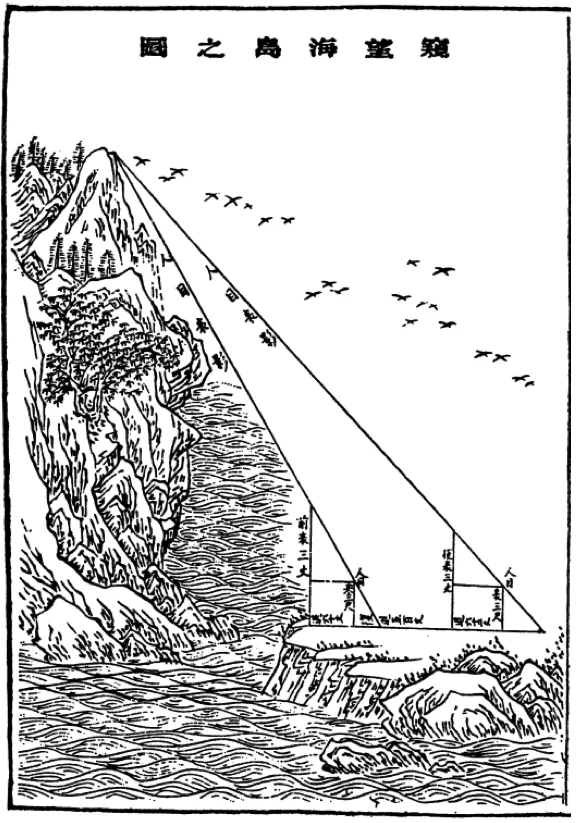
The foundational text, occupying a position equivalent to Euclid’s Elements, was Jiǔzhāng suànshù (九章算術, Nine Chapters on the Mathematical Art). It was compiled over the Han dynasty and in the first century CE, with no recorded author. The text contains 246 problems structured as problem (問), answer (答) and general procedure (術).
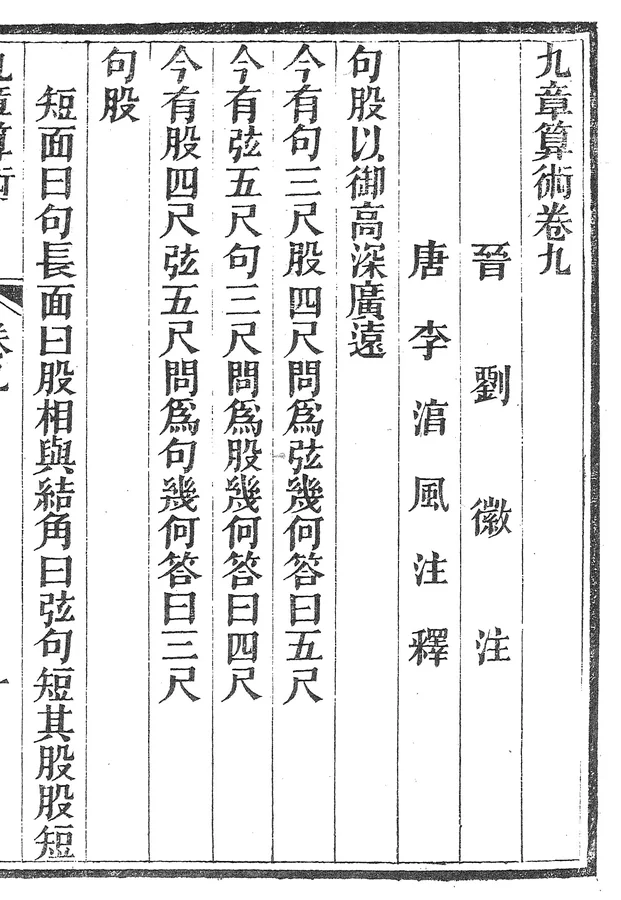
For example, the right-triangle relation (the theorem we now know as the Pythagorean theorem) is there as the gōugǔ (勾股) rule:
問 (problem): 今有句三尺,股四尺,問為弦幾何?
A right triangle has a short leg of 3 feet and a long leg of 4 feet. How long is the hypotenuse?
答 (answer): 答曰:五尺。
Answer: 5 feet.
術 (procedure): 句股術曰:句股各自乘,并,而開方除之,即弦。
The leg-and-leg procedure: square each leg, add the squares, take the square root. That is the hypotenuse.
The procedure works for any right triangle, but is given to the reader as an instruction — not as a statement or claim about all right triangles. A later commentary by Liu Hui (劉徽) supplied the reasoning by slicing the two smaller squares and reassembling them into a larger square.
Euclid’s version, Proposition I.47, runs very differently.
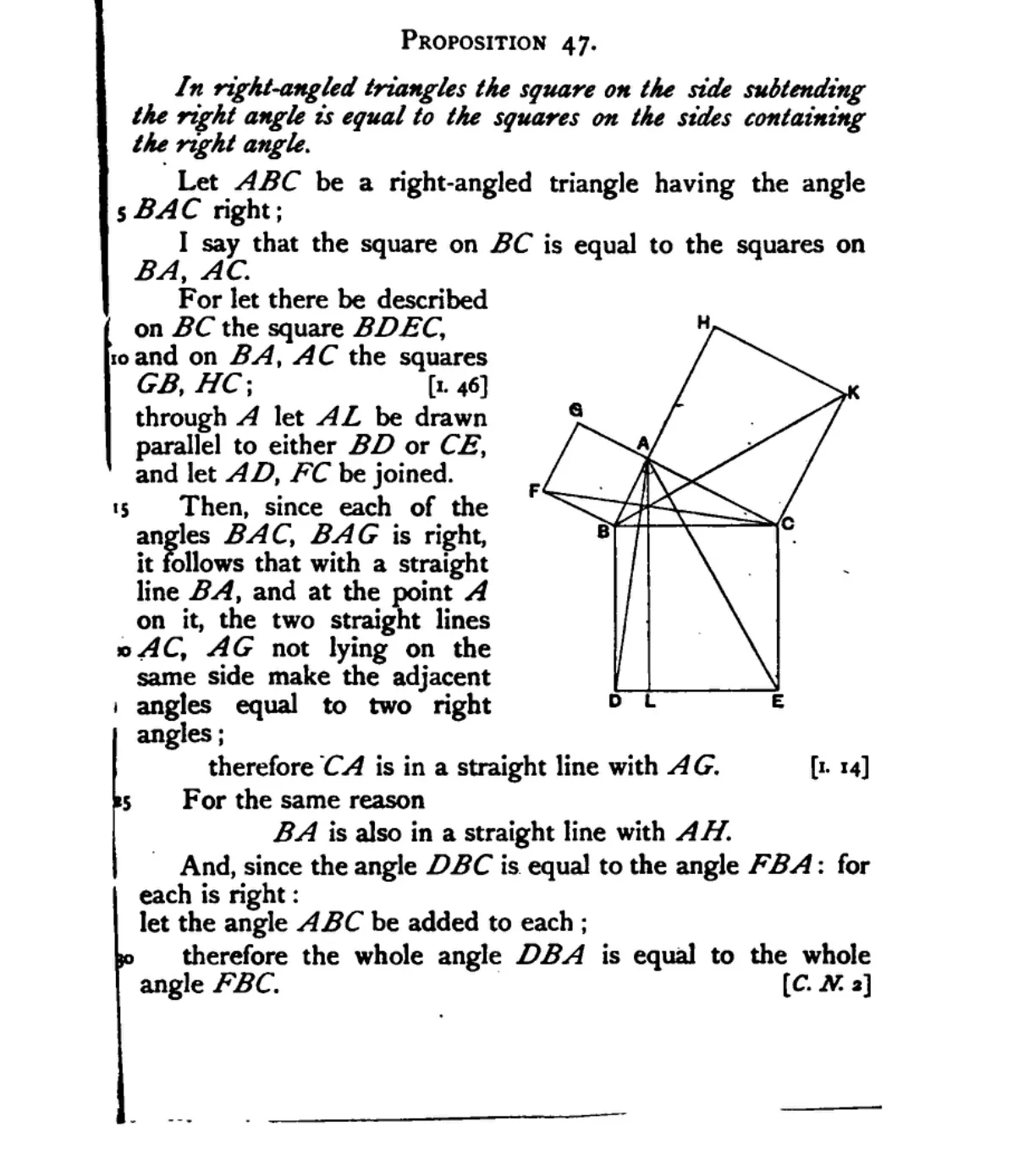
A general statement comes first (in every right triangle the square on the hypotenuse equals the two squares on the legs), then a proof built on the propositions before it. No side is given a specific length or computed value; every magnitude is only a line labeled by a letter. While the Nine Chapters move from a question to a procedure, Euclid presents a definition and then theorem of universality.
It’s mind-bending to consider that the deductive method is not self-evident, as we tend to treat it centuries later, but a system of conventions. It starts by asking the reader to agree to a set of terms and definitions which are essentially unproven assumptions, and then uses these pieces to build towards mathematical certainty. Before a single proof appears in Elements, the reader is first required to accept 23 definitions, 5 postulates, and 5 common notions.
Ricci and Xu translated Euclid thus not only as a text but as a genre of radically new mathematical reasoning. The pair coined a few dozen new technical terms, including jièshuō (界說) for definition, qiúzuò (求作) for postulate, and gōnglùn (公論) for axiom (although these were later replaced by terms developed in Meiji Japan and then carried back into Chinese). Their names for figures, like 點 for point, 直角 for right angle, 平行線 for parallel lines, and others, survived. These terms are still found in primary-school textbooks today.
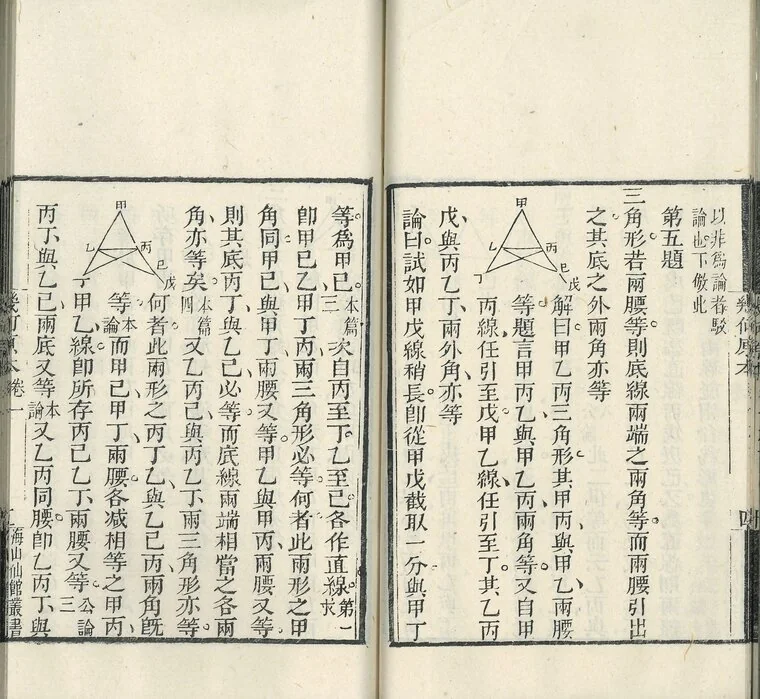
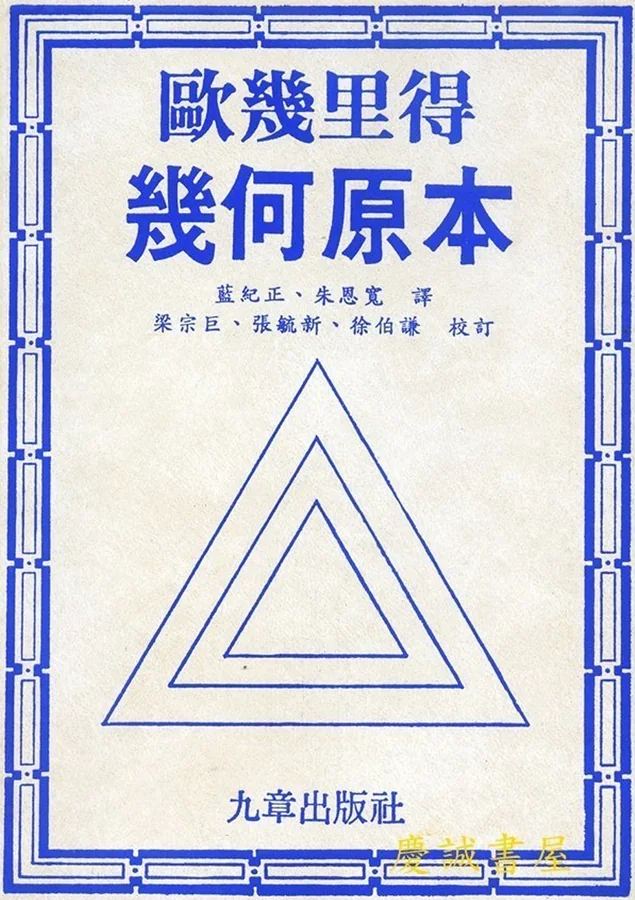
The word chosen to translate definition as a mathematical term, 界說, illustrates how meaning was carried in surprising ways. Euclid used ὅρος, horos, meaning a boundary or limit. The Latin definitio carries the same image, from finis for border. Ricci and Xu coined an assemblage of jie 界, meaning boundary, and shuo 說, meaning explanation. Their first note explains that when constructing an argument, one must first mark the limits of the names used in it, hence “boundary-explanations.” The original Greek etymology was thus preserved in this Chinese translation.
The deductive method is not self-evident, as we tend to treat it centuries later, but a system of conventions.
For the title, on the other hand, they repurposed native Chinese terms. Jihe 幾何, was actually the Chinese term for “how much.” It was used because geometry and arithmetic were both studies of quantity. In fact, 幾何 is a formulation used in every problem in the Nine Chapters. The second half of the title, yuanben 原本, is yuan 原, source, and ben 本, root, their rendering of Elements. So 幾何原本 meant something like “the origins of quantity.”
Only Ricci and Xu’s translation of the first six books, all plane geometry, circulated in China for the next 250 years. So the word jihe 幾何 (simplified Chinese: 几何) has come to refer to geometry alone.
Translation is sometimes seen as simply moving meaning between one language and another. Yet language is often a record of what people have thought thus far, not merely a code for universal understanding. The Chinese translation of Euclid’s Elements, a singular text, reveals how translation is often a much older and stranger discipline.
Sources
Ashworth, William B., Jr. “Henry Billingsley.” Scientist of the Day. Linda Hall Library, November 22, 2019. https://www.lindahall.org/about/news/scientist-of-the-day/henry-billingsley/
Barrow-Green, June. “‘Much Necessary for All Sortes of Men’: 450 Years of Euclid’s Elements in English.” BSHM Bulletin 21, no. 1 (2006). https://doi.org/10.1080/17498430600566527
Bertolami Fine Art. “Euclide. Euclidis Elementorum Libri XV. Colonia 1591.” Lot 40, Libri antichi, rarità bibliografiche e prime edizioni del ’900, Auction 290, Rome, March 21, 2024. https://www.bertolamifineart.com/it/asta-0290/euclide-euclidis-elementorum-libri-xv-colonia-1591-109656
“Billingsley, Henry (c.1538–1606), of Fenchurch Street, London.” In The History of Parliament: The House of Commons 1558–1603, edited by P. W. Hasler. London: HMSO, 1981. https://www.historyofparliamentonline.org/volume/1558-1603/member/billingsley-henry-1538-1606-0
Brandenburg, Rik, and Keimpe Nevenzeel. “The Nine Chapters on the History of Chinese Mathematics.” University of Groningen, 2007. https://math.ucr.edu/~res/math153/nine-chapters.pdf
Byrne, Oliver. Oliver Byrne’s Elements of Euclid: The First Six Books with Coloured Diagrams and Symbols. Art Meets Science Edition. Art Meets Science, 2022. https://www.artmeetsscience.co/books/oliver-byrnes-elements-of-euclid/
Cambridge University Library. “Billingsley Instructs Readers on Interpreting Images on a Page Using Pop-Up Shapes.” Cambridge Digital Library. https://cudl.lib.cam.ac.uk/view/PR-SYN-00003-00057-00004-00001/1
Casselman, Bill. “One of the Oldest Extant Diagrams from Euclid.” University of British Columbia. https://www.math.ubc.ca/~cass/Euclid/papyrus/
Davis, Ernest. “Euclid’s Elements Through the Ages.” Review of Encounters with Euclid: How an Ancient Greek Geometry Text Shaped the World, by Benjamin Wardhaugh. SIAM News 57, no. 5 (June 2024). https://www.siam.org/publications/siam-news/articles/euclid-s-elements-through-the-ages/
De Young, Gregg. “Al-Ḥajjāj in the Andalusian Euclidean Tradition.” Islamic Studies 30, no. 1/2 (1991): 171–78. https://www.jstor.org/stable/20840034
Engelfriet, Peter M. Euclid in China: The Genesis of the First Chinese Translation of Euclid’s Elements, Books I–VI (Jihe Yuanben, Beijing, 1607) and Its Reception up to 1723. Sinica Leidensia 40. Leiden: Brill, 1998. https://books.google.com/books?id=aKLr5duAiwMC
Euclid. Elementa geometriae. Translated by Adelard of Bath. Edited by Johannes Campanus. Venice: Erhard Ratdolt, 1482. Bibliothèque Sainte-Geneviève, OEXV 231 RES. Internet Archive. https://archive.org/details/OEXV231RES/page/n7/mode/2up
Euclid. Euclid’s Elements of Geometry. Edited and translated by Richard Fitzpatrick. Rev. ed., 2008. https://farside.ph.utexas.edu/Books/Euclid/Elements.pdf
Euclid. Jihe yuanben 幾何原本. Translated by Matteo Ricci and Xu Guangqi. Beijing, 1607. Digitized by Shuge 書格. https://www.shuge.org/view/ji_he_yuan_ben/
Euclid. Jihe yuanben 幾何原本. Translated by Matteo Ricci and Xu Guangqi. World Digital Library. Library of Congress. https://www.loc.gov/resource/gdcwdl.wdl_17216_001/?sp=8
Euclid. Ou ji li de Jihe yuanben 歐幾里得幾何原本. Translated by Lan Jizheng 藍紀正 and Zhu Enkuan 朱恩寬. Taipei: Jiuzhang Publishing House 九章出版社. ISBN 9576030161.
Euclid. The Thirteen Books of Euclid’s Elements. Translated by Thomas L. Heath. Vol. 1. Cambridge: Cambridge University Press, 1908, 349. https://archive.org/details/EuclidsElementsBooksIIIVolume1Heath/Euclid%27s_Elements_Books_I-II_Volume_1-Heath/
“The First Six Books of the Elements of Euclid (1847).” Public Domain Review, June 21, 2012. https://publicdomainreview.org/collection/the-first-six-books-of-the-elements-of-euclid-1847/
Folger Shakespeare Library. “Mathematical Diagrams from 1482.” Euclid, Preclarissimus liber elementorum Euclidis perspicacissimi. Venice: Erhard Ratdolt, 1482. INC E86. https://www.folger.edu/explore/collection-highlights/mathematical-diagrams-from-1482/
Foroughi, Louisa. “Translation in the Latin East: Antioch, Acre, Cyprus.” The French of Outremer. Fordham University. https://frenchofoutremer.ace.fordham.edu/thematic-essays/translation-in-the-latin-east-antioch-acre-cyprus/
Grant, Hardy. “Euclid’s Elements in Cultural Context.” Cubo Matemática Educacional 4, no. 1 (2002): 1–12. https://cubo.ufro.cl/index.php/cubo/article/view/1719/1571
Halsted, George Bruce. “Note on the First English Euclid.” American Journal of Mathematics 2, no. 1 (1879): 46–48. https://static-prod.lib.princeton.edu/scsites/misc/Euclid_1879.pdf
“Henry Billingsley’s 1570 English Euclid: Paper That Stands Up.” Abakcus. https://abakcus.com/articles/billingsley-euclid
Horng Wann-Sheng. “The Influence of Euclid’s Elements on Xu Guangqi and His Successors.” In Statecraft and Intellectual Renewal in Late Ming China: The Cross-Cultural Synthesis of Xu Guangqi (1562–1633), edited by Catherine Jami, Peter Engelfriet, and Gregory Blue, 380–97. Leiden: Brill, 2001. https://doi.org/10.1163/9789004482975_018
Hsia, R. Po-chia. “Zhaoqing.” In A Jesuit in the Forbidden City: Matteo Ricci 1552–1610. Oxford: Oxford University Press, 2010. https://doi.org/10.1093/acprof:oso/9780199592258.003.0004
Ji Zhigang 纪志刚. “Cong Lading yu dao gu Hanyu: Hanyi Jihe yuanben juan yi ‘jieshuo’ de fanyi fenxi” 从拉丁语到古汉语——汉译《几何原本》卷一“界说”的翻译分析 [From Latin to classical Chinese: An analysis of the translation of the definitions in book 1 of the Chinese Elements]. Ziran bianzhengfa tongxun 自然辩证法通讯 [Journal of Dialectics of Nature], 2017, no. 2. https://jdn.ucas.ac.cn/home/journal/view/id/3174
Jiuzhang suanshu 九章算術. Chapter 9, “Gougu” 句股. Chinese Text Project. https://ctext.org/nine-chapters/gou-gu
Jiuzhang suanshu 九章算術. Chapter 9, “Gougu” 句股. With commentary by Liu Hui 劉徽 and annotations by Li Chunfeng 李淳風 et al. Wuyingdian juzhen ban 武英殿聚珍版 edition. Zhejiang University Library, CADAL 06210166, p. 82. Wikimedia Commons. https://commons.wikimedia.org/wiki/File:CADAL06210166_九章算術:下.djvu
Kircher, Athanasius. China monumentis qua sacris qua profanis… illustrata. Amsterdam: Jacobus à Meurs, 1667. National Library of Poland. Wikimedia Commons. https://commons.wikimedia.org/wiki/File:Matteo_Ricci_and_Xu_Guangqi_from_Athanasius_Kircher_(3756759).jpg
Library of Congress. “Euclid’s ‘Elements.’” Venice: Erhard Ratdolt, 1482. https://www.loc.gov/item/2021667076/
Library of Congress. “Ji he yuan ben: Liu juan 幾何原本:六卷.” https://www.loc.gov/item/2021666487/
Library of Congress. “Xi yang xin fa li shu.” https://www.loc.gov/item/2021666392/
Ménabréaz, Julien. “Jesuits in China.” Europeana, December 3, 2021. https://www.europeana.eu/en/stories/jesuits-in-china
Moriarty, Clare Marie. “‘Tint and Form’: The Geometric Philosophy Underlying Oliver Byrne’s Elements.” Leonardo 56, no. 2 (2023). https://doi.org/10.1162/leon_a_02242
Murdoch, John E. “Euclid: Transmission of the Elements.” In Dictionary of Scientific Biography, edited by Charles Coulston Gillispie, vol. 4. New York: Charles Scribner’s Sons, 1971. https://www.encyclopedia.com/science/dictionaries-thesauruses-pictures-and-press-releases/euclid-transmission-elements
O’Connor, J. J., and E. F. Robertson. “Overview of Chinese Mathematics.” MacTutor History of Mathematics Archive, University of St Andrews, December 2003. https://mathshistory.st-andrews.ac.uk/HistTopics/Chinese_overview/
Ogawa, Masahiro. “Xu Guangqi and the Chinese Translation of Euclid’s Elements: Some Problems of Terminology and Their Cultural Context.” HERSETEC 5, no. 1 (2011): 13–33. https://www.gcoe.lit.nagoya-u.ac.jp/result/pdf/5-1_%E5%B0%8F%E5%B7%9D%28E%29.pdf
Penn Museum. “Euclid II.” Object E2748. Oxyrhynchus, Egypt, 200–400 CE. Distribution from the Egypt Exploration Fund, 1901. https://collections.penn.museum/collections/object/63505
Portrait of Xu Guangqi 徐光啟. Unknown artist, 17th century. Nanjing Museum 南京博物院. Wikimedia Commons. https://commons.wikimedia.org/wiki/File:徐光啟.jpg
“Reading Euclid at Cambridge.” Cambridge University Library Special Collections (blog). https://specialcollections-blog.lib.cam.ac.uk/?p=16324
Ricci, Matteo. Kunyu wanguo quantu 坤輿萬國全圖. Copy of the 1602 map, 17th century. Kano Collection, Tohoku University Library. Wikimedia Commons. https://commons.wikimedia.org/wiki/File:Kunyu_Wanguo_Quantu_(坤輿萬國全圖).jpg
Ricci, Matteo. “Yi Jihe yuanben yin” 譯幾何原本引 [Preface to the translation of the Jihe yuanben]. 1607. Wikisource. https://zh.wikisource.org/wiki/%E5%B9%BE%E4%BD%95%E5%8E%9F%E6%9C%AC/%E5%8E%9F%E5%BA%8F
Ricci, Matteo, and Xu Guangqi, trans. Jihe yuanben 幾何原本 (Elements, 6 juan). Panyu: Panshi Haishan xianguan 潘氏海山仙館, 1849. Chinese University of Hong Kong Library. Kunstmatrix. https://art.kunstmatrix.com/en/artwork/1743389/ricci-matteo-guangqi-xu-trans-jihe-yuanben-elements-6-juan
Schwartz, Randy K. “A Classic from China: The Nine Chapters.” Convergence. Mathematical Association of America, December 2018. https://old.maa.org/press/periodicals/convergence/a-classic-from-china-the-nine-chapters
Schwartz, Randy K. “A Classic from China: The Nine Chapters.” The Right Angle 16, no. 2 (October 2008). https://people.math.harvard.edu/~knill/teaching/math22a2018/exhibits/gaussjordan/SchwarzNineChapters.pdf
“Seeing Euclid: Euclid’s Elements of Geometry in Early Modern Britain and Ireland.” University of Aberdeen Special Collections (blog), June 15, 2018. https://specialcollectionslearning.wordpress.com/2018/06/15/seeing-euclid-euclids-elements-of-geometry-in-early-modern-britain-and-ireland/
Shih, Joseph Hsing-san. “Matteo Ricci.” Encyclopaedia Britannica. https://www.britannica.com/biography/Matteo-Ricci
Sotheby’s. “An Important Arabic Translation of Euclid’s Elements, Probably Egypt, 13th Century.” Lot 30, Arts of the Islamic World, London, 2018. https://www.sothebys.com/en/auctions/ecatalogue/2018/arts-of-the-islamic-world-l18220/lot.30.html
Swetz, Frank J., and Victor J. Katz. “Mathematical Treasures – Billingsley Euclid.” Convergence. Mathematical Association of America, 2011. https://old.maa.org/press/periodicals/convergence/mathematical-treasures-billingsley-euclid
Wagner, Donald B. “A Proof of the Pythagorean Theorem by Liu Hui (Third Century A.D.).” Historia Mathematica 12 (1985). Web version. http://donwagner.dk/Pythagoras/Pythagoras.html
“Woman Teaching Geometry.” Illuminated initial in Euclid, Elementa, translated by Adelard of Bath, c. 1309–1316. British Library, Burney MS 275, fol. 293r. Wikimedia Commons. https://commons.wikimedia.org/wiki/File:Woman_teaching_geometry.jpg
Xu, Yibao. “The First Chinese Translation of the Last Nine Books of Euclid’s Elements and Its Source.” Historia Mathematica 32, no. 1 (2005): 4–32. https://doi.org/10.1016/j.hm.2003.12.002
Yu Wenhui (Emmanuel Pereira). Portrait of Matteo Ricci. c. 1610. Oil on canvas. Patrimonio del Fondo Edifici di Culto, amministrato dal Ministero dell’Interno, on loan to the Church of the Gesù, Rome. Wikimedia Commons. https://commons.wikimedia.org/wiki/File:利玛窦像,游文辉绘.jpg
Zong, Chuanming. “The Journey of Euclid’s Elements to China.” Notices of the American Mathematical Society 70, no. 6 (2023): 953–61. https://doi.org/10.1090/noti2719